How Do Forestry and Soft-Ground Operations Affect Crawler Undercarriage Selection?
Forestry and soft-ground operations affect undercarriage selection by changing both the ground that must support the machine and the way the machine loads that ground. A sound decision therefore needs more than operating mass or a nominal ground-pressure figure. It needs soil trafficability, machine configuration, load distribution, travel and turning patterns, repeated-pass exposure, and a verification plan tied to the actual site.
No track layout is universally best for forestry. A configuration may behave differently after rainfall, on a slope, during a tight turn, or under a different load state. The OEM must define those conditions before supplier assessment.
Define the Forestry and Soft-Ground Operating Scope
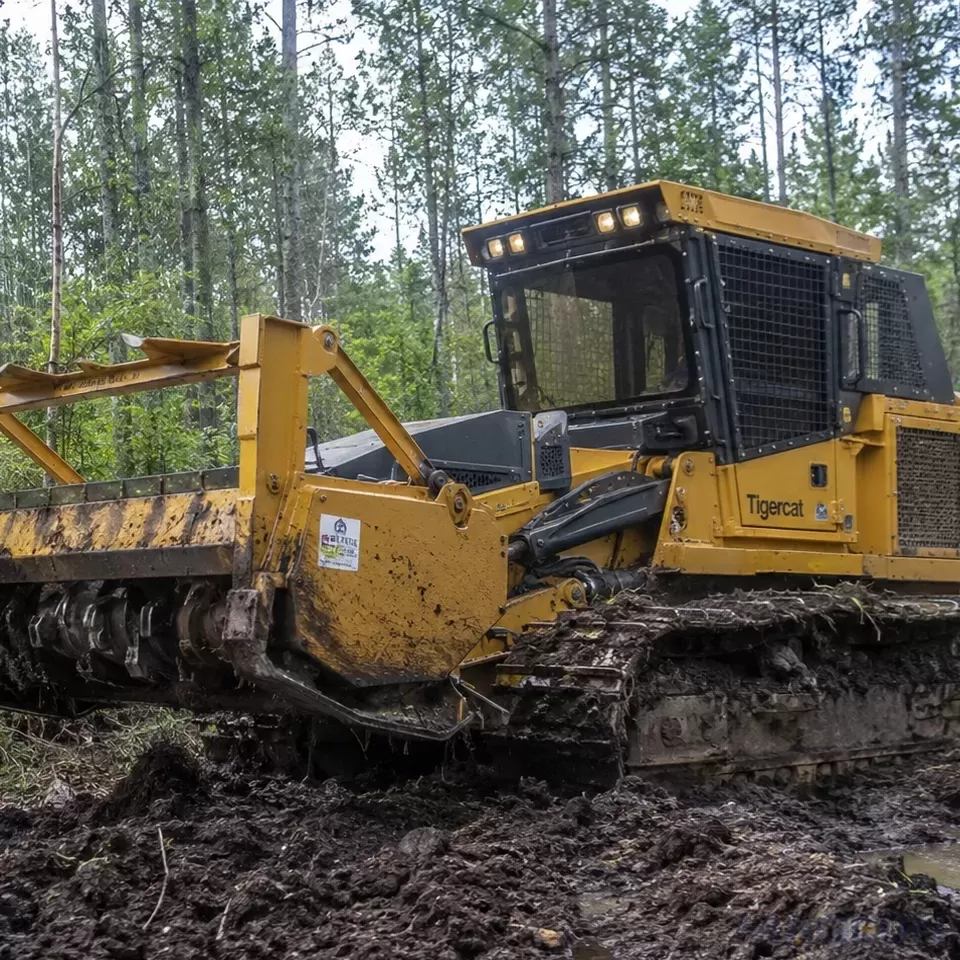
This analysis concerns ground-based forestry work and related tracked machines operating where soil strength, moisture, surface cover, rutting, or access may limit mobility. It is not a market forecast, and it does not claim that one regional study represents every forest or soft-ground site.
The evidence used here spans North American and European forestry research published mainly from 2006 to 2026, together with an international crawler-machine standard. That evidence supports a decision framework, not a universal design value. Soil texture, organic layers, drainage, season, slope, machine configuration, and operating method remain project-specific.
The practical distinction is between two control layers. Machine configuration affects how load and tractive forces enter the ground. Operating controls—such as route planning, timing, pass management, turning practice, slash cover, or matting—affect where and how often those forces are applied. Neither layer can compensate reliably for missing information in the other.
Why Average Ground Pressure Is Not Enough
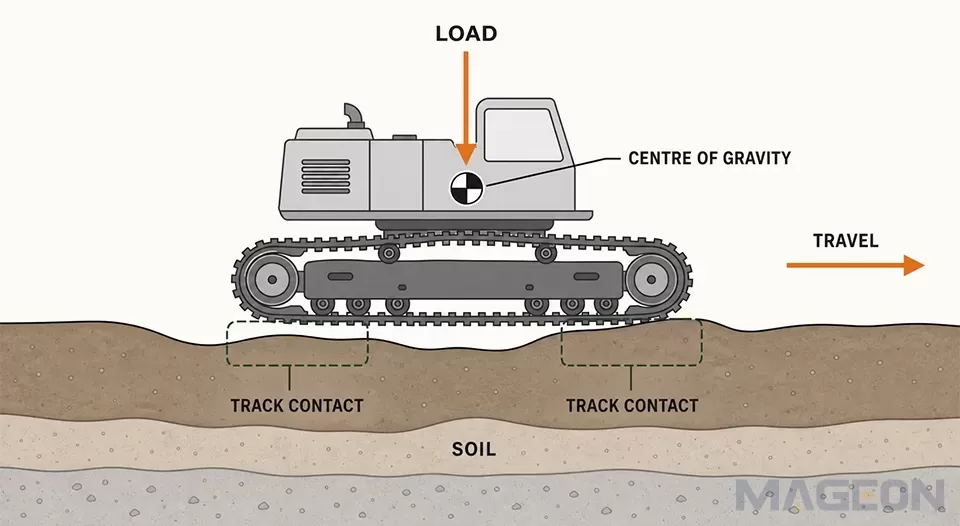
ISO 16754:2008, confirmed as current by ISO in 2025, provides a uniform method for calculating average ground contact pressure for crawler machines. ISO also limits the result to comparison between machine models. It states that actual operating pressure varies with load, centre-of-gravity position, terrain, track-shoe type and size, and surface conditions.
| What it indicates | What it misses | Required evidence | |
|---|---|---|---|
| Average ground contact pressure | A consistent model-to-model comparison | Local load peaks, dynamic operation, turning and changing soil | Calculation basis plus field-specific verification |
| Operating mass and load state | The gravity load for a defined configuration | How load is distributed along and across the tracks | Configuration list, load cases and centre-of-gravity range |
| Track contact geometry | Nominal footprint and packaging relationship | Sinkage, soil deformation and loss of effective contact | Track dimensions plus representative ground evaluation |
| Surface condition | The context in which contact occurs | Changes caused by rain, organic cover, repeated traffic or slope |
The table is a screening framework, not a completed engineering check. Average pressure can help compare concepts, but it cannot certify flotation, soil protection, stability, traction, or acceptable rutting in a forestry operation.
How Soil Moisture, Texture, and Surface Cover Change the Risk
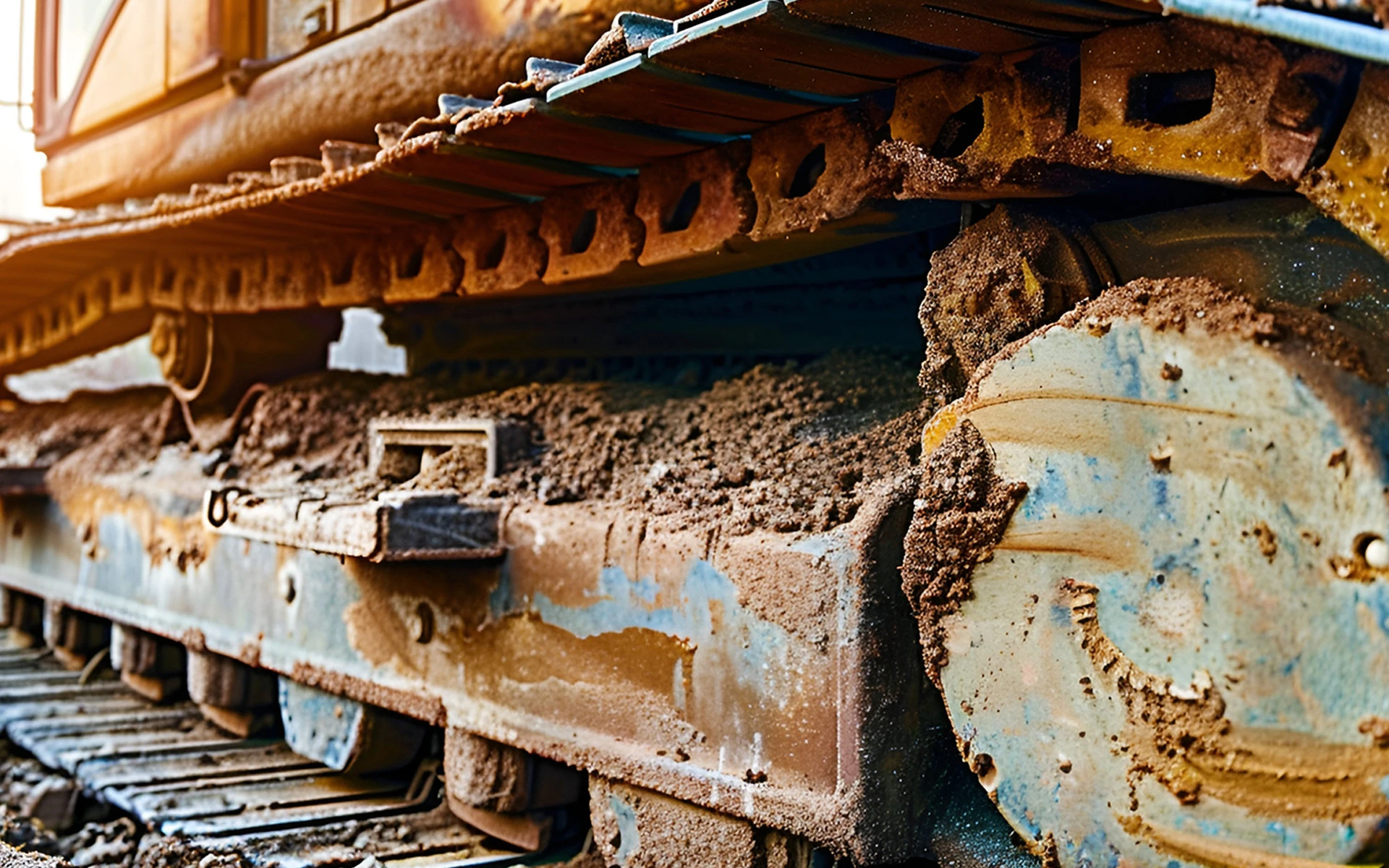
The USDA Forest Service’s 2022 report on soil trafficability treats trafficability as the soil’s capacity to support moving vehicles and reviews factors such as moisture, porosity, compaction and disturbance. For an OEM, the important implication is that “soft ground” is not a sufficient requirement. The site description must identify the soil and the condition in which the machine is expected to work.
Controlled forestry research also shows why a single rule is unsafe. A USDA-indexed cut-to-length harvesting study tested moisture, slash and machine-pass effects on a particular silt-loam site. Moisture and traffic influenced the measured soil response, while slash protection depended on the tested condition. These findings support collecting moisture and pass data; they do not establish a universal allowable moisture level or pass count.
Surface cover is similarly a system input. Slash, corduroy or portable mats can redistribute traffic or protect parts of the surface, but their effectiveness depends on material, placement, soil and repeated use. The undercarriage should therefore be assessed together with the planned ground-protection method, not as if the bare-soil condition were the only operating case.
How Repeated Passes and Turning Change Ground Disturbance
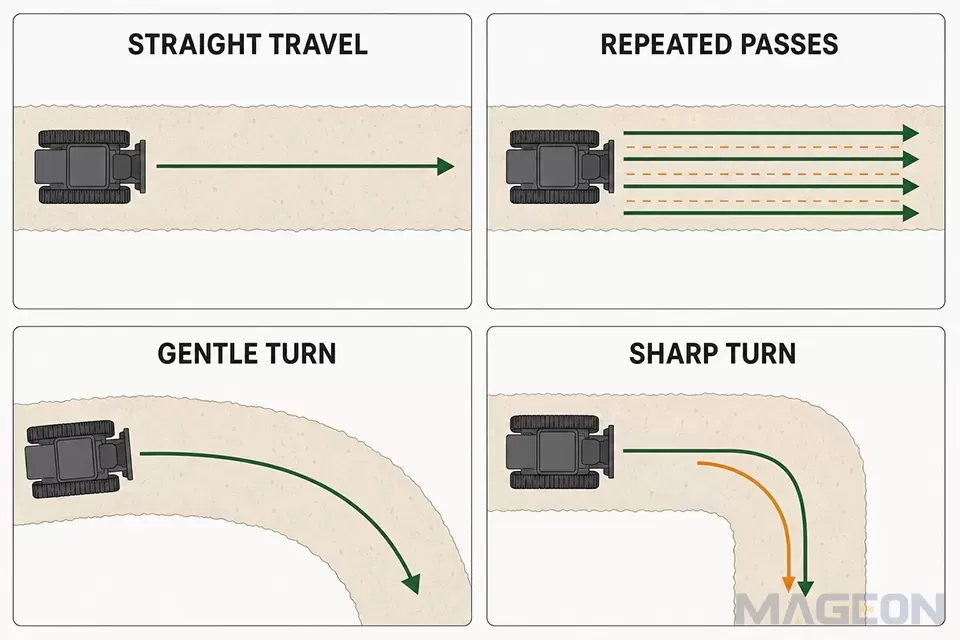
Travel distance alone does not describe a forestry duty cycle. One route may receive a single straight pass; another may concentrate loaded travel, reversing and turns at a landing. The latter can produce a different combination of normal load, slip and ground shear even when the same machine is used.
A 2026 Soil and Tillage Research paper on a lightweight rubber-tracked mini forestry crawler examined a specific Cambisol under unfavourable moisture conditions. In that experiment, successive passes increased disturbance, steering produced particularly intensive effects, and portable matting reduced but did not eliminate soil change. The study is useful because it isolates pass and steering effects; its machine, soil and test results must not be generalized into design limits for other equipment.
For specification work, the lesson is practical: record loaded and unloaded routes, expected pass concentration, reversing, turning radius, pivot-turn use, slope transitions and landing manoeuvres. These inputs help define what needs to be simulated, measured or tested before a configuration is accepted.
Translate Forestry Conditions into Undercarriage Inputs
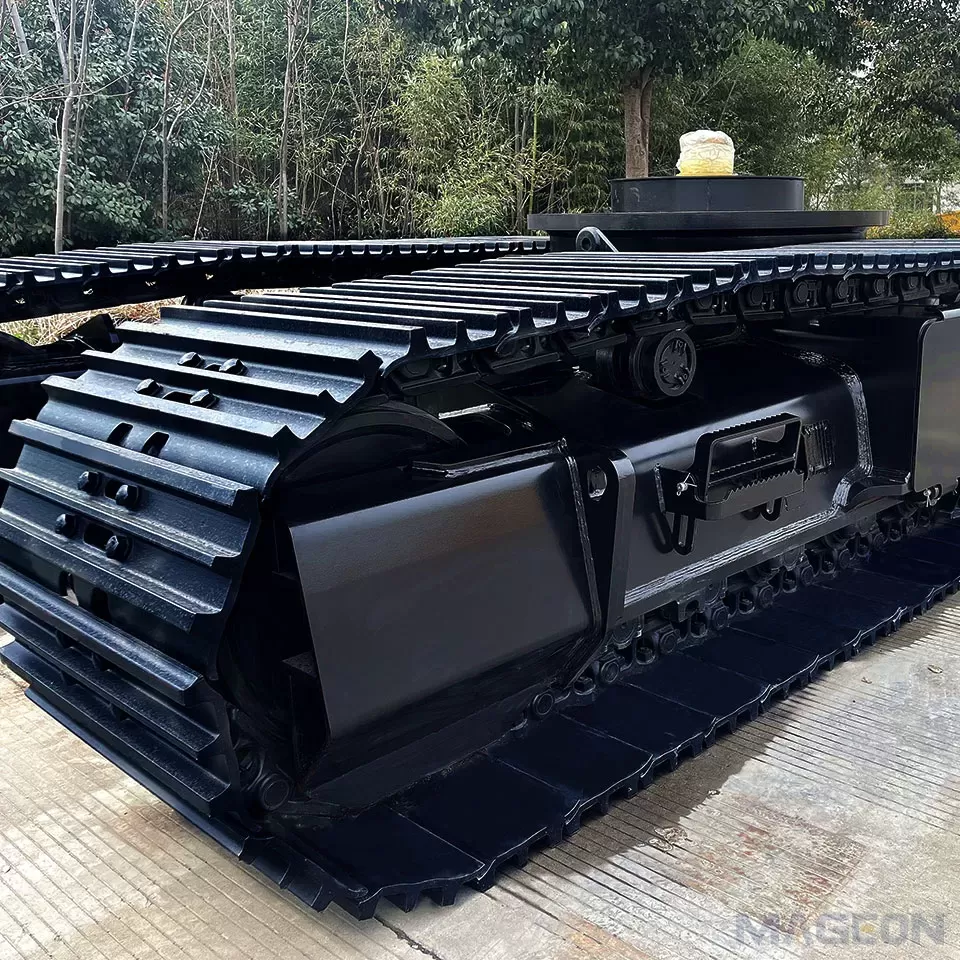
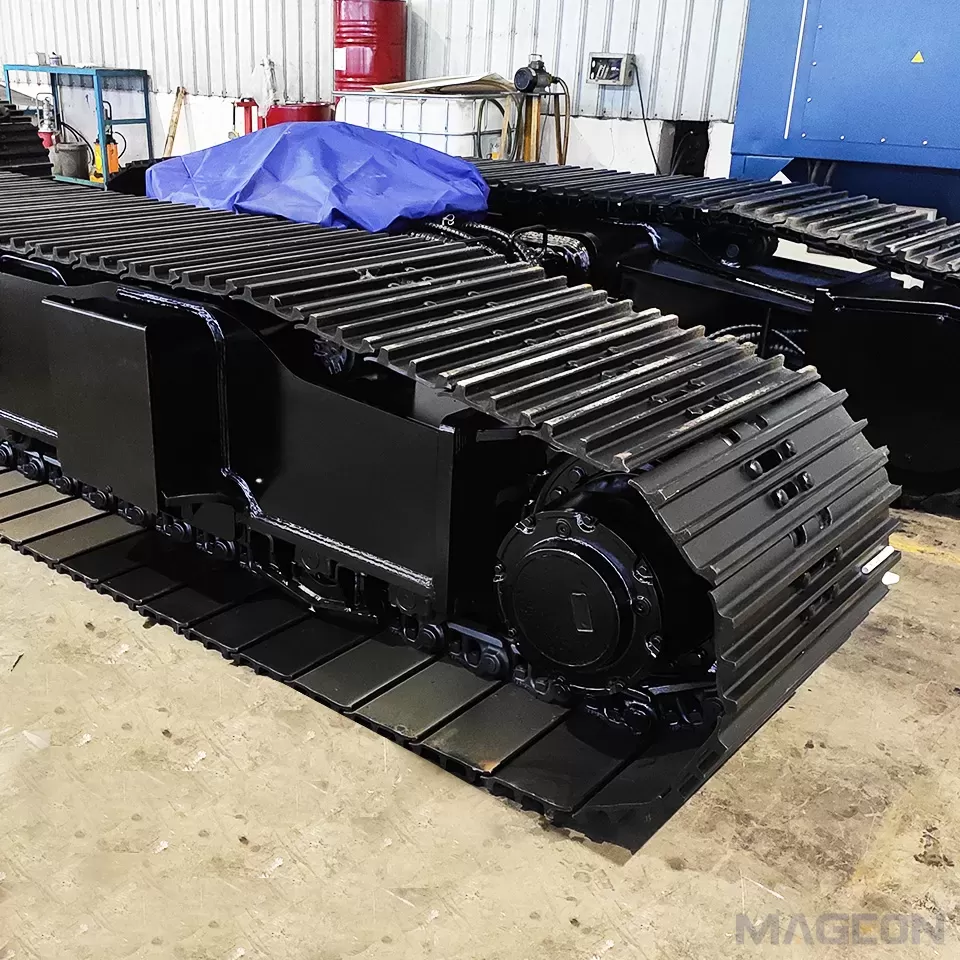
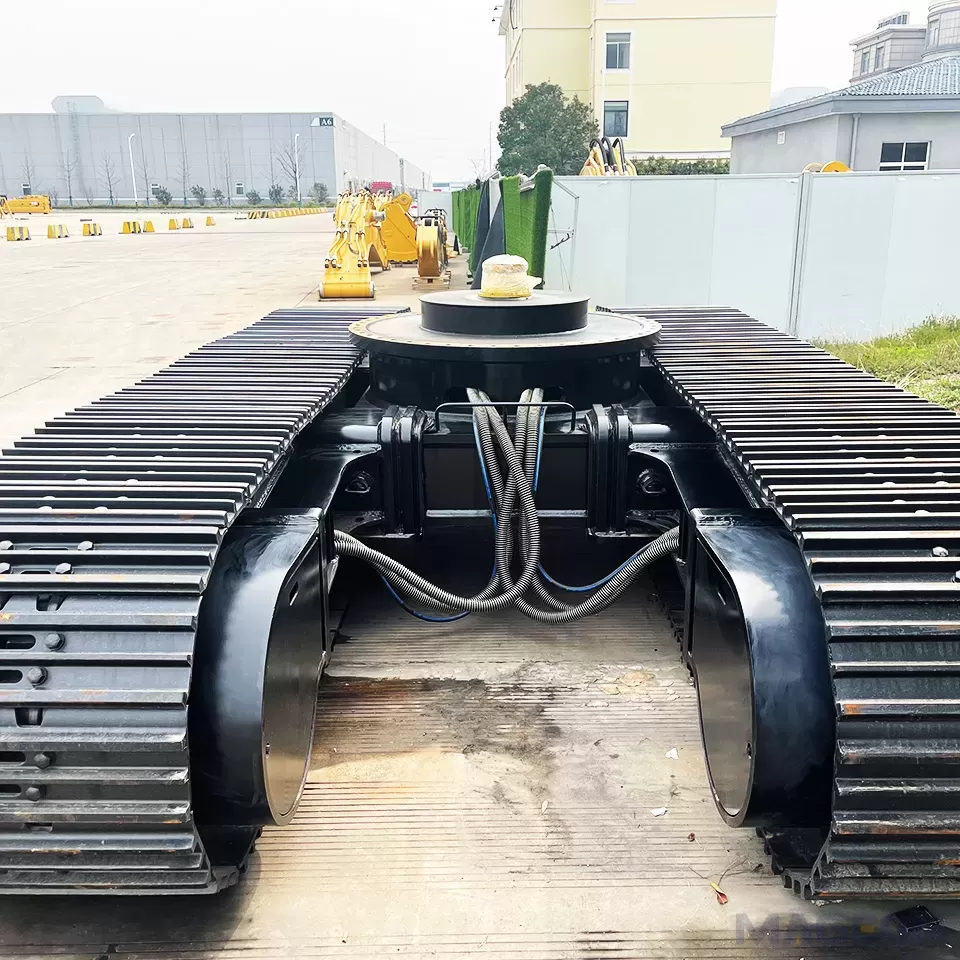
The soil and trafficability evidence should become part of a custom crawler undercarriage specification, not remain as a general site note.
| Why it matters | OEM input | Verification need | |
|---|---|---|---|
| Soil type and moisture state | Changes support, sinkage and deformation response | Soil description, seasonal range and representative wet condition | Site data or agreed representative test condition |
| Machine configuration | Changes total load and its distribution | Operating mass, attachment, payload and centre-of-gravity cases | Controlled configuration baseline |
| Travel and turning pattern | Changes pass concentration, slip and shear | Route map, speed, turns, reversals and pass frequency | Duty-cycle review and representative manoeuvres |
| Terrain and surface protection | Changes contact, traction and disturbance controls | Slope, obstacles, organic cover, slash or matting plan |
These are input categories, not substitute values. The OEM and its engineering partners still need to define the applicable calculations, test method, measurement locations and acceptance criteria for the target machine and site.
Separate Machine Configuration from Operating Controls
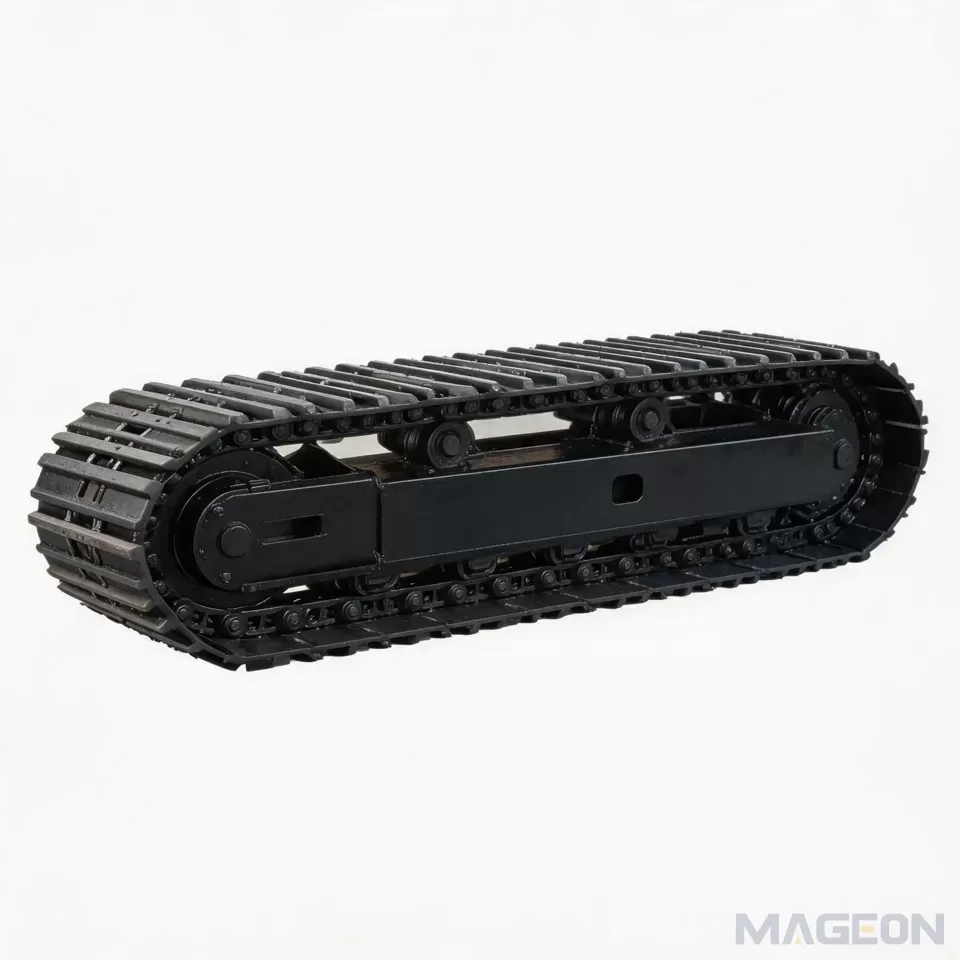
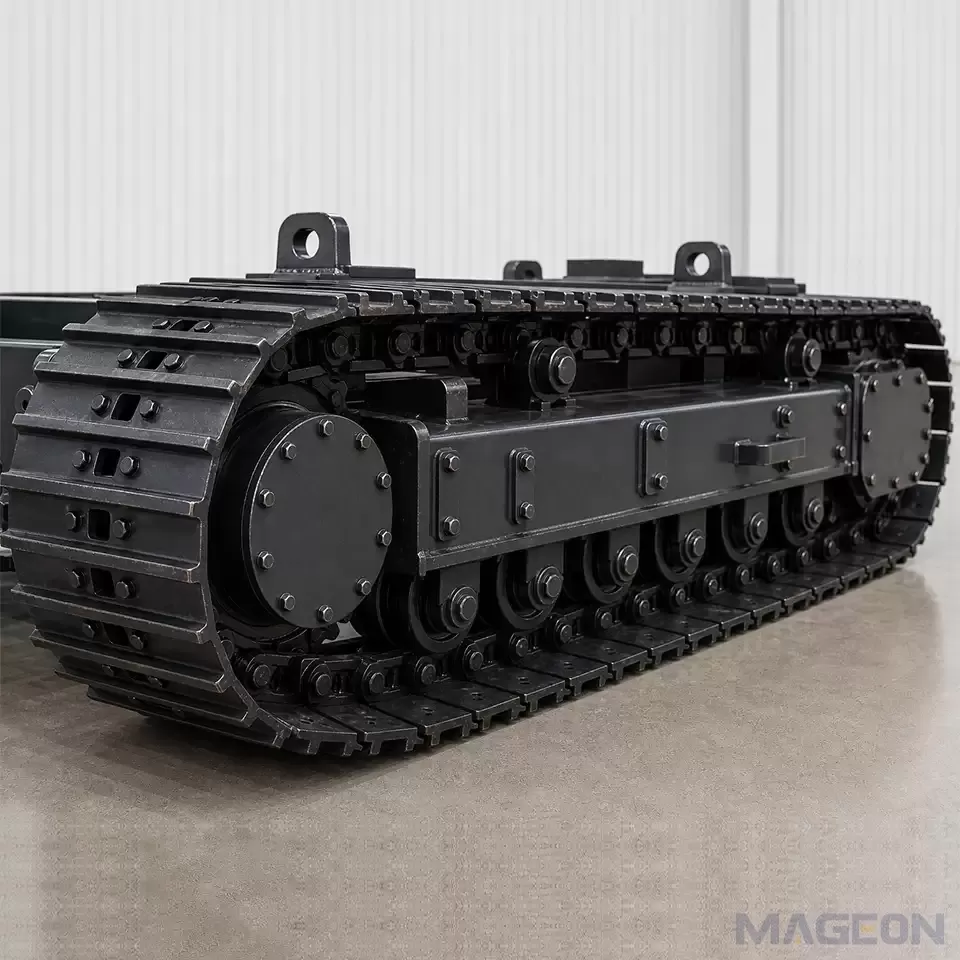
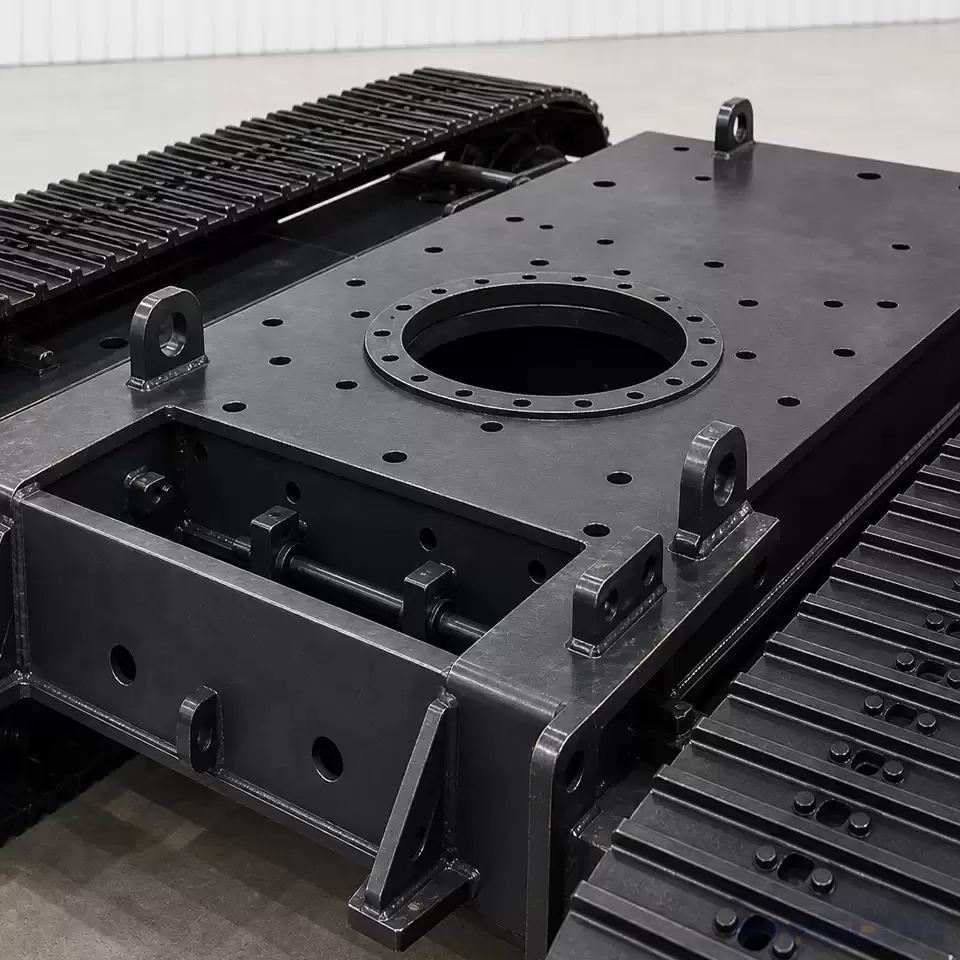
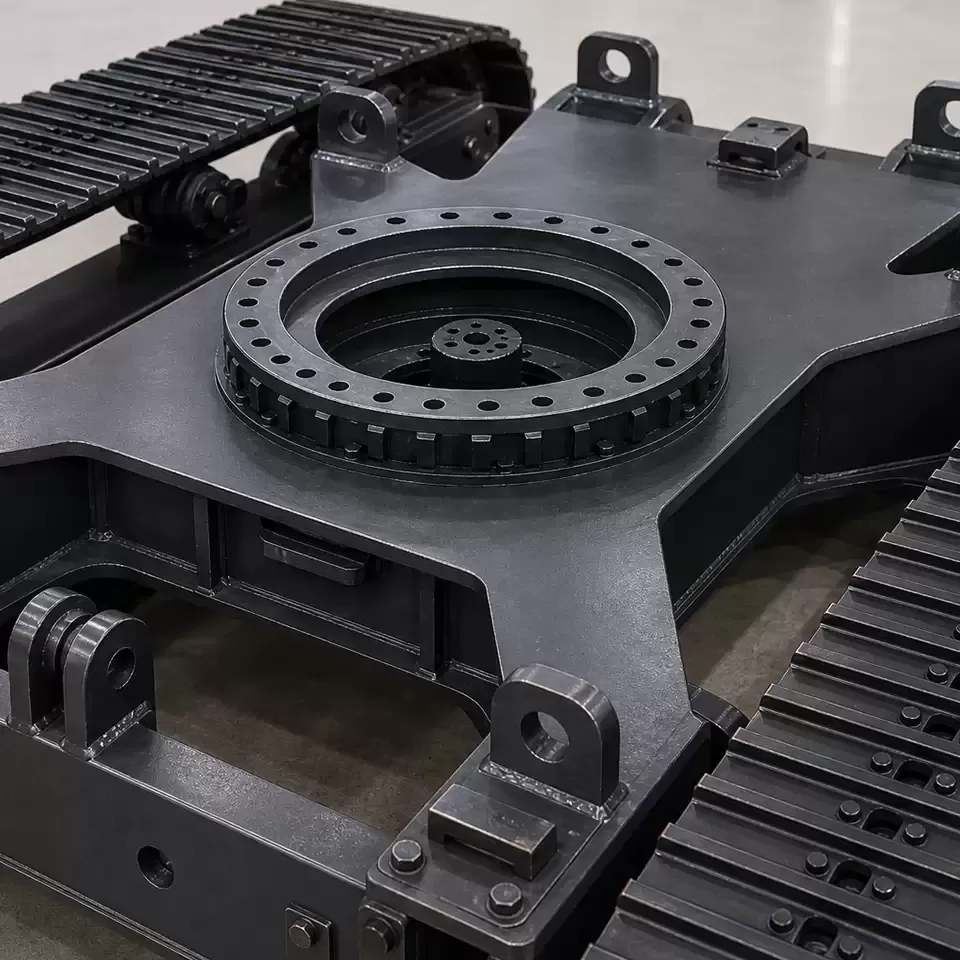
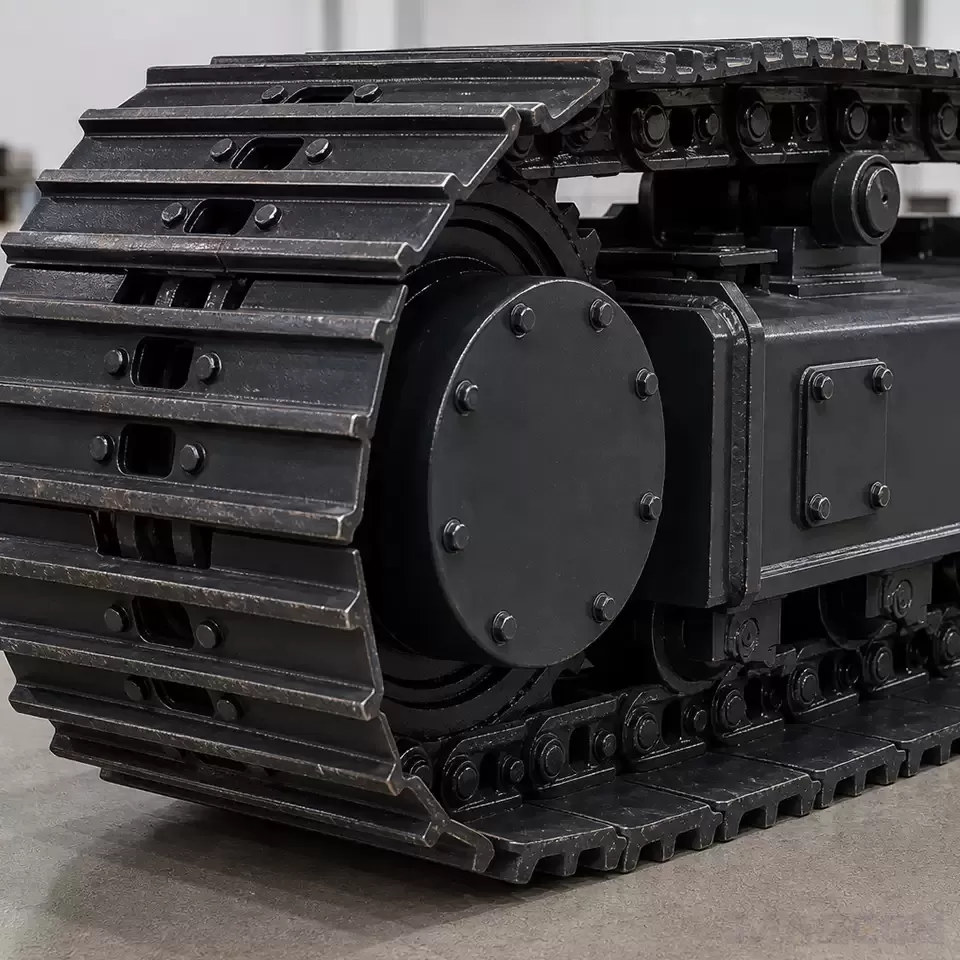
Machine-side decisions may include track contact geometry, gauge, ground clearance, shoe arrangement, drive and braking interfaces, structural load cases, tensioning, debris management and service access. Each decision must be evaluated against the complete machine, not selected from a forestry label alone.
Operating controls address a different risk layer: when the site is trafficable, where machines may travel, how routes are protected, how turns are executed, how many passes are concentrated, and when work should stop for inspection or changing ground conditions. The USDA Forest Service’s Timber and Tracks guidance groups forestry disturbance into compaction, displacement and erosion, plus surface rutting and puddling, and emphasizes maintaining protective surface layers.
An undercarriage supplier cannot resolve an uncontrolled route or unknown soil condition through hardware alone. Equally, careful operations cannot correct an undercarriage that was assessed against the wrong load, geometry or interface baseline. Procurement documents should assign ownership for both layers.
Conclusion
Forestry undercarriage selection starts with trafficability and a controlled machine baseline, not a single nominal pressure figure. Soil condition, load distribution, pass concentration, steering and surface protection work together, and the relative importance of each factor changes by site and operating plan.
The strongest OEM inquiry therefore connects field evidence to engineering inputs and verification responsibilities. That approach makes supplier evaluation more precise while avoiding unsupported promises about flotation, compaction, stability or service performance.
Frequently Asked Questions
Does lower average ground contact pressure guarantee less soil compaction?
No. It is useful for comparing defined machine models, but actual field response also depends on load distribution, soil, moisture, terrain, track shoes and operation. Field-specific evidence is still required.
Are wider tracks always better for forestry machinery?
Not automatically. Track width affects nominal contact geometry, but it also interacts with machine envelope, turning behaviour, transport constraints and soil conditions. The complete configuration must be assessed rather than optimizing width alone.
Why should an OEM record the number of machine passes?
Repeated traffic can change soil response and concentrate disturbance on specific routes. Pass counts should be linked to load state, direction, turns and ground-protection measures so the duty cycle can be reproduced or reviewed.
Should turning manoeuvres be part of undercarriage validation?
Yes, when the application includes frequent or tight turns. Turning can introduce slip and ground shear that are not represented by straight-line travel or a static pressure comparison.
Can slash or portable mats replace undercarriage verification?
No. They are operating controls whose effectiveness depends on their material, placement, soil and repeated use. They should be included in the operating scenario, not treated as proof that the machine configuration is suitable.
What information should an OEM provide before requesting an undercarriage assessment?
Provide the machine configuration, loads, centre of gravity, dimensions, interfaces, soil and terrain conditions, travel and turning pattern, duty cycle and planned ground protection. Identify the source, revision and approval status of each input so open assumptions remain visible.
Applicable products:
What OEMs Should Provide for Technical Evaluation
Prepare a controlled input package covering:
machine purpose, configurations, attachments and operating-mass cases;
payload, external loads, centre-of-gravity range and relevant dynamic events;
dimensional envelope, mounting interfaces, ground clearance and transport limits;
soil type, moisture range, bearing or trafficability evidence, slope and surface cover;
straight travel, steering, reversing, pass concentration and landing manoeuvres;
duty cycle, inspection plan, ground-protection measures and acceptance evidence.
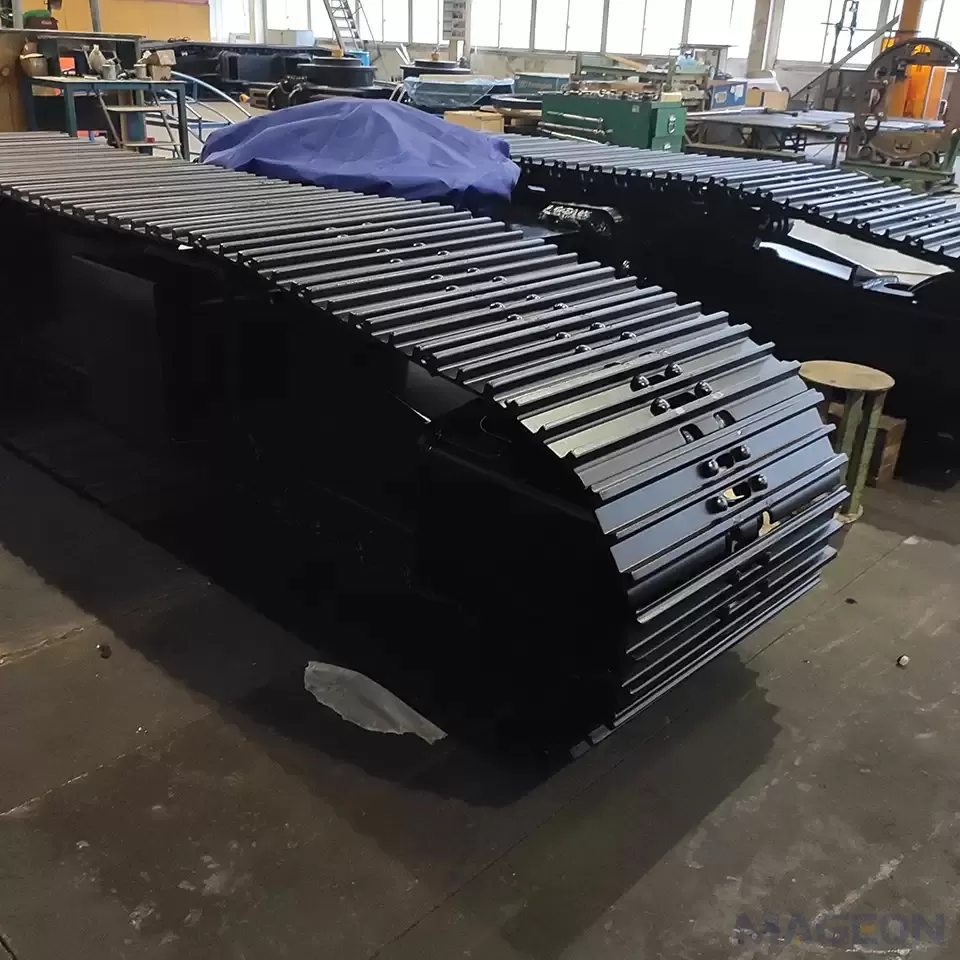
MAGEON's approved product scope centers on complete crawler undercarriage assemblies. For a technical evaluation or inquiry, provide the equipment, load, dimensional and duty-condition information above so the project requirements can be reviewed against a defined baseline. Any project fit, parameter, application capability or performance conclusion must be confirmed for the specific machine.
Please leave your customization requirements, and we will contact you as soon as possible!
Leave your requirements, we'll get back to you within 24 hours.