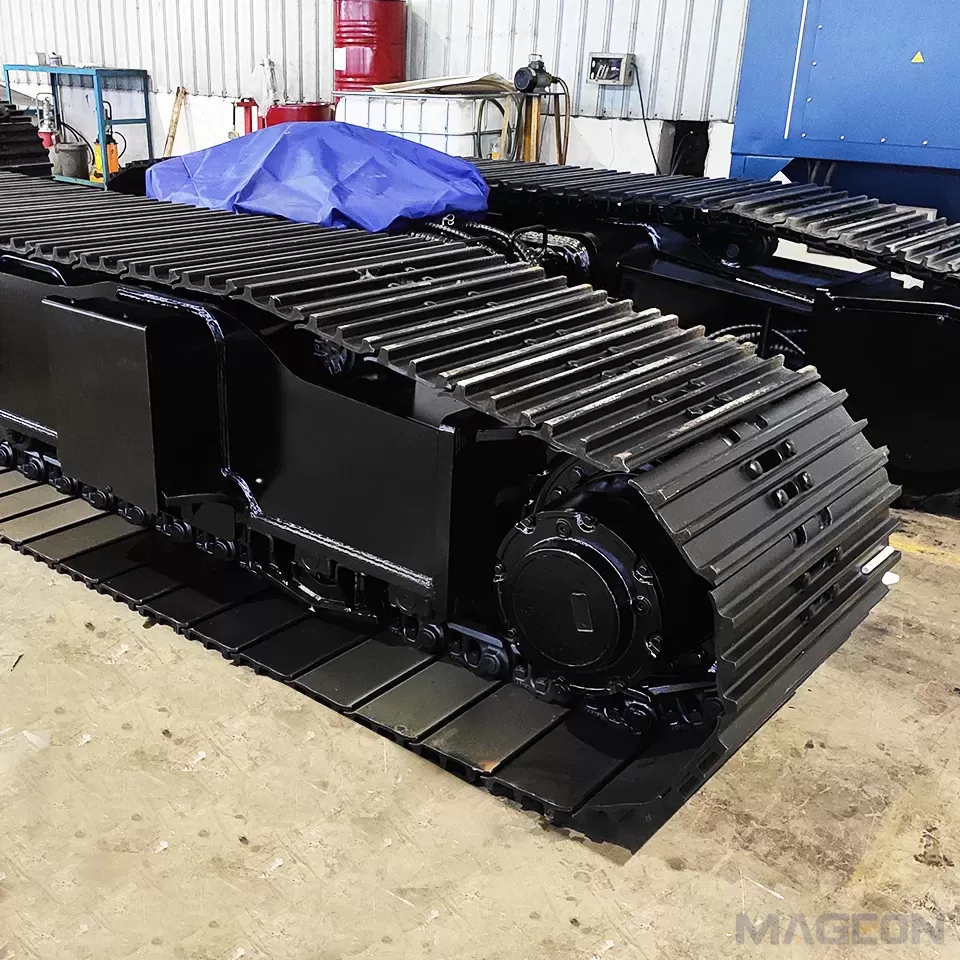
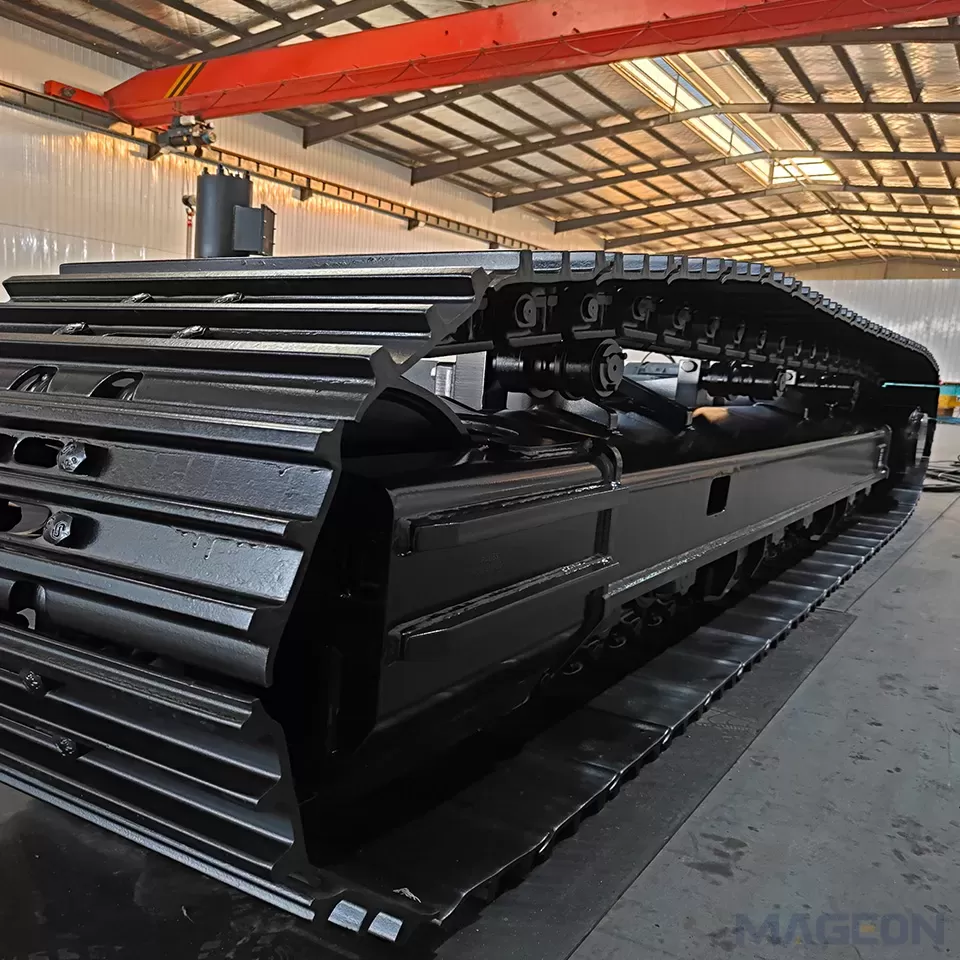
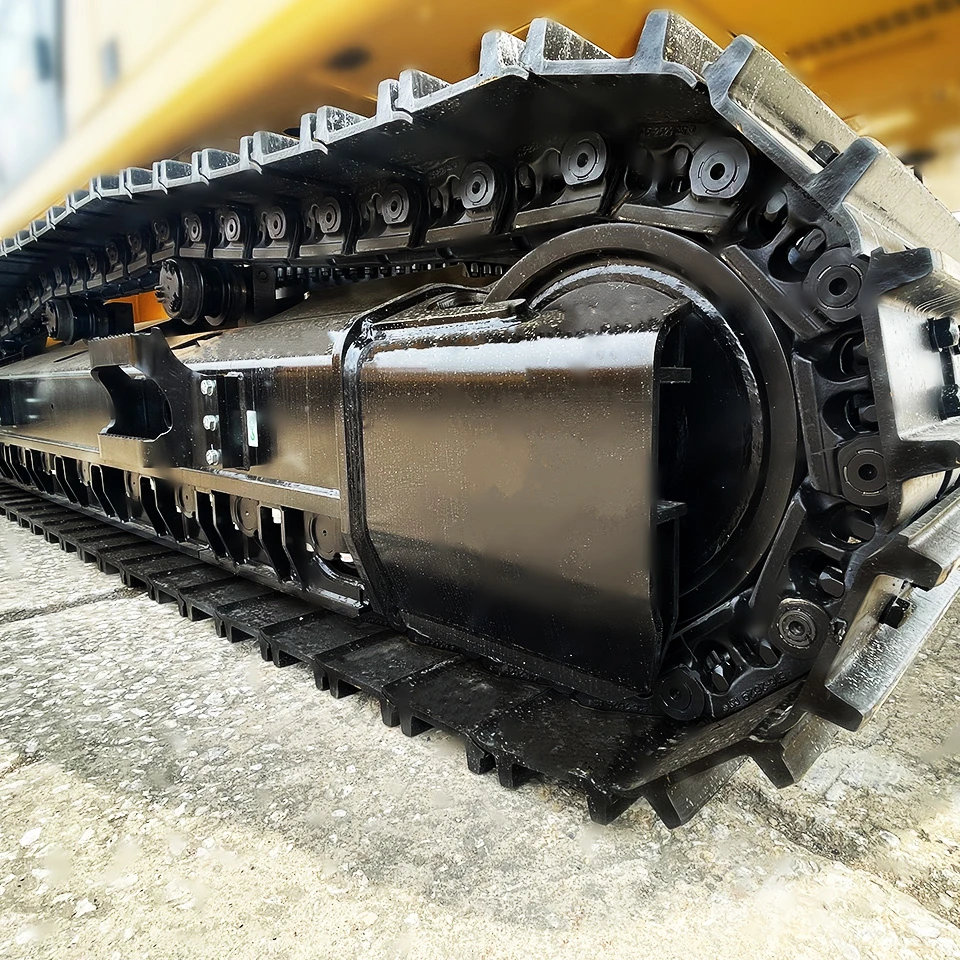
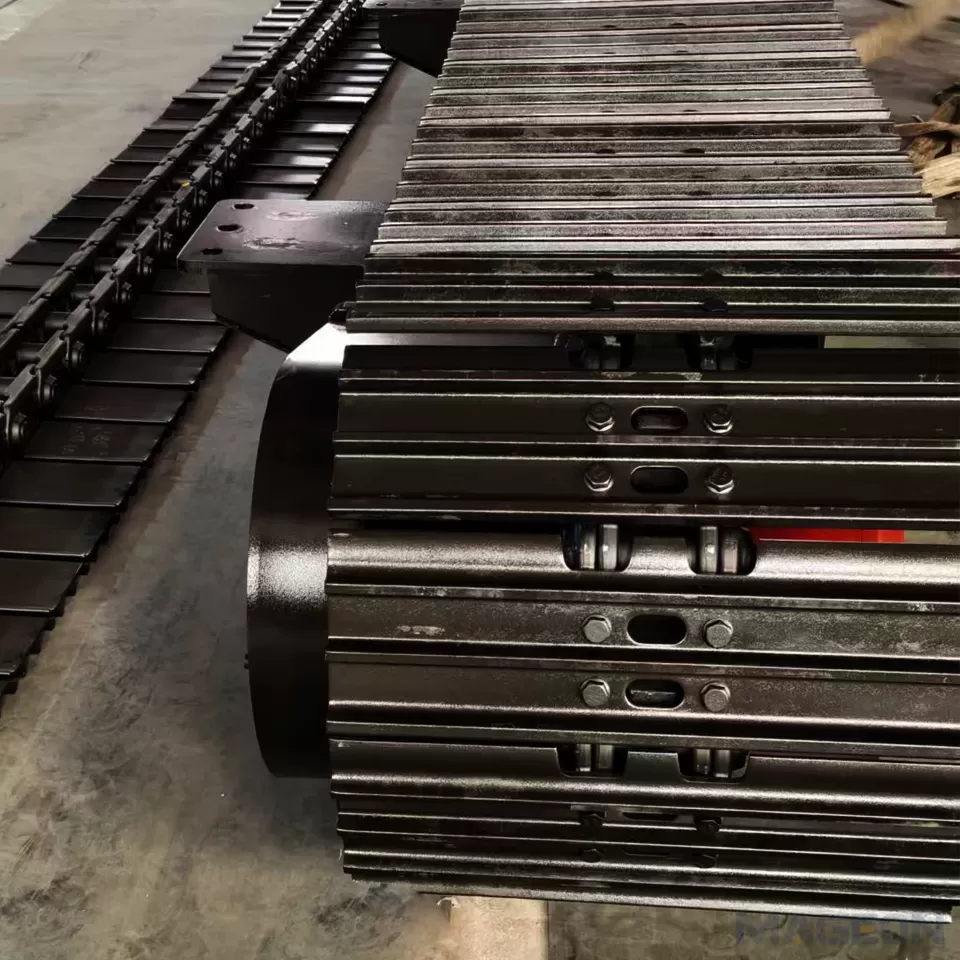
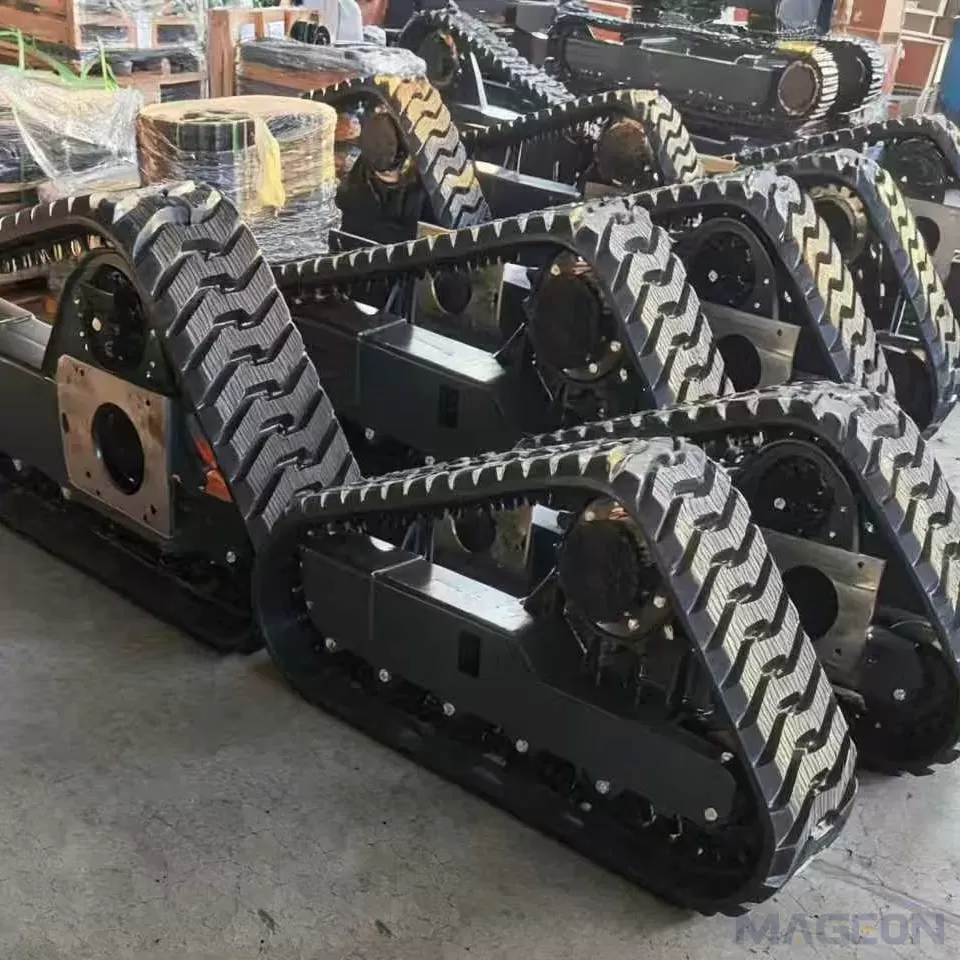
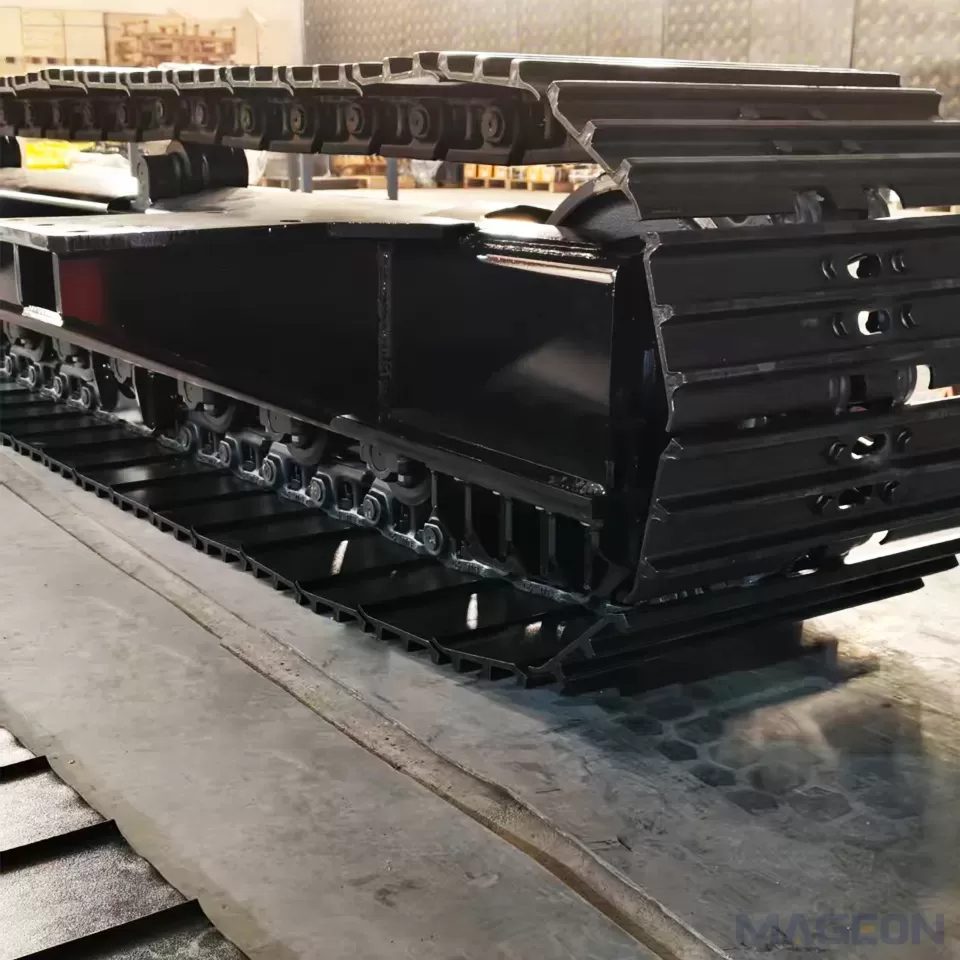
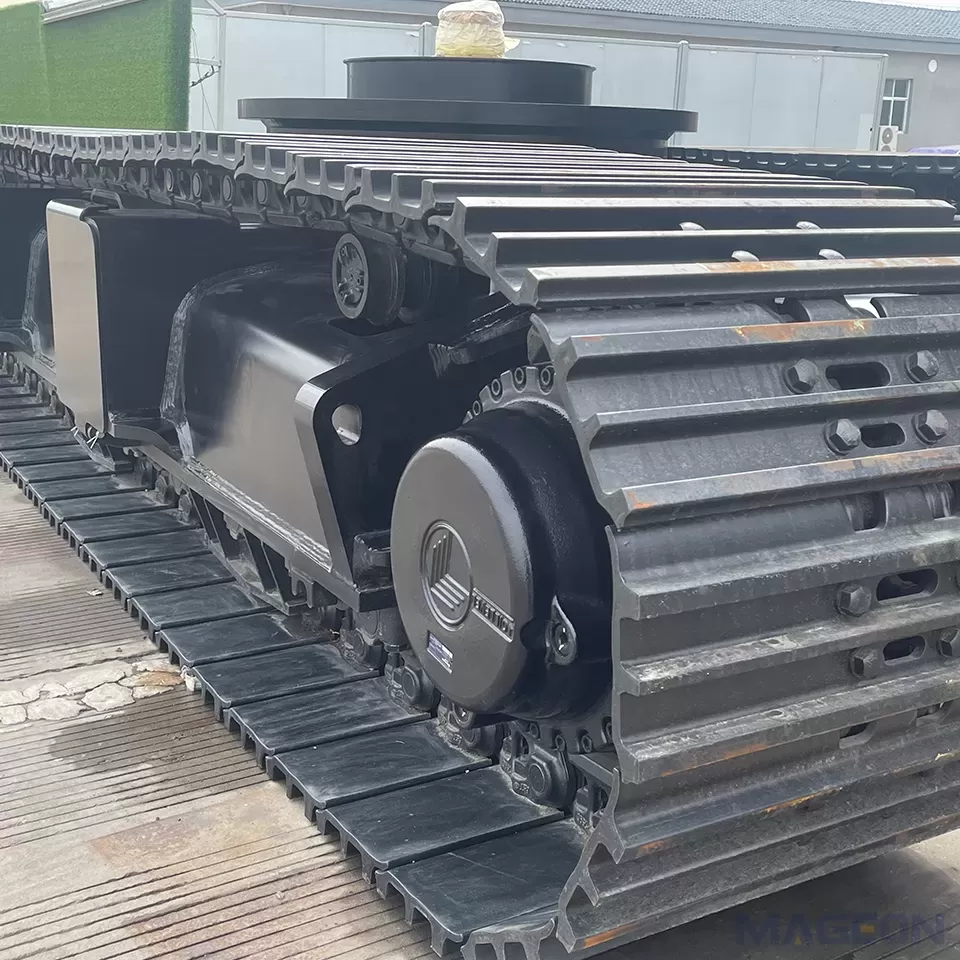
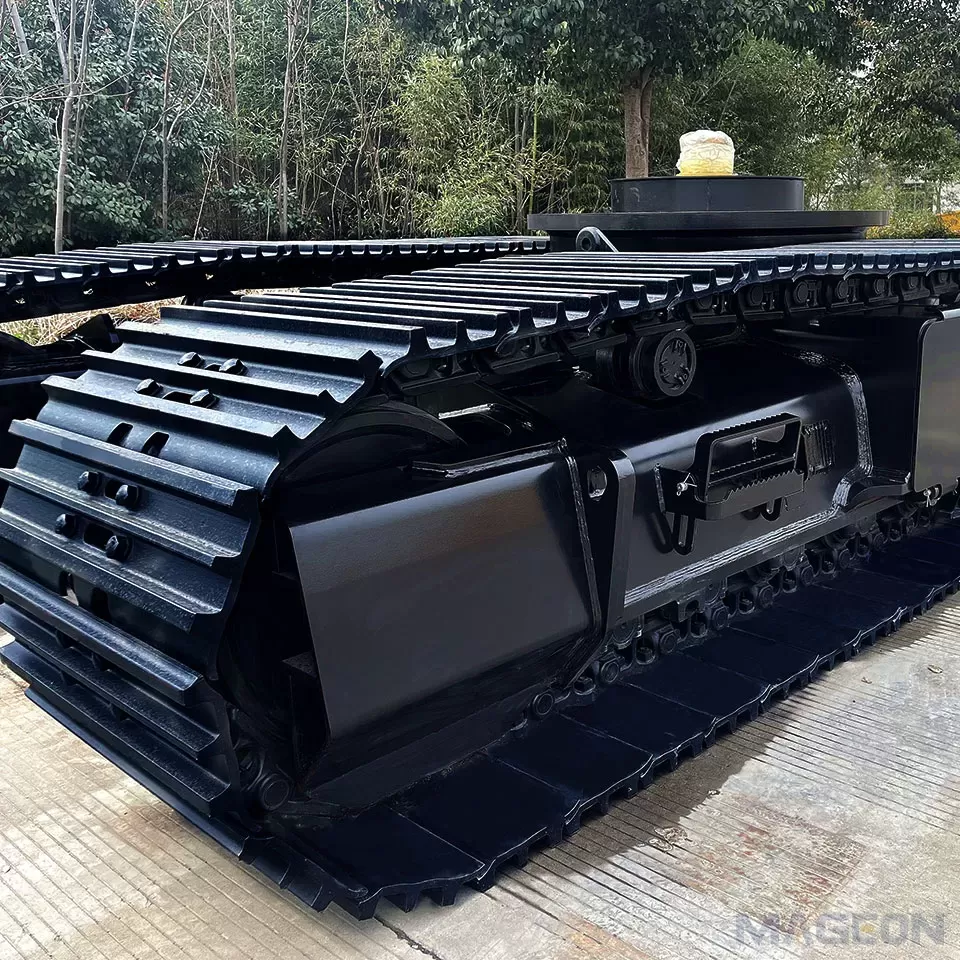
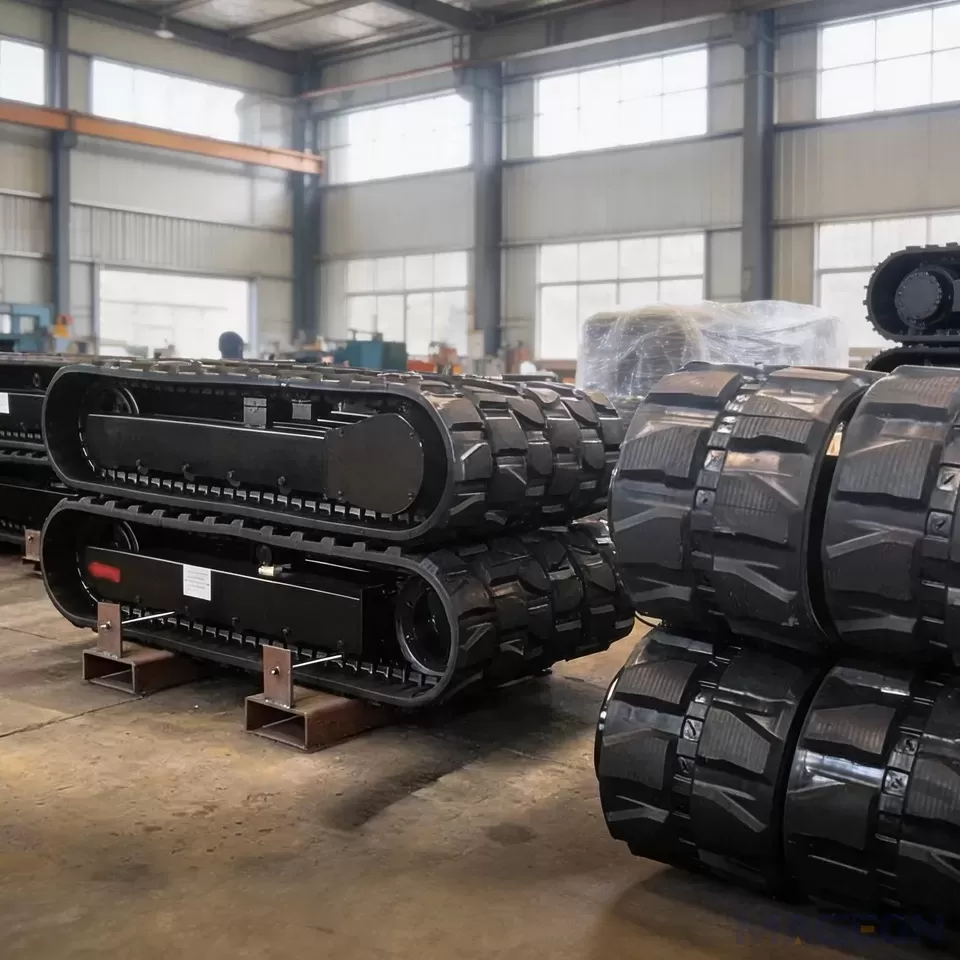
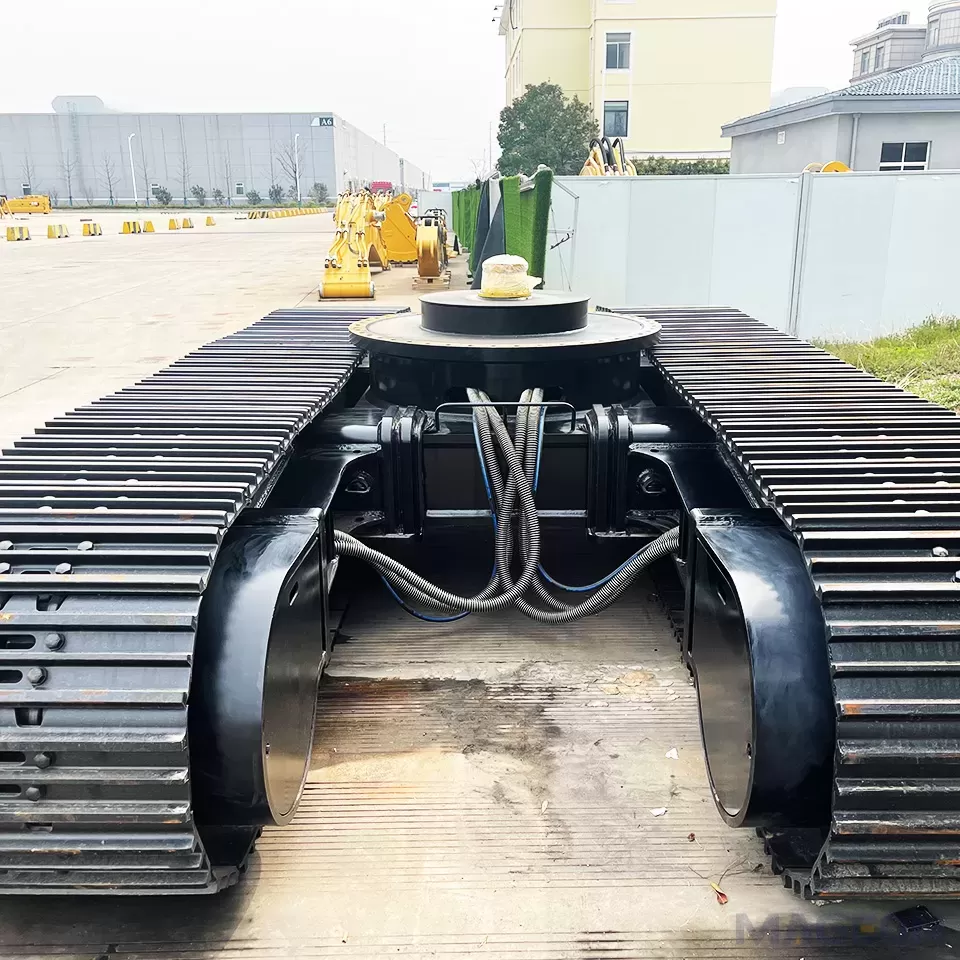
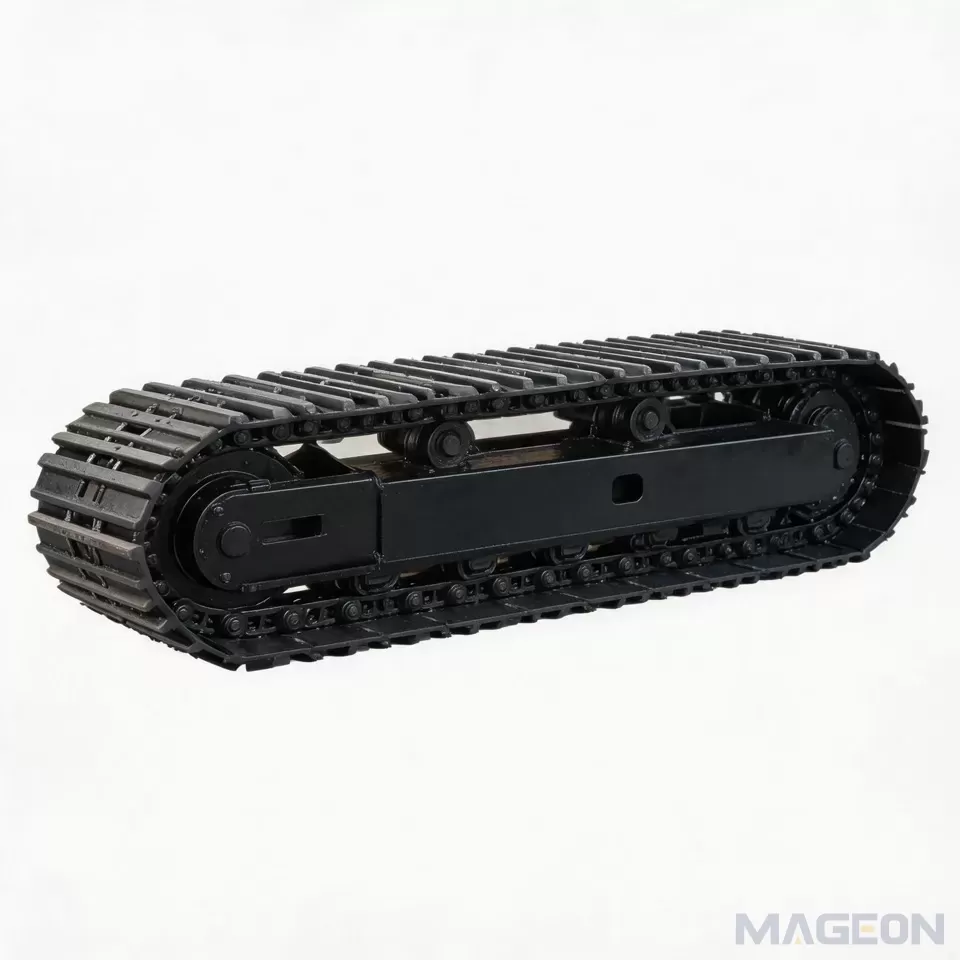
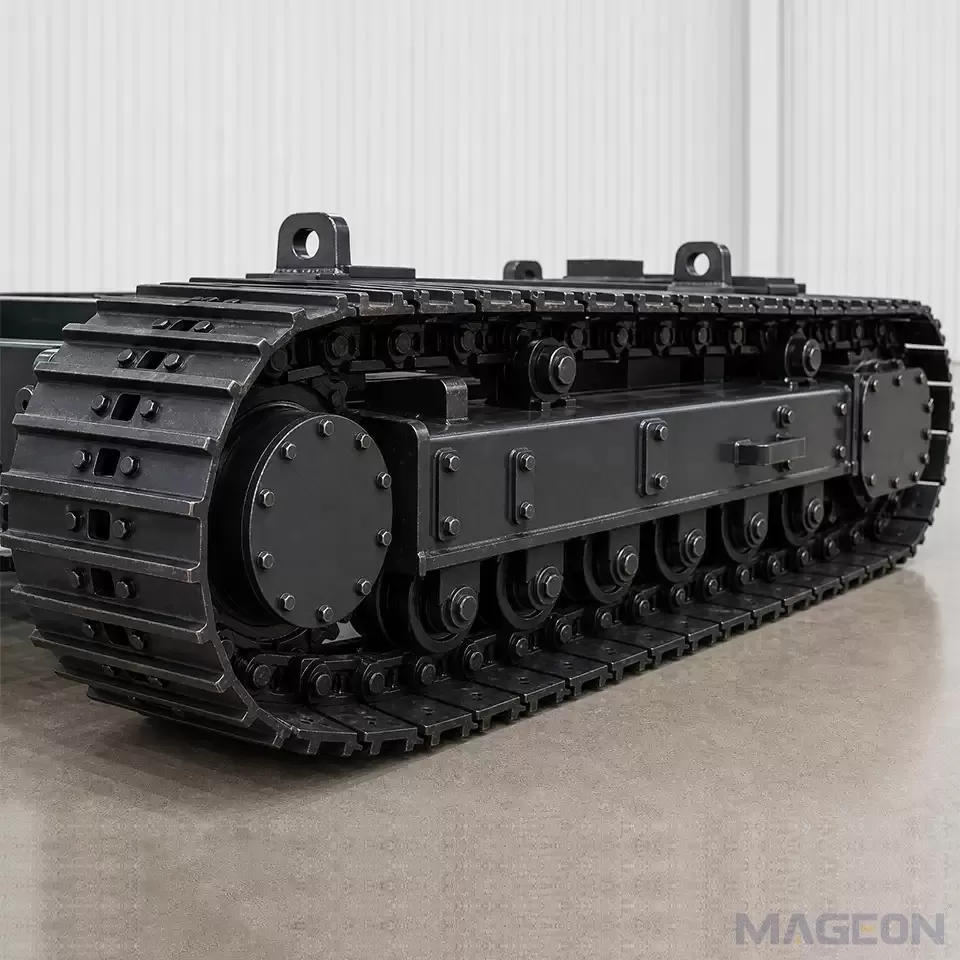
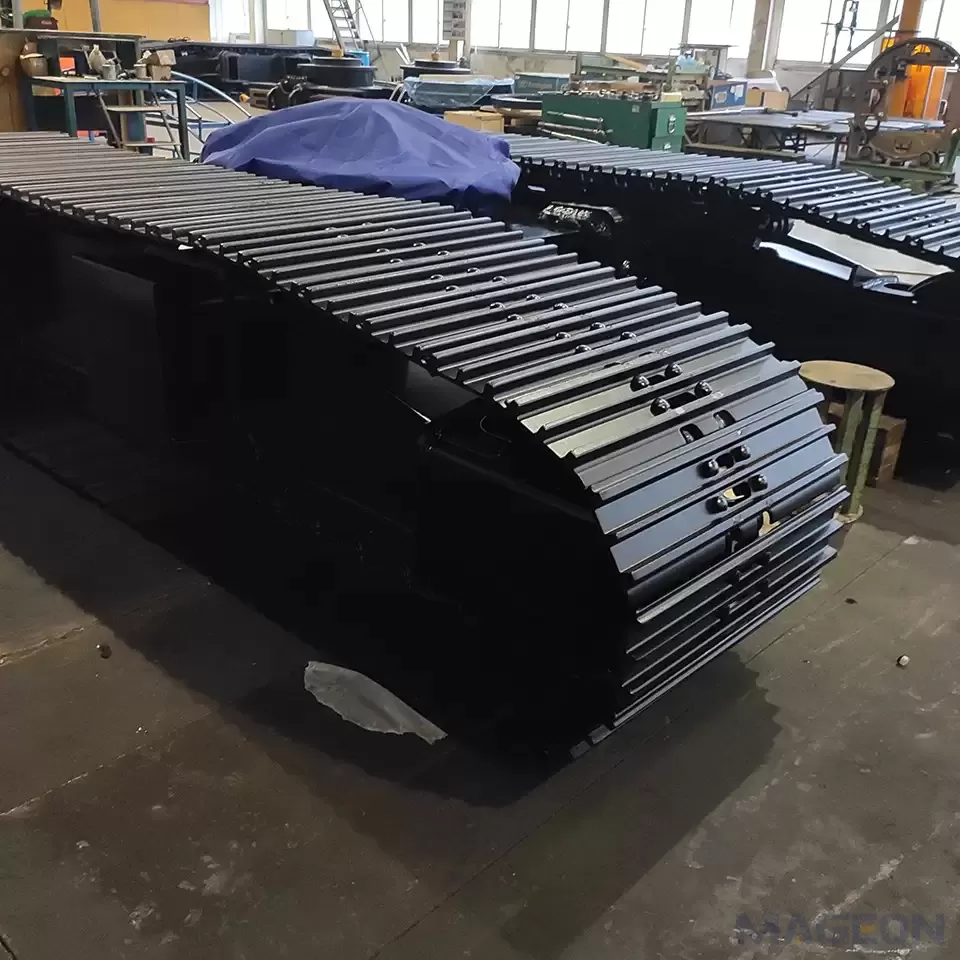
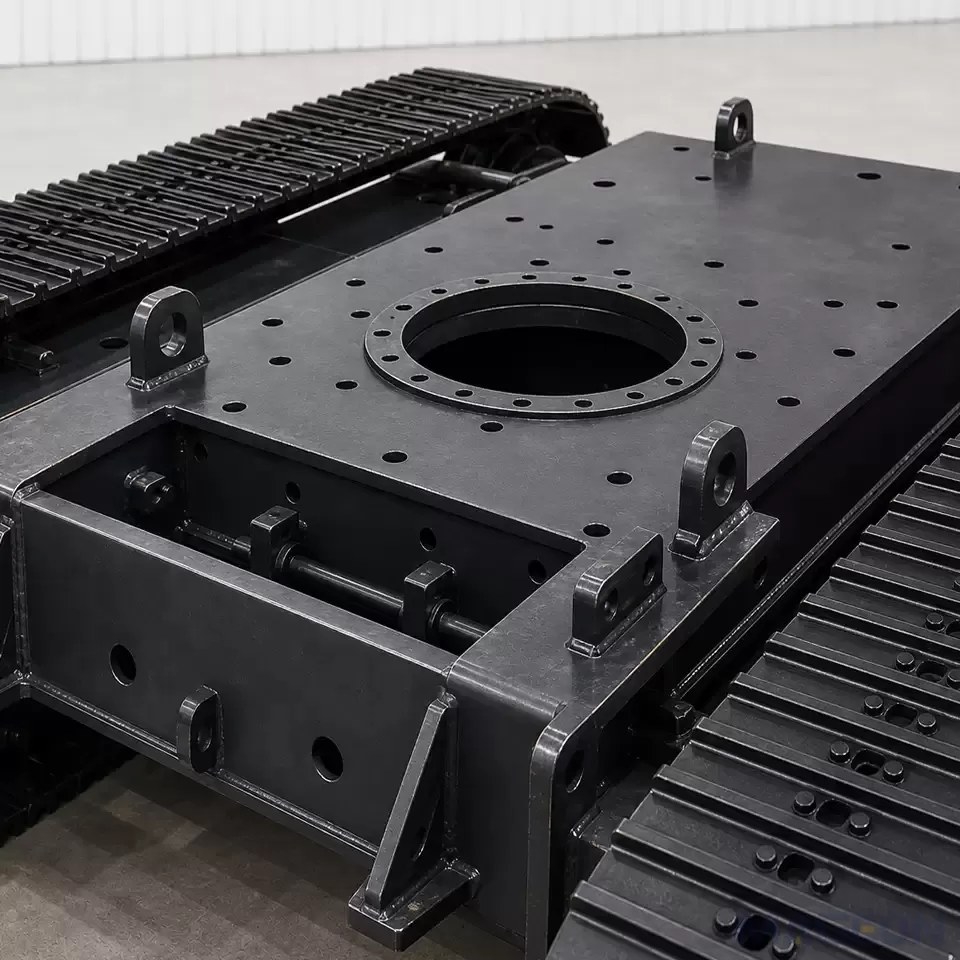
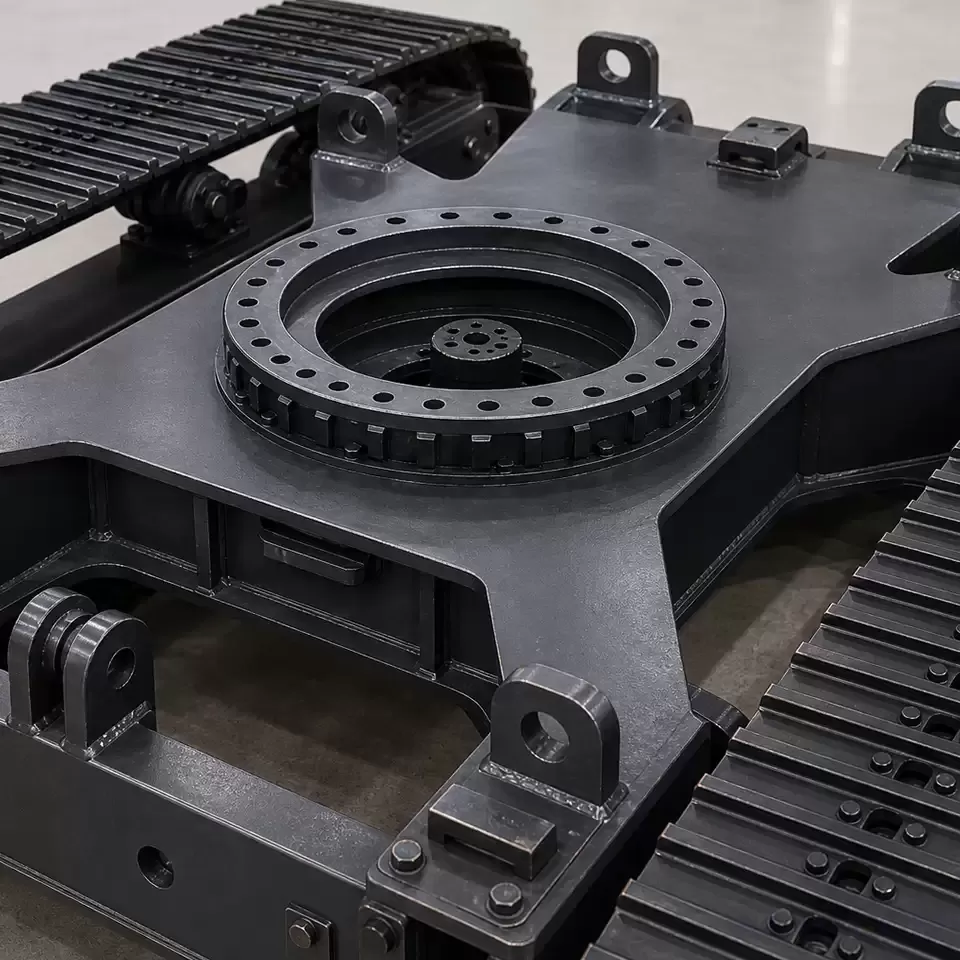
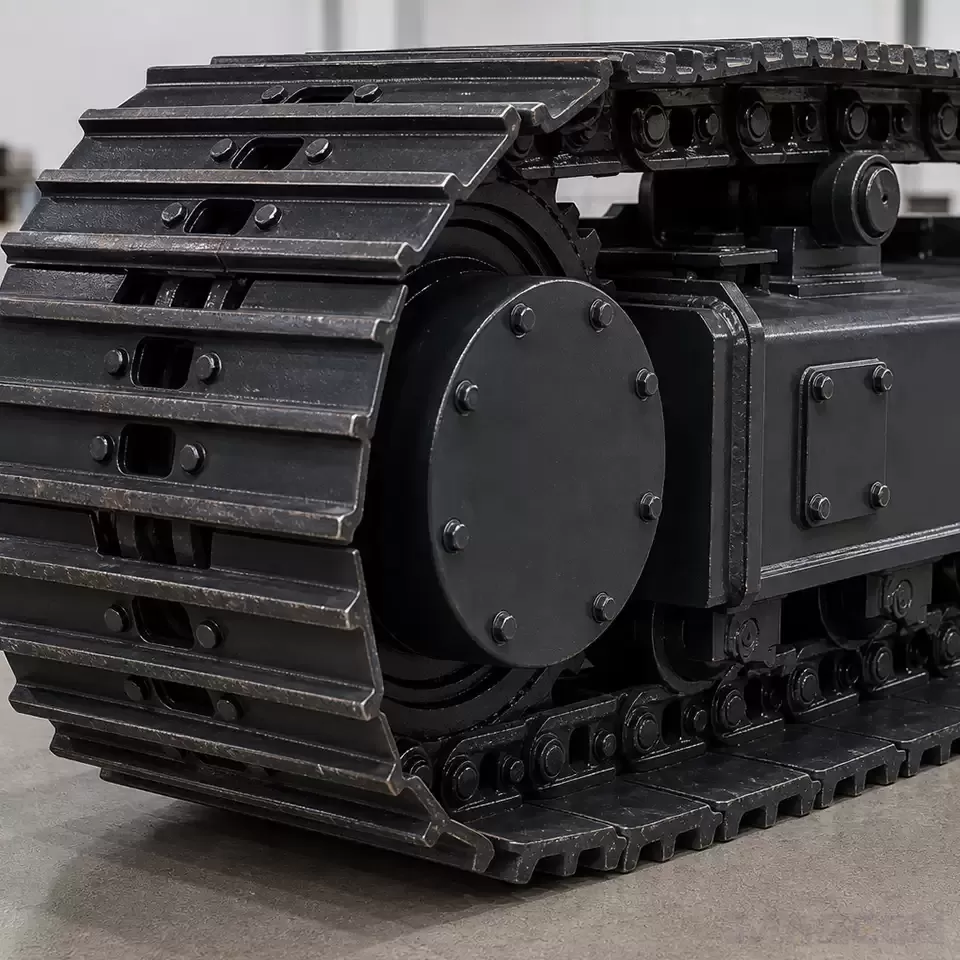
Q:What kind of equipment is this steel track undercarr
Machine Types We Build For
MAGEON steel crawler undercarriages are designed for tracked machines across five main categories. The architecture differs mainly in how the load is distributed and how the drive is arranged, so the same chassis family covers a very wide machine range.
| Machine category | Typical application | Load range | Key design driver |
|---|
| Rotary drilling rigs | Geotechnical drilling, foundation work, water well drilling | 5-150T | High downforce and stability against drilling reaction torque |
| Excavators | Hydraulic excavators, mining shovels, trenchers | 5-80T | Arm reaction force transmission through the frame |
| Drilling and foundation equipment | Piling rigs, screw rigs, crawler cranes | 10-150T | Ground pressure and stability on soft terrain |
| Material handling | Tracked dumpers, pipe layers, grapples, slew loaders | 3-60T | Centre of gravity shift as the load moves |
| Special and modified machines | Agicultural robots, aerial platforms, tunnel vehicles, walking machines | 0.5-30T | Interface fit and unusual ground clearance |
Four-Wheels-One-Track Configurations
Many modern machines use a mixed arrangement - rubber wheels at one end and a crawler track at the other. This is the configuration used on most rotary drilling rigs and on walking excavators, and it is worth understanding because it changes the design logic.
With a conventional full-track chassis, the machine sits on a rigid frame and the whole undercarriage is the structural member. With four-wheels-one-track, the track section becomes a mobile base while the wheels carry part of the load and control the steering. The engineering focus shifts to the track section's own stiffness and to how the transition between the wheel line and the track line handles articulation.
Why the Interface Matters More Than the Machine Type
In practice, the machine type alone is not enough to select a chassis. The four things that actually determine the design are the mounting interface, the total machine weight, the load distribution including the working envelope, and the ground condition. Two machines of the same nominal type can need completely different chassis if the mounting points or the weight distribution differ - for example, a drilling rig with a tall mast has a very different load profile from a low-reach rig of the same nominal capacity.
This is why we ask for the interface drawing rather than just the machine name. A chassis that is correct for one rig and wrong for another will show up as track wear problems or frame cracking, and both are expensive to rectify after delivery.
Configurations We Have Built
- Standard rigid crawler frame, sprocket at the rear, idler at the front
- Four-wheels-one-track with a raised walking beam
- Telescopic booms with hydraulic width adjustment for narrow passage work
- Low-profile chassis with reduced ground clearance for tunnel and indoor work
- High-clearance chassis with a raised sprocket for mud and marsh work
- Traction-optimised configurations with larger shoes and wider grousers for soft ground
- Undercarriages for fully electric machines, with no hydraulic drive and a different motor interface
Tell us the machine type, the gross weight, the working load, the ground condition, and the interface dimensions, and we will confirm which configuration is appropriate and what it will take to build it.
Q:Can this undercarriage work on complex urban ground
Yes, With the Right Configuration
A steel crawler undercarriage can work on complex urban ground, but the answer always comes with conditions. Urban sites combine several demanding features in one place, and the chassis has to be configured for the worst of them rather than the average.
What Makes Urban Sites Demanding
| Urban condition | Effect on the chassis | Configuration response |
|---|
| Broken asphalt, rubble, kerbstones | Point loading on the track chain and impact on the roller mounts | Reinforced track chain pitch, hardened roller rims, thicker shoe wear plate |
| Narrow streets and doorways | Turning radius exceeds the machine width | Telescopic width adjustment, or a narrow fixed-width design |
| Soft asphalt and landscaped verges | Ground pressure damages the surface and the machine sinks | Wider tracks with lower ground pressure, or rubber-pad conversion |
| Pipes, cables and shallow utilities | Track chain damage and derailment risk | Protective track shoes, careful ground clearance selection |
| Wet, oily, chemically aggressive surfaces | Corrosion of pins, bushings and hydraulic components | Anti-corrosion coating, sealed and greased track chains, stainless pin sleeves |
| Continuous travel on hard surface | Accelerated wear on rubber elements and pin seals | Steel-on-steel configuration with appropriate grease intervals |
Three Configurations We Recommend for Urban Work
- Telescopic crawler undercarriage - the track width retracts hydraulically to pass through a standard doorway or a confined site entrance, then extends for stability during digging. This is the most requested configuration for urban utility and foundation work.
- Rubber-pad steel track - steel chain with bolt-on rubber pads. Keeps the steel load capacity of a crawler while avoiding damage to paved surfaces and reducing noise in residential areas.
- Low-profile rigid steel track - reduced ground clearance and low overall height, for sites with height restrictions such as underpasses, tunnels, and covered work areas.
Where Steel Beats Rubber on Urban Sites
It is worth being direct about this, because the assumption often goes the other way. On urban sites with substantial broken surface, steel outlasts rubber significantly. A rubber track is cut by rebar and sharp rubble, and a cut rubber track cannot be repaired in the field. Steel chain in this environment may lose shoes, but a damaged shoe is a 30-minute swap with standard tooling and the chain continues in service. For a contractor working a congested city site, steel is usually the lower total cost despite the higher noise and vibration transfer to the machine.
How to Assess Your Site
Before specifying, walk the site and note four things: the narrowest access point, the softest ground area and its depth, the amount of loose rubble or broken surface, and whether the machine will travel on public roads between sites. Send us those four observations along with the machine weight, and we can tell you which configuration will hold up and where the wear will concentrate. If you are unsure, we can also supply a wear part kit sized to your expected hours on that specific site.
Q:How will you place your order?
The Order Process, Step by Step
MAGEON works on a quotation-first basis with a technical confirmation stage before any money changes hands. This protects both sides: you do not pay for a chassis that does not fit your machine, and we do not start engineering against an incomplete requirement.
- Enquiry - Send your machine type, working load, ground condition, track width and mounting interface. A photo or a 2D drawing of the existing interface is the single most useful item you can provide, because it removes the main source of fit-up errors.
- Technical review - Our engineers assess feasibility and flag anything that needs clarification. For standard models this takes a few hours. For a new design it typically takes two to three working days.
- Quotation - You receive a written quotation covering the chassis configuration, price, lead time, and the drawing that defines exactly what will be built. The quotation is valid for 30 days.
- Drawing approval - For customized orders you confirm the engineering drawing. This is the point of no return, so we encourage you to check the interface dimensions against your actual machine rather than relying on the drawing alone.
- Proforma invoice and deposit - We issue the proforma invoice with bank details. A 30% deposit secures your production slot.
- Production and inspection - Manufacturing runs against the confirmed slot. Before shipment we carry out load testing and send you the inspection report with photographs and dimensional checks.
- Shipment - After the balance is received we book the cargo, insure it, and courier the original B/L and shipping documents. We send the B/L copy earlier so you can arrange clearance and unloading in advance.
- After-sales - Spare parts are held against your machine serial for five years, so replacement parts match the original build exactly.
What We Need From You to Start
| Information | Why it matters | How to provide it |
|---|
| Machine type and model | Determines the undercarriage architecture and grade of steel | Text is enough |
| Total machine weight and load distribution | Sets the load capacity, roller spacing and frame section | Text is enough |
| Ground condition | Decides track width, shoe type, and ground pressure | Describe the typical site |
| Track width, overall length, mounting interface | Determines whether a standard model fits | Photo, 2D drawing or 3D file |
| Hydraulic motor and pump requirements | Selects the drive package, torque and speed | Model number is enough |
| Target delivery date | Lets us confirm or optimise the production slot | Text is enough |
Documents You Will Receive
- Engineering drawing defining the build (custom orders)
- Proforma invoice and commercial invoice
- Mill test certificates for the main structural steel and track chain material
- Load test report with measured deflection and test load
- Pre-shipment inspection photographs and dimensional report
- Original bill of lading, packing list and certificate of origin on request
- CE declaration of conformity for the European market, and ISO 9001 certificate for the factory
If your project requires documents we have not listed, say so at the enquiry stage. Documentation requirements vary by country and by end customer, and it is much easier to include them in the build than to chase them afterwards.
Q:What is the average delivery time?
Average Delivery Time by Configuration
Our average on-time delivery rate over 2025 was 94%. The average production and delivery window depends on how much of the chassis is customised.
| Configuration | Average production time | Shipping time | Total to destination port |
|---|
| Standard catalogue model | 12-18 days | 30-45 days (sea) | 42-63 days |
| Part-customised (track width, frame length, interface) | 22-32 days | 30-45 days (sea) | 52-77 days |
| Fully customised (new design, FEA, prototype) | 38-55 days | 30-45 days (sea) | 68-100 days |
| Evaluation unit (air freight) | 12-18 days | 5-10 days (air) | 17-28 days |
What the Averages Include
These figures cover the time from deposit receipt to the vessel departing, and are based on completed orders rather than the fastest ones. They include drawing approval time for customised builds, which typically accounts for 5-10 days of the total depending on the number of review rounds. They do not include the time between the deposit arriving and the drawing being approved, because that depends on how quickly your side responds.
Situations That Extend the Schedule
- Drawing approval rounds - each additional review round adds 3-5 days. Approving with clear, consolidated comments in one pass is the single biggest lever you have on the date.
- Non-standard track chains - special profiles or oversize pitch lengths need procurement and typically add 7-10 days.
- Peak season - orders placed in the weeks before the European construction season, and before the Chinese National Day holiday in early October, need 5-7 days more.
- Custom certification - a new CE or country-specific certification on the documentation side adds 3-5 days of administrative time.
What We Do to Hold the Date
- Production slots are reserved at deposit confirmation, not at the start of the build, so your position in the queue is protected.
- Material for confirmed orders is bought in advance of the build slot, so a supplier delay does not push your shipment.
- Every customised chassis is load tested before dispatch, and the test plus the report takes 2-3 days. We build this into the schedule rather than compressing it.
- If a schedule does slip, we tell you early with a revised date and a recovery plan, not at the shipping deadline.
Planning Around a Project Date
If you have a fixed on-site date, tell us at enquiry stage rather than after ordering. We can usually work backwards from that date and confirm whether a production slot can meet it, and we will be direct if it cannot. The most common successful pattern we see is a 4-6 week buffer between the planned on-site date and the standard lead time, which absorbs customs clearance variability in the destination country - a factor outside our control and outside yours.
Q:Do you provide custom design services?
What the Custom Design Service Includes
Yes. Custom design is the core of what MAGEON does - roughly 70% of the chassis we ship are built to a customer specification rather than a catalogue item. The service covers the full chain from a blank requirement sheet to a load-tested production unit.
| Stage | What we deliver | Your involvement |
|---|
| Requirement review | List of gaps and any technical risks in the stated requirement | Answer our questions accurately - this stage is where most fit-up problems are caught |
| Concept proposal | Layout options with 2D drawings and an initial load calculation | Select the direction you prefer |
| 3D modelling | Full 3D model of frame, roller arrangement, sprocket position and drive interface | Review for clearance, access and interference |
| Structural verification | FEA stress and deflection analysis under rated and overload conditions | Confirm the duty cycle matches your real work |
| Drawing freeze | Manufacturing drawing with tolerances, weld procedure and inspection points | Sign off - this becomes the contract document |
| Prototype and test | Prototype build plus load test report | Witness the test if you wish |
| Production | Manufacture to the frozen drawing, with in-process inspection | Approve the pre-shipment inspection report |
What We Need From You to Start
You do not need to come to us with a finished design. A machine type, working load, and an interface photo is enough to begin. We work from three levels of input:
- Level 1 - Reference machine - an existing chassis you want to replace or improve. We measure, scan, and produce a drawing.
- Level 2 - Interface drawing - a 2D or 3D file of the mounting points and the envelope the chassis must fit into. This is the most common starting point and usually needs the least back-and-forth.
- Level 3 - Performance brief - a written specification of the duty: machine type, gross weight, load distribution, ground condition, working speed, and the environment. We propose the architecture ourselves.
Engineering Tools in Use
SolidWorks for 3D modelling, ANSYS for finite element analysis, and in-house load test rigs to 150T capacity. FEA is run on the frame weldment, roller mountings, and sprocket engagement region, and the report is included with the manufacturing documentation. For simple interface adaptations we may skip full FEA and rely on calculation plus prototype testing, which we will tell you openly at proposal stage.
Design for Manufacture
There is a point where further refinement stops being useful. We flag it when we see it. For a frame that will be built in small batches, a design that is theoretically lighter but requires a unique machining fixture is usually more expensive and less reliable than a slightly heavier design using standard sections. Our aim is a chassis that can be manufactured repeatedly to the same tolerance, serviced with standard tooling, and delivered on the date we committed to.
Cost and Timing of Design Work
Initial feasibility review and the concept proposal are free of charge and normally take two to three working days. Detailed 3D modelling and FEA are included in the order price once you proceed to production. If the design does not proceed, you still own the 3D model and drawings we produced, and we will release them to you on request - the engineering is yours once paid for, whether or not you order from us.
Send us your machine type, working load, and any interface information you have, and we will come back with an initial feasibility view within three working days.
Q:What is the lead time for customized orders?
The lead time for customized orders is typically around 30 days, depending on the complexity and quantity of the order.
Standard Lead Time by Order Type
MAGEON operates three distinct production lines, and lead time is quoted against the line your order runs on:
| Order type | Typical lead time | Notes |
|---|
| Standard catalog model (steel crawler undercarriage, 0.5-150T) | 15-20 days | Stock frames and standard track chains; can be shortened with air freight |
| Light customization (track width, frame length, hydraulic interface) | 25-35 days | Uses standard frame weldment with modified dimensions |
| Full customization (FEA-verified design, 3D modelling, prototype testing) | 40-60 days | Includes engineering drawing approval and load test |
| Batch / OEM orders (10 sets and above) | 30-45 days | Production slot scheduled after deposit; volume pricing applies |
What Determines the Actual Delivery Date
- Drawing approval - Custom orders normally require 2-3 rounds of drawing confirmation. Each round adds roughly 3-5 days, so the fastest path is to send a complete requirement sheet (machine type, working load, ground condition, mounting interface) at the first enquiry.
- Steel and track chain sourcing - Standard track chains are sourced from certified suppliers. For special profiles or larger pitch sizes, procurement can extend the schedule by 7-10 days.
- Seasonal peak - Orders placed before the European construction season and before Chinese National Day (early October) typically need 5-7 days more.
- Load testing - Every customized chassis is load tested before dispatch. Testing and reporting take 2-3 days and cannot be compressed.
How to Compress Your Lead Time
- Provide 3D drawings or a clear interface drawing instead of a description - this removes one full drawing round.
- Confirm the hydraulic motor and pump model early, since the drive package is often the longest-lead item.
- Accept a standard track width where the application allows - this is usually the single biggest time saver.
- Split the order: take the frame and drive package first, complete assemblies later. We can ship in two batches at no extra tooling cost.
Production Capacity and Payment Terms
Monthly capacity is approximately 60 sets across all lines, which means a 10-set batch occupies roughly one sixth of a month's output. A 30% deposit confirms the production slot; the balance is due against the pre-shipment inspection report, which is the standard arrangement for 85% of our European and North American customers. We also support 30% deposit with 70% against the bill of lading for established distributor accounts.
For project-based orders, we can align delivery with your construction schedule. Send us your required on-site date and we will confirm whether the production slot can meet it before you place the order.
Q:What is the minimum order quantity?
MOQ by Product Category
There is no single blanket minimum across the whole catalogue. The minimum depends on whether the item is a standard model or a custom build, because the two consume very different amounts of material and engineering time.
| Category | MOQ | Reason |
|---|
| Standard steel crawler undercarriage (0.5-15T, in-stock models) | 1 set | Stock frames and standard track chains; can ship directly |
| Standard steel crawler undercarriage (15T and above) | 2 sets | Longer weldment and paint cycle; batch scheduling is more efficient |
| Rubber track undercarriage | 1 set | Rubber track is moulded to size, so a single set is economical |
| Undercarriage components (track roller, idler, sprocket, track chain) | 10 pieces per item | Machining and surface treatment setup cost per part number |
| Complete machine modification / whole machine | 1 set | Each project is engineered individually |
| Fully custom chassis (FEA-verified design) | 1 set | Engineering is the main cost, not the steel |
Why We Set a Minimum on Components
For wear parts such as track rollers and idlers, the cost of a single machining setup plus the hardening and shot peening run is the same whether we make 10 pieces or 1,000. Below 10 pieces the unit price stops being competitive for you as well, so the minimum protects the buyer from overpaying for setup. For a complete undercarriage there is no equivalent constraint, because the frame weldment dominates the cost.
Mixing Models in One Order
You are not required to order the same model in all units. A common arrangement is one unit of a custom configuration for evaluation, followed by a larger batch of a simplified version once the field trial passes. We have also supplied mixed orders where a customer takes a 5T, 8T and 12T chassis for different work faces in the same shipment. The engineering and shipping costs are shared, so the delivered price is lower than ordering separately.
What Happens at Trial Stage
For customers who cannot commit to a full order immediately, we can supply a single evaluation unit first. The purchase order is then converted into a repeat order at the agreed price without re-running the design or re-moulding tooling. We keep the original drawings on file for a minimum of five years so a repeat order ships against exactly the same configuration, which removes the risk of a different machine behaving differently on site.
How to Confirm Your MOQ and Price
Send us the machine type, working load, ground condition, and mounting interface. We will confirm the MOQ applicable to your specific configuration together with the quotation, so there is no need to negotiate it separately. If your requirement is unusual and does not fit the categories above, tell us - the minimum is negotiable where the engineering work is already done.
Q:Does MAGEON provide OEM services?
What Our OEM Service Covers
MAGEON produces crawler undercarriages under customer brands for machine builders, distributors and rental companies who do not want to run their own chassis production line. The engagement usually covers the full product cycle, but it is also modular - some customers only take the design and manufacturing and handle branding and distribution themselves.
| Service scope | What we do | Typical lead time |
|---|
| Private label / white label | Your brand on the nameplate, in the manual, and on the packaging; MAGEON not identified in the product | Same as standard - 15-20 days for catalog models |
| Full OEM manufacturing | Design, engineering, sourcing, welding, machining, painting, assembly, load test, and delivery under your specification | 30-60 days depending on customization |
| ODM with your own drawings | You supply the drawing and we manufacture strictly to it, with dimensional inspection at every stage | 25-45 days |
| Long-term supply agreement | Reserved monthly capacity, agreed pricing, and scheduled call-off orders against a rolling forecast | Per call-off |
| Private tooling and IP protection | Your jigs and fixtures are made for your exclusive use; your drawings stay confidential under NDA | Tooling 15-20 days |
How We Protect Your IP
Customer drawings are treated as confidential and are not reused for other accounts. We can sign a mutual NDA before your first technical exchange, and we operate under a manufacturing agreement that defines who owns which design element. Where a design is developed jointly, the agreement states the ownership split explicitly. Your tooling, once paid for, remains physically identifiable as yours and is not used for other customers' production.
Labeling and Documentation for Private Label
For white-label orders we produce the nameplate, serial number plate, operation and maintenance manual, and packaging to your specification. The manual can be supplied in your own format or ours, in English or with a translation you provide. Serial numbers follow a scheme we agree with you so that your aftersales team can trace any unit to its production batch, and spare parts can be matched to it for the life of the machine.
Requirements for Starting an OEM Project
- A clear brand or label specification, including logo files and the required serial format
- Your drawing or a machine interface we can engineer from
- Annual volume forecast, even a rough one, so we can reserve capacity realistically
- Your target market and certification requirements, since CE, UKCA and other marks are handled per destination
Volume matters less than expected for getting started. We have supported first-time OEM accounts with single-set evaluation units before moving to a supply agreement, and several of those are now among our regular accounts. The main thing we need is the specification and a realistic forecast - the commercial terms follow from those two things.
Q:What about the shipping fees?
How Shipping Cost Is Calculated
Shipping is quoted as a separate line, not built into the product price, because the actual cost depends on three variables: the size and weight of the consignment, the destination, and the mode of transport. Giving you a transparent breakdown lets you compare our quotation against other suppliers on the same basis.
The Variables That Determine Freight Cost
| Factor | Effect on cost | Typical range |
|---|
| Consignment weight and volume | Primary driver - freight is charged per container or per cubic metre | 1 set of 10T chassis is roughly 1.5-2.5 cubic metres |
| Number of units | Unit freight drops sharply with volume because the container cost is fixed | 8 units in one 40ft container costs far less per unit than 8 separate shipments |
| Destination port and inland distance | Ocean freight to Europe, Southeast Asia, Middle East and North America varies considerably | Quoted against the port of discharge |
| Mode | Sea LCL is cheapest but slowest; FCL is faster; air freight is 4-8 times the ocean cost | Air is viable for sample or evaluation units |
| Insurance | Cargo insurance is normally 0.3-0.5% of the consignment value | Included in the quotation as a separate line |
Incoterms We Work With
- EXW (Ex Works) - cost ends at our factory gate. You arrange collection and everything onward. The lowest quoted price, and the right choice if you have your own freight forwarder with better rates.
- FOB (Free On Board) - we deliver the goods on board the vessel at the named port, including export clearance. The most commonly used term for buyers who work with their own clearing agent at destination.
- CIF (Cost, Insurance and Freight) - we arrange carriage and insurance to your destination port. A good default if you want a single landed cost and do not have a forwarder.
- DDP (Delivered Duty Paid) - we deliver to your door with duties and customs clearance handled. Convenient, but the most expensive term because it carries the most risk and administrative load for us.
We can also quote FCA, which often works better than FOB for containerised shipments to certain destinations. Tell us your preferred term and your destination, and we will price to it.
Typical Transit Times
| Destination | Sea freight (approx.) | Door delivery after arrival |
|---|
| North Europe (Rotterdam, Antwerp, Hamburg) | 30-38 days from Ningbo | 3-7 days |
| Mediterranean (Genoa, Valencia, Piraeus) | 33-42 days | 4-8 days |
| North America (East Coast) | 35-45 days | 5-10 days |
| Southeast Asia | 7-14 days | 3-7 days |
| Middle East (Jebel Ali, Dammam) | 18-26 days | 5-10 days |
Packaging and Loading
Each chassis is packed in a steel frame crate with the track and components protected against corrosion and impact, and desiccant is used for long-transit consignments. We can consolidate multiple chassis into one container or on breakbulk, and we can ship in two lots if your site storage or unloading capability is limited. Export packaging and marking is done to your requirement, including the HS code and shipping marks on each crate.
Send us your destination port or city, the number of units, and the model list, and we will return the freight cost as a separate line in the quotation so you can see the landed cost clearly.
Q:What is the product warranty and after-sales service
Warranty Coverage
All MAGEON crawler undercarriages carry a warranty against defects in materials and workmanship. The standard terms are as follows.
| Item | Coverage | Period |
|---|
| Structural frame weldment | Manufacturing defects, weld defects, material faults | 18 months or 12 months of operating hours, whichever comes first |
| Track chain and track shoes | Manufacturing defects including heat treatment and material faults | 12 months |
| Rollers, idlers, sprockets | Manufacturing defects, bearing and seal failures caused by assembly | 12 months |
| Hydraulic drive assembly (if supplied by MAGEON) | Manufacturing defects; motor and pump warranty passes through from the original manufacturer | 12 months |
| Paint and surface coating | Adhesion and coating defects on the supplied surface | 12 months |
The warranty period starts from the date of shipment, not the date of commissioning, so time spent in transit and customs clearance does not consume your coverage.
What Is Not Covered
- Normal wear - wear on track chains, shoes, rollers and idlers caused by normal operation is not a defect. Wear rate depends on ground conditions, load, and maintenance discipline.
- Improper operation - running beyond the rated capacity, working in conditions outside the agreed envelope, or operating with a hydraulic mismatch.
- Missing maintenance - failing to service track tension, lubrication points, and sprocket engagement per the manual. This is the most common cause of a warranty claim being declined.
- Third party modifications - drilling, welding, or altering the chassis after delivery voids the structural warranty.
- Normal consumables - oil, filters, seal kits, and similar items.
How to Make a Warranty Claim
- Send us the machine serial number and the failed component's serial number.
- Provide photographs and a short description of the failure and the operating conditions.
- Send the component back to us, or to our inspection partner in your region, for assessment.
- We respond with the assessment within 5 working days of receiving the parts.
If the component is confirmed as defective, we repair or replace it and cover the freight. Where a claim is valid, we do not attempt to recover costs from you. In practice our claim rate is low - across the 2025 production year, 94% of units shipped went through the full warranty period with no claim, and the 6% that did were resolved without customer cost.
After-Sales Service and Spare Parts
Spare part drawings and serial numbers are held for every machine for five years from the date of supply. This means a replacement roller or track section five years later will still match the original build, which matters when the machine has been modified in the field. We hold the tooling data and can supply individual components, complete kits, or a full rebuild, and the wear part catalogue is available on request against your serial number.
Technical Support
Support is available through your MAGEON contact by email and WhatsApp, and by phone for technical escalation. Around 90% of the technical questions raised by our customers are resolved remotely within the first exchange, because the serial number identifies the exact build and its design data. For on-site support, we can send an engineer for commissioning and training, or work with your local dealer where one is appointed in your market.
Spare Part Kit Recommendation
For machines working in harsh conditions, we recommend ordering a recommended spare part kit with the machine rather than waiting. The kit is sized to your operating hours and includes the items that fail most often - track chains, shoes, rollers, idlers, sprocket bolts, and seals. Carrying these on site converts a potential 30-day downtime into a same-day repair, which is usually the deciding factor in a machine's total cost of ownership.
Q:What are the payment terms?
Standard Payment Arrangement
MAGEON accepts payment by wire transfer (T/T). The standard terms for both domestic and international orders are:
- 30% deposit due upon order confirmation and drawing approval. This secures your production slot in the schedule.
- 70% balance due against a copy of the bill of lading (B/L). At this point the goods have been shipped and insured, and the production has been completed and inspected.
Alternative Terms We Accept
| Payment option | Structure | Who it suits |
|---|
| Irrevocable L/C at sight | 100% against shipping documents | Large projects and first-time orders above 10 sets where the buyer prefers documentary security |
| 30% T/T deposit + 70% against B/L copy | Default arrangement | Most European and North American buyers |
| 30% T/T deposit + 70% against B/L copy with 3-6 month credit terms | Subject to approval | Established distributors with a trading history and credit insurance in place |
| 100% T/T before shipment | Full prepayment | Small standard-model orders from buyers who prefer to avoid any documentary arrangement |
Currency and Bank Details
Quotations are issued in USD by default, with EUR and CNY available on request. Bank charges are split by standard practice: the buyer covers the sending bank fees, and MAGEON covers the receiving bank fees, so the net amount that reaches us is exactly the invoiced value.
We will send a proforma invoice with the full order breakdown, drawing reference, and the correct beneficiary bank account details after technical confirmation. Please verify the beneficiary name matches the company name on the proforma invoice before remitting - we never change bank accounts by email, and any such request should be verified by phone with your MAGEON contact.
What Happens If the Schedule Changes
If the production slot needs to move after the deposit is paid, we will offer either a revised delivery date or a refund of the deposit minus the value of any non-recoverable work already carried out, such as custom steel procurement. This is rare - across 2025 fewer than 2% of orders required a schedule adjustment - but the policy is documented and applied consistently.
Order Confirmation Checklist
- Technical specification sheet signed off by both sides.
- Proforma invoice issued and deposit received.
- Production slot confirmed and the production start date communicated to you in writing.
- Pre-shipment inspection report and photos sent for your approval before the balance invoice.
- Booking confirmed, then original B/L and other shipping documents couriered on the day of shipment.
Q:Are there price discounts for bulk orders?
How Bulk Pricing Works
Yes - volume directly reduces the unit price, and the discount is not a token percentage. The saving comes from three places: material is bought at mill quantity pricing, setup costs (jigs, paint runs, machining programmes) are spread across more units, and the production line runs more efficiently with fewer changeovers.
Indicative Discount Structure
| Order quantity | Indicative discount vs single unit | What changes for you |
|---|
| 1 set | List price | Full customization available, one-off tooling |
| 2-3 sets | 3-6% | Standard models; share the same design across units |
| 5-9 sets | 8-12% | Dedicated production slot; single shipment |
| 10-19 sets | 12-18% | Own tooling; reserved monthly capacity |
| 20 sets and above | 18-28% | Supply agreement with agreed pricing and call-off schedule |
These are indicative ranges for standard configurations. Highly customized builds with unique tooling per unit sit at the lower end, because the engineering cost does not reduce with volume. We will confirm the exact figure in the quotation.
What Determins the Final Discount
- Quantity - the single largest factor, applied as shown above
- Configuration convergence - if all units share the same specification, tooling and setup are shared and the discount is at the higher end. If each unit differs, you pay closer to single-unit pricing
- Payment terms - full prepayment or L/C at sight is priced more favourably than extended credit
- Forecast reliability - a rolling 12-month forecast lets us reserve capacity and buy material in advance, which is worth a further 2-3%
- Repeat business - for accounts that reorder, we can convert a one-off discount into a contractual price, so you are not renegotiating each time
Ordering in Batches
If your project needs more units than your current budget allows, we can split the order into batches at the same unit price. This is a scheduling decision, not a discount decision - the price holds as long as the total quantity and configuration remain the same. It is a common way for contractors to phase a fleet deployment against separate site budgets.
Beyond Unit Price
For orders above 10 sets it is worth looking at the wider cost, not just the chassis price. Consolidating several models into one shipment reduces your per-unit freight cost significantly, because a 40-foot container carries a fixed cost regardless of whether it holds 8 chassis or 20. We will advise on the most economical split, and on consolidating models where the interface allows it. Spare part kits can also be included in the same shipment to avoid a second delivery charge later.
Send us your required quantity and the configuration list, and we will return the quotation with the applied discount shown as a line item so you can see exactly what it is based on.
Q:What are the core advantages of steel track undercar
Why Steel Tracks Fit Excavators
An excavator spends most of its working life stationary - digging, lifting, slewing - and the undercarriage's job during that time is to resist three forces at once: the machine's own weight, the digging force reacted through the boom, and the overturning moment as the load swings out beyond the tracks. Steel handles that combination well, and the comparison with rubber comes down to what the machine actually does.
Steel vs Rubber for Excavator Work
| Factor | Steel crawler track | Rubber track |
|---|
| Ground damage on paved surfaces | Chain and steel shoes mark and can cut asphalt | Marking is minimal; suitable for finished surfaces |
| Noise and vibration into the machine | Higher - the operator feels the ground through the frame | Lower, noticeably more comfortable over long shifts |
| Sharp debris resistance | Excellent - a broken shoe is swapped in minutes | Poor - rebar and rubble cut the rubber, and it cannot be field-repaired |
| Long travel on hard surface | Best suited; chain links are the wear item | Accelerated wear on the rubber and the pin seals |
| Ground pressure | Higher for the same width; wide steel tracks are needed for soft ground | Lower - a real advantage on soft ground |
| Purchase and running cost | Lower purchase, longer life, cheaper track chain to replace | Higher purchase, shorter rubber life, dearer replacement |
Where Steel Wins Clearly
- Rock and demolition work - the track is the sacrificial element. On steel, teeth and grousers wear progressively and are replaceable. On rubber, the whole track is destroyed by the same work.
- Quarry and aggregate - continuous high load and abrasive material. Steel chain life in these conditions is typically three to five times rubber.
- Demolition and scrap handling - where the machine works on rubble and rebar, a cut rubber track ends the shift.
- Any machine doing significant digging - the reaction force from a full bucket can exceed the machine's own weight, and a steel frame transmits that into the ground rather than absorbing it in the rubber.
Where Rubber Wins
- Urban work on finished surfaces where surface damage is a contractual issue
- Pipeline and utility trenching on sensitive ground, where low ground pressure prevents heave
- Long-duration operator work where vibration fatigue is a concern for both the operator and the machine
- Environments where hydraulic oil or fuel spills are a concern - rubber does not contaminate the ground
The Sprocket and Chain Trade-off
A steel track does put more load into the final drive, because the chain engages the sprocket teeth rather than a rubber belt. This is a design point, not a defect: MAGEON sizes the sprocket and the motor for the full rated working load, and the drive is selected against the duty cycle rather than the machine's static weight. For machines working predominantly at high breakout force, we often specify a larger sprocket and a slightly lower reduction ratio, which improves both the digging force and the heat margin in the final drive.
What to Specify
For an excavator, the key inputs are the machine weight, the maximum digging force and its reach, the average bucket fill, the ground condition, and the proportion of the working day spent travelling versus digging. That last number often decides the question on its own - above roughly 40% travel on hard surface, steel becomes the more economical choice even on a site with sensitive ground, because the track chain replacement cost over the machine's life more than offsets the surface protection rubber provides.
Send us the machine model, operating weight, and the typical ground and travel conditions, and we will confirm the configuration and the expected wear part consumption for your duty cycle.
Q:What are the key technical requirements for steel tr
Matching a Chassis to a Rotary Drilling Rig
A rotary drilling rig imposes a load pattern that is unusual for a crawler undercarriage: a continuous downward thrust, plus a reaction torque from the rotating drill head, plus a tall mast that moves the centre of gravity forward. A chassis designed for excavation will feel this and may show it. These are the requirements we design against.
The Four Requirements That Drive the Design
| Requirement | What it means | Design response |
|---|
| Downforce capacity | Rig weight plus the maximum feed force must be carried by the track | Ground bearing pressure below 0.3 bar on soft ground; wide track shoes |
| Reaction torque | The drill head torque reacts against the chassis | Diagonal bracing in the frame weldment, and a rigid connection between the track frame and the upper structure |
| Stability with mast forward | A tall mast with feed force shifts the load forward | Track length and the front/rear roller distribution sized so the tipping point is not reached at maximum feed |
| Dynamic response | Continuous vibration from rotating and feeding | Stress-relieved frame welds, and the sprocket engagement designed to absorb the cyclic load rather than the roller mounts |
Key Technical Parameters to Confirm
- Rig gross weight including mast, deck, and the full feed force
- Maximum drilling torque and how it is reacted - this drives the frame bracing requirement
- Feed force range and the feed speed, because impact load at bit break-in matters
- Ground bearing capacity at the site, typically 0.1-0.3 bar for soft ground
- Working envelope - the horizontal reach of the mast, which sets the tipping constraint
- Track width required to keep ground pressure within the soil limit
- Transport configuration - whether the chassis must be retracted for road transport
Four-Wheels-One-Track as Used on Drills
Most modern rotary drilling rigs use a mixed arrangement: a crawler track at the rear carrying the drive and the main load, and rubber wheels at the front controlling the feed reaction. The engineering focus sits in the transition zone. The wheel line must resist the drilling reaction without transmitting shock into the track section, and the articulation between the two must accommodate the mast's movement.
In this configuration, the drive sprocket sits at the front of the track section close to the walking beam, which shortens the load path from the mast into the chain. The chain itself sees a higher cyclic component than in an excavator application, so the heat treatment and the pin fit are specified higher than a general-duty chassis would require.
Ground Pressure Calculation
The check we run first is ground bearing pressure. The contact area is the track shoe area, and for a typical 600mm shoe on a rig of 45T, the calculation gives roughly 0.28 bar - which is at the upper limit for soft clay and above it for peat or recently filled ground. If the calculation comes out too high, there are three levers, in order of preference: widen the track, lengthen it to increase the contact length, or reduce the machine weight by reviewing the counterweight. Increasing the shoe width is usually the cheapest of the three, and a shoe pattern with a wider grouser plate is often better than simply making the shoe wider.
Verification and Testing
Every rig chassis is load tested before dispatch, with the test load set above the rated machine weight to include the feed force contribution. For rigs we also run a static deflection check on the frame at the mast mounting point, because excessive deflection there shows up as drill bit wander and shortened bit life, which the operator experiences as poor drilling performance even when the chassis is structurally sound. The deflection figure and the recommended grouser specification for the expected ground condition are included in the documentation.
Send us the rig weight, drilling torque, feed force, and the expected ground conditions, and we will come back with a configuration proposal and the calculated ground bearing pressure so you can confirm it against your site geotechnical data.
Q:What performances should be prioritized when choosin
Rank the Requirements by Working Condition
There is no universal priority list for mining undercarriages, because the operating environment changes which property matters most. What we can give you is a framework for identifying the governing constraint, and how each condition shifts the ranking. Getting this right at the specification stage is what separates a chassis that lasts from one that needs constant repair.
The Six Properties That Determine Chassis Life
| Property | What it means | Dominant factor in |
|---|
| Wear resistance | Resistance of chain, shoes, rollers and idlers to abrasive wear | Hard rock, high-tonnage open pit, shotcrete, abrasive ore |
| Impact and shock resistance | Ability to absorb cyclic and impact loading without cracking | Drill rigs, shovel loading, rough terrain, loading of blasted rock |
| Ground pressure | Contact pressure and the resulting sinkage in soft ground | Soft tailings, mud, peat, deep overburden, wet fines |
| Stability and tipping resistance | Resistance to overturning at full reach and full load | Shovels and excavators working at maximum radius on uneven ground |
| Sealing and contamination resistance | Resistance to ingress of water, dust, and fines | Dusty sites, waterlogged pits, abrasive slurry |
| Maintainability | Ease and cost of field replacement of wear parts | Remote sites with long supply lines, contract mining |
How the Ranking Shifts by Condition
- Hard rock open pit - wear resistance first, impact resistance second. Track chain material and heat treatment dominate the specification, and the grouser height and shoe thickness become the wear items you will replace most often.
- Soft tailings or mud - ground pressure becomes the governing constraint, and the design response is a wide track with a large contact area rather than a stronger chain. Expect to run lower ground pressure than the machine weight suggests, and accept a lower maximum speed.
- Drill rigs - impact resistance and deflection control take priority. The concern is not wear rate but the fatigue life of the frame and the pin fit in the chain, because a drill rig produces high-frequency cyclic load for long continuous periods.
- Loading of blasted rock - a combination of impact and wear, with the peak load arriving when the bucket hits the muck pile. This is where the frame weldment design and the roller mount detail are tested hardest.
- Long-distance haul in a large open pit - maintainability moves up the list. When a replacement part is a 40-minute drive from the workshop, the hourly cost of a wear part becomes the dominant operating cost, and a longer-life component is worth paying for.
- Underground or confined sites - ground pressure and clearance dominate, because the width available is limited and the ground is often reclaimed fill with poor bearing capacity.
How We Approach the Specification
When we receive an enquiry for a mining chassis, we ask for the working conditions before we propose a configuration. Specifically: the ore or rock type and its abrasivity, the haul distance and gradient, the ground bearing capacity, the machine's average daily operating hours, and how far the site is from a workshop. From that we build a wear profile and identify which of the six properties is governing.
We then design to that governing property rather than to a balanced compromise. A chassis built for balanced performance is a chassis that is over-specified on the properties that do not matter for your site and under-specified on the one that does. Where two properties conflict - for instance a wide track improves ground pressure but raises the drive load - we will tell you the trade-off explicitly and let you decide, because the right balance depends on your operating economics rather than ours.
Send us the site conditions and the machine data, and we will identify the governing property for your operation and specify accordingly.
Q:What are the stability advantages of steel track und
Why a Steel Track Gives a Crane Better Stability
A crawler crane lifts its load at radius. That single fact drives everything about the undercarriage, because the tipping moment increases with the square of the load radius while the resisting moment from the machine's weight increases only linearly. A steel crawler undercarriage contributes to that resistance in three distinct ways, and a rubber track contributes to only one of them.
The Three Sources of Stability Gain
| Mechanism | What it does | Available on a rubber track? |
|---|
| Wider contact patch | The same machine weight spread over a larger area, so the tipping line moves outward | Partially - a rubber track can be made wide, but the drive is limited by the belt's permissible tension |
| Continuous rigid frame | The load path from the slew ring into the track frame is uninterrupted, so the machine weight is transferred directly | No - a rubber belt is compliant and takes up load in tension rather than compression |
| Lower centre of gravity | A steel track assembly sits lower because the chain and roller stack can be shallower than a rubber belt of equal capacity | No - a rubber belt needs a deeper tensioning and drive structure |
The Numbers Behind It
Consider a 50T crawler crane with a 3.0m track width. The contact length is typically 4.0m, giving a contact area of 12 square metres, and a rated tipping load of around 60% of machine weight at a 2.5m radius. The same machine on a rubber track of the same width will have a noticeably lower tipping load, typically in the region of 10-20% lower, and this is not a manufacturing quality difference - it is inherent to the belt's construction.
The practical consequence is a smaller load chart. A crane operator working at 80% of the steel chart may find that the same configuration on rubber sits above 100% of the rubber chart, which means the load must be reduced or the radius shortened. In excavation and lifting work where productivity depends on cycle time, that is a real cost.
Ground Pressure Matters Too
On soft ground the equation reverses, and this is where rubber has a genuine advantage. A rubber track of 3.0m width develops roughly 40-50% less ground pressure than a steel track of the same width, because the rubber pads conform to the surface and the effective contact area is larger. On reclaimed ground, sand, or mud, this can be the deciding factor.
Steel answers this with wide tracks and, where the situation allows, with a raised-sprocket configuration that increases the contact length. A 3.0m wide steel track with a 4.5m contact length brings the ground pressure close to a 3.5m rubber track, at the cost of a larger machine footprint and turning circle.
Which to Choose
- Steel - where the load chart is the constraint: heavy lifting, high radius work, and operations on hard compacted ground. Also where the machine travels on roads or hardstand between sites, since steel tolerates that far better.
- Rubber - where ground pressure is the constraint: soft ground, confined urban sites, and work over finished surfaces where surface damage is a contractual issue.
- Rubber-pad steel track - the compromise used on many smaller cranes: steel chain for load capacity and durability, with bolt-on rubber pads for surface protection and a moderate ground pressure reduction. It also reduces vibration into the machine, which matters on a crane where the operator's comfort over long shifts affects productivity.
What to Confirm Before Specifying
The machine weight, the maximum lift radius and the lift height at that radius, the ground bearing capacity at the site, and the proportion of the working day spent travelling on hard surface. From that we can calculate the tipping margin and the ground bearing pressure for either configuration and show you the numbers side by side. If the site conditions are marginal, we will say so rather than quote a crane that will not lift the load in practice.
Q:What are the applicable conditions and limitations o
Where Steel Tracks Are the Right Choice for Loaders
Wheel loaders work in a specific way - a cycle of load, carry, dump, and return - and the undercarriage's job during that cycle is different from an excavator's. The conditions steel handles well and the ones it does not are worth separating, because the answer is not always steel.
Conditions Where Steel Is the Better Choice
| Working condition | Why steel wins | Watch out for |
|---|
| Quarry and aggregate | Abrasive material destroys rubber belts quickly; steel chain life is several times longer | High chain wear - plan a replacement interval |
| Steel scrap yards and foundries | Sharp metal debris cuts rubber and cannot be field-repaired; on steel only a shoe is lost | Shear pins and the track frame need guarding in hot work areas |
| Mining and coal handling | Continuous load, high abrasivity, and long service intervals make steel's lower total cost decisive | Routine sprocket and roller inspection |
| Demolition | Impact loading is absorbed by the track, and the track is the sacrificial part | Track frame and roller mount fatigue - inspect after severe impact |
| Long haul on hard or paved surfaces | Steel tolerates continuous travel on hard ground without the pin and seal wear that destroys rubber | Noise and vibration into the operator station |
| Heavy load on soft ground | Steel track chains and shoes are far stronger, and a wide steel track can be specified for a low ground pressure | Machine weight and total cost of ownership are higher |
Conditions Where Rubber Is the Better Choice
- Finished surfaces - warehouse floors, factory yards, and paved logistics areas. Steel track shoes mark and can cut asphalt, and in some facilities surface damage is a contractual penalty.
- Soft ground and low bearing capacity - a rubber track of the same width develops roughly 40-50% less ground pressure, because the pads conform to the surface. On mud, sand, or reclaimed ground this is often decisive.
- Noise-sensitive sites - urban waste collection, night-time logistics, and any operation near residential or hospital boundaries. Rubber is significantly quieter and transmits less vibration.
- Light duty, short cycle work - where the loader spends most of its time on firm ground travelling between short dig and dump cycles, rubber's higher initial speed and lower rolling resistance can offset the wear difference.
What Actually Determines the Choice
Three numbers decide it in practice: the abrasivity of the material being handled, the proportion of the working day spent on soft ground, and whether the machine travels on paved surfaces. If abrasivity is high, steel wins regardless of the other two. If ground pressure is the binding constraint, rubber or a wider track wins. If the machine crosses a customer site regularly, surface protection matters more than most operators expect.
Limitations to Be Aware Of With Steel
- Speed - steel chains have more internal friction than a rubber belt, so top travel speed is typically 10-15% lower. For a loader this is rarely decisive, but it matters if the machine spends a lot of time travelling.
- Noise and operator comfort - steel transmits more vibration into the cab. On long shifts this is a genuine fatigue factor, and it is the most common reason operators ask for rubber after working a steel machine.
- Ground damage - steel track shoes will mark paved surfaces, and the point loading from the grouser can be significant on soft asphalt.
- Shock damage - a steel track is stronger but not unbreakable. A track frame can be damaged by a severe impact, and it will not absorb the energy the way a rubber belt does.
The Compromise: Rubber-Pad Steel Track
For a loader working on mixed ground, a rubber-pad steel track is often the most practical answer. It keeps the steel load capacity and the field-repairability of the chain, while the bolt-on pads protect paved surfaces and cut the ground pressure by roughly 30%. The trade-off is that the pads themselves become a wear item, and they need replacing more often than bare steel shoes. We can size the pad thickness and the grouser pattern to your actual abrasivity, which is often much better than specifying a heavy pad that will only abrade faster.
What to Send Us
The loader operating weight, the bucket capacity and the material being handled, the typical ground conditions including how often the machine works on soft ground, and whether it travels on paved surfaces. From that we will specify the configuration, calculate the ground bearing pressure, and give you an indicative wear part consumption figure for a year of operation in those conditions, so you can compare the running cost of steel against rubber honestly rather than on purchase price alone.