Comprehensive Comparison of Three Track Undercarriage Types: MAGEON‘s Guide to Choosing the Right Travel System for Your Operating Conditions
Executive Summary
In the heavy machinery, agricultural equipment, and special-purpose vehicle sectors, the choice of track undercarriage directly affects equipment operational efficiency and lifecycle. The three main types of track undercarriages commonly available are:Rubber Track Undercarriage, Steel Crawler Undercarriage, and Hybrid Track Undercarriage — each with its own unique technical characteristics and application scenarios. As a globally leading manufacturer of Custom Tracked Chassis, MAGEON draws on deep understanding of all three technology paths and extensive industry application experience to provide a systematic analysis of the core differences, selection criteria, and suitable scenarios for different track undercarriage types — helping industry users make precise decisions among numerous options.
1. Overview of the Three Track Undercarriage Types
Track undercarriages are primarily divided into three categories based on track material and structural design:rubber track undercarriages, steel crawler undercarriages, and hybrid track undercarriages. Each has its own advantages and disadvantages in load capacity, surface protection, noise control, service life, and maintenance costs.
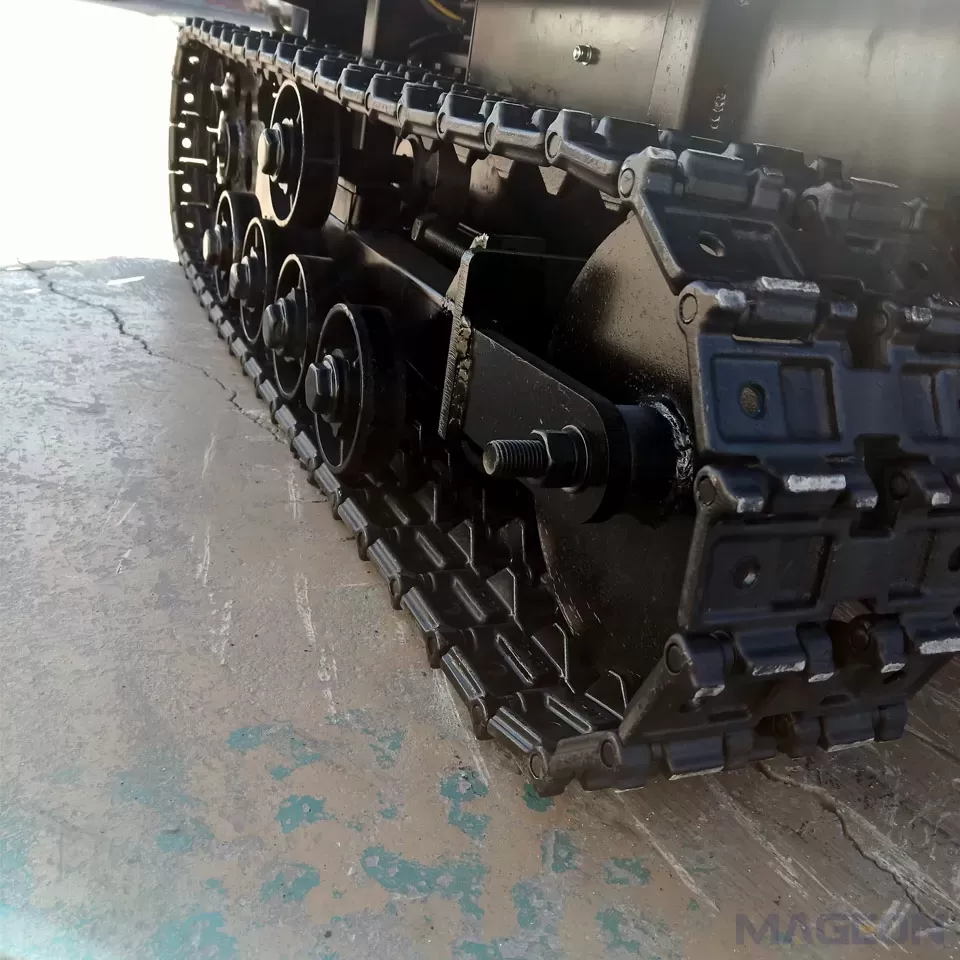
1.1 Rubber Track Undercarriage
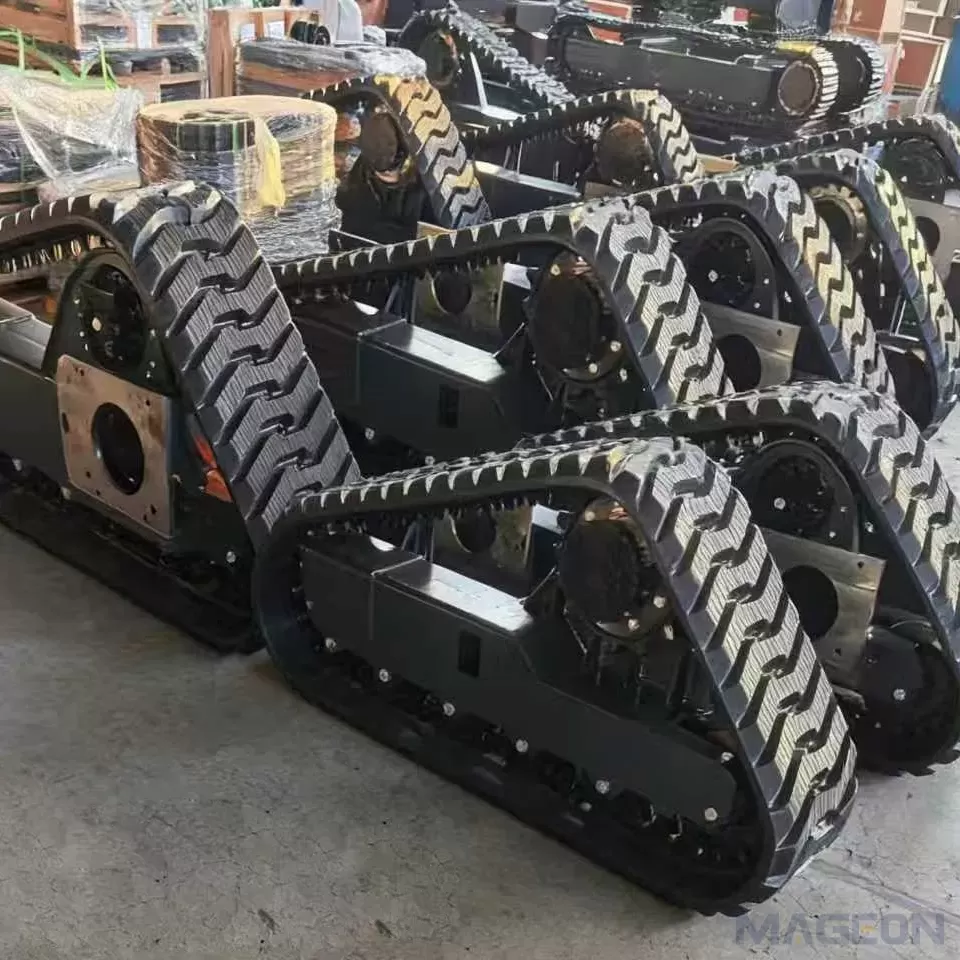
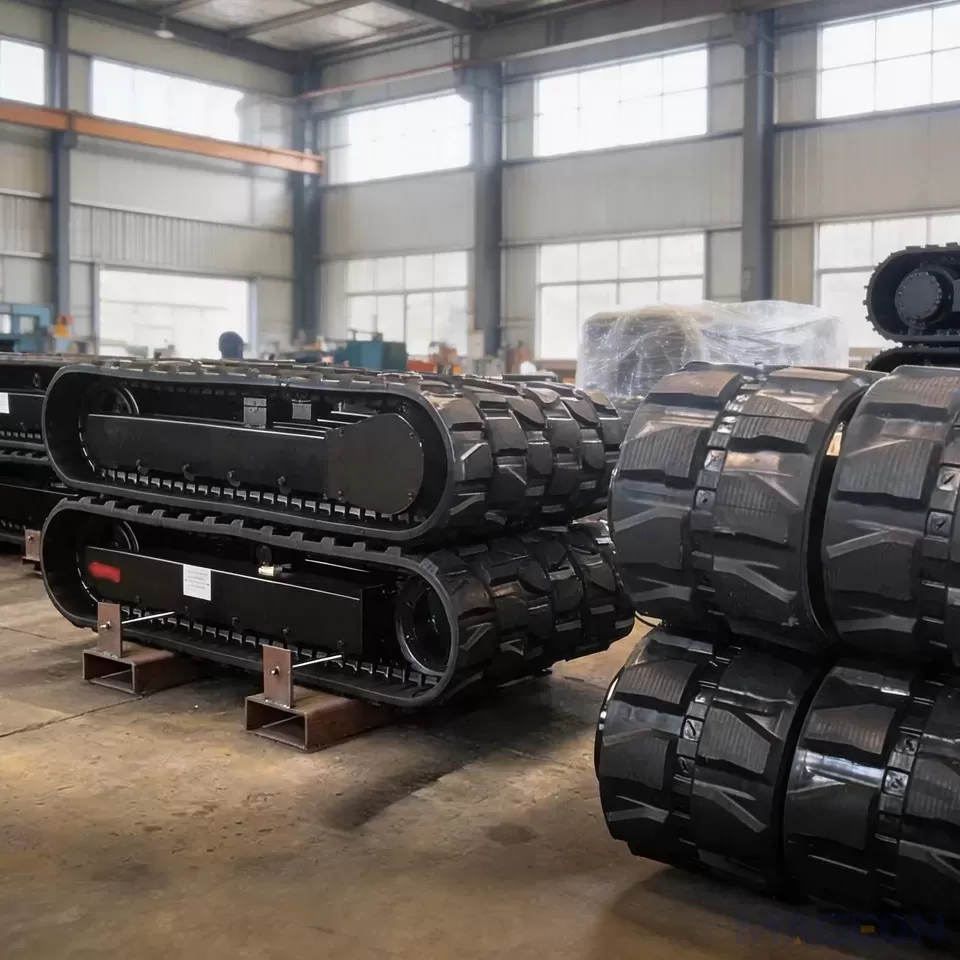
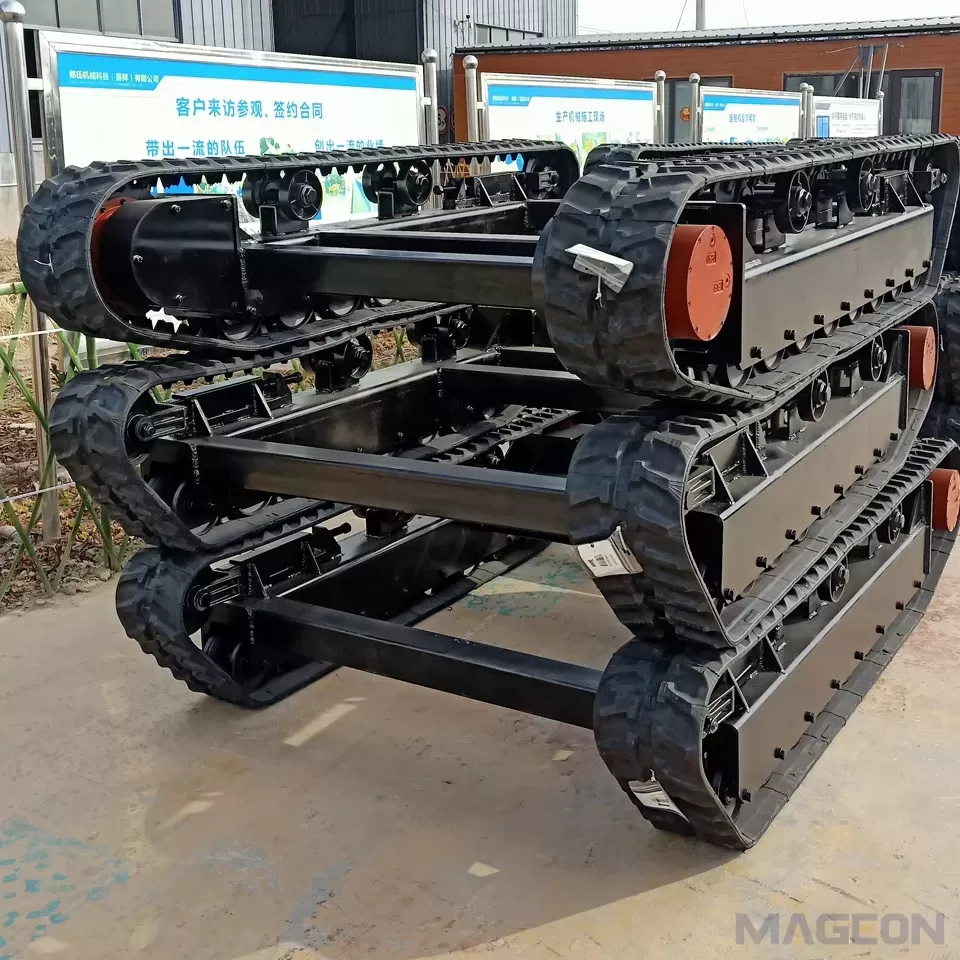
Rubber track undercarriages use rubber as the primary material with embedded steel cord or fabric reinforcement, making them the ideal choice for light equipment and urban construction.
Core Characteristics:
· Low noise, low vibration — the natural damping properties of rubber provide quiet and smooth operation
· Surface-friendly — causes virtually no damage to paved surfaces such as asphalt, concrete, and tiles
· Good flexibility — better adapts to uneven ground, improving vehicle mobility
· Load Range:0.5 – 12 tons
Applicable Scenarios: Urban road construction, indoor venue construction, agricultural machinery, small drilling equipment, aerial work platforms
1.2 Steel Crawler Undercarriage
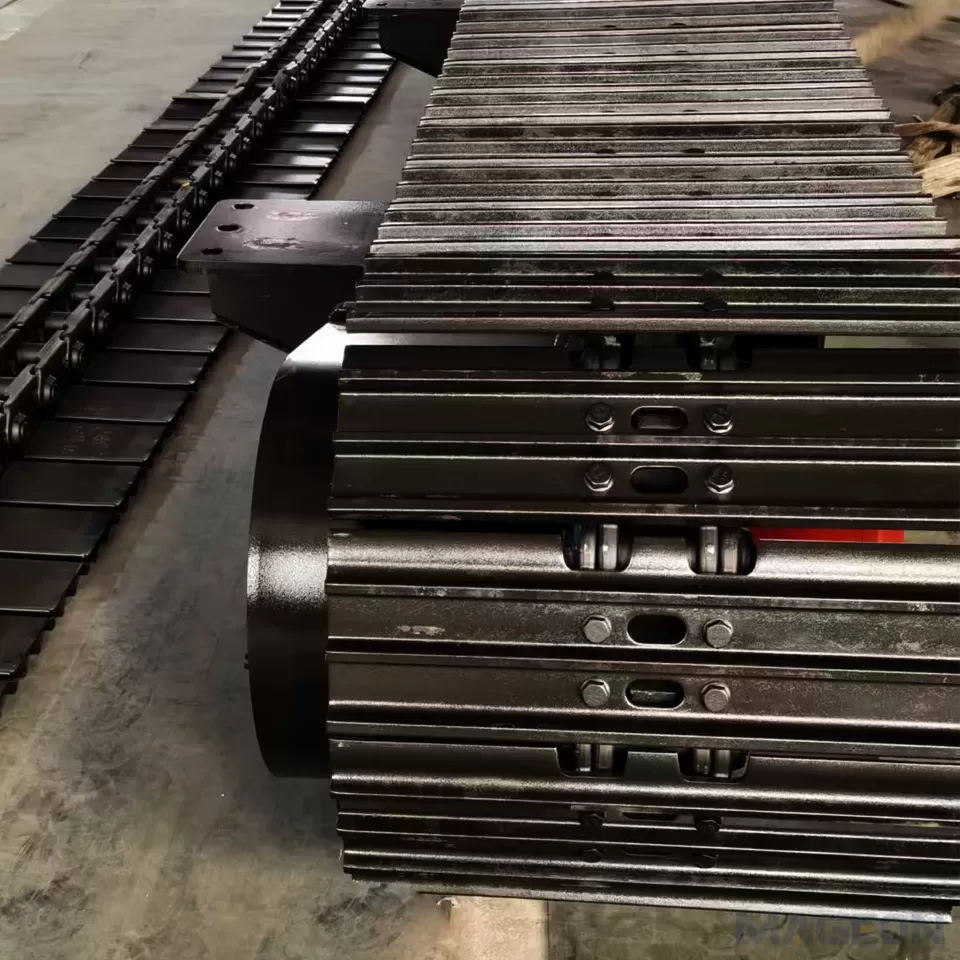
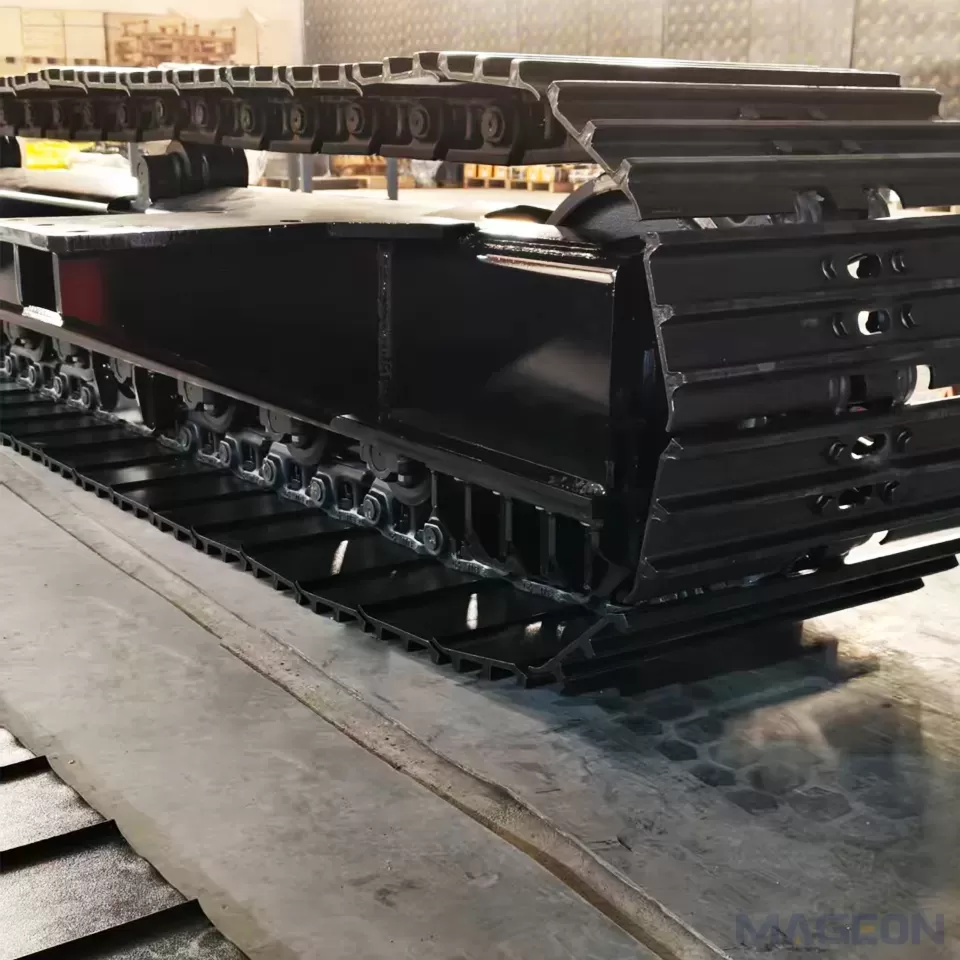
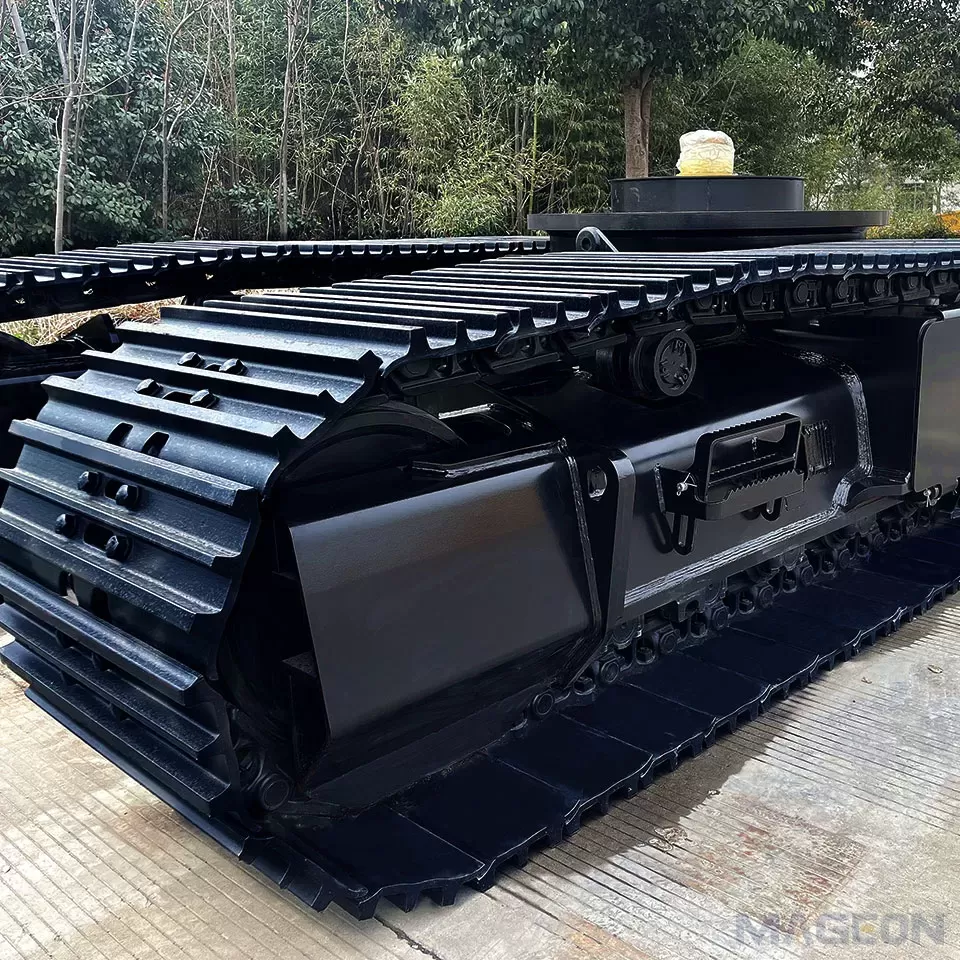
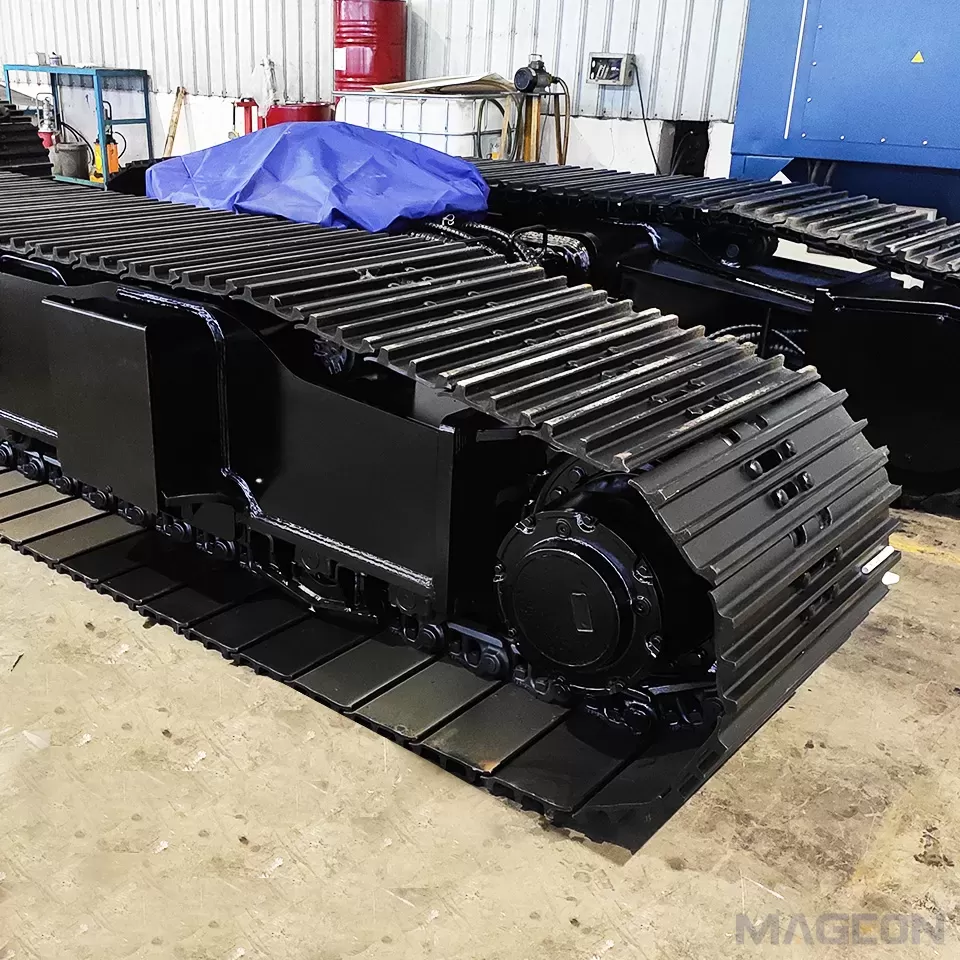
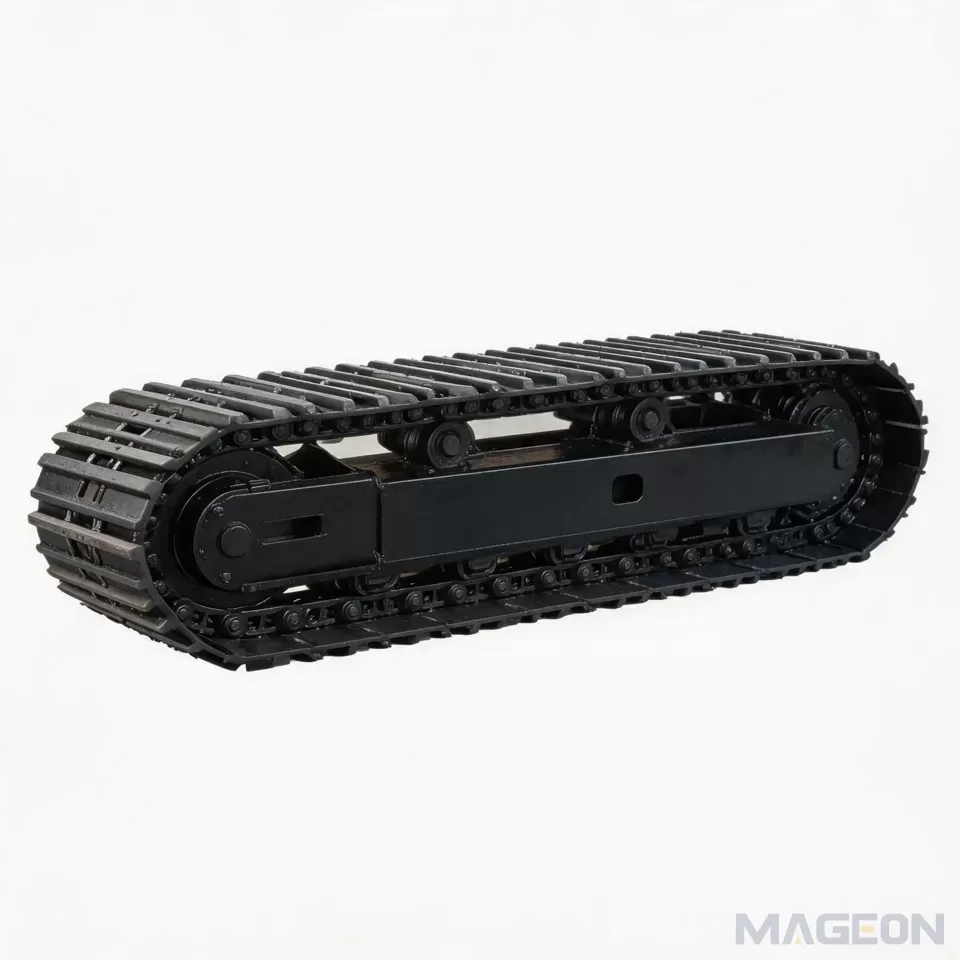
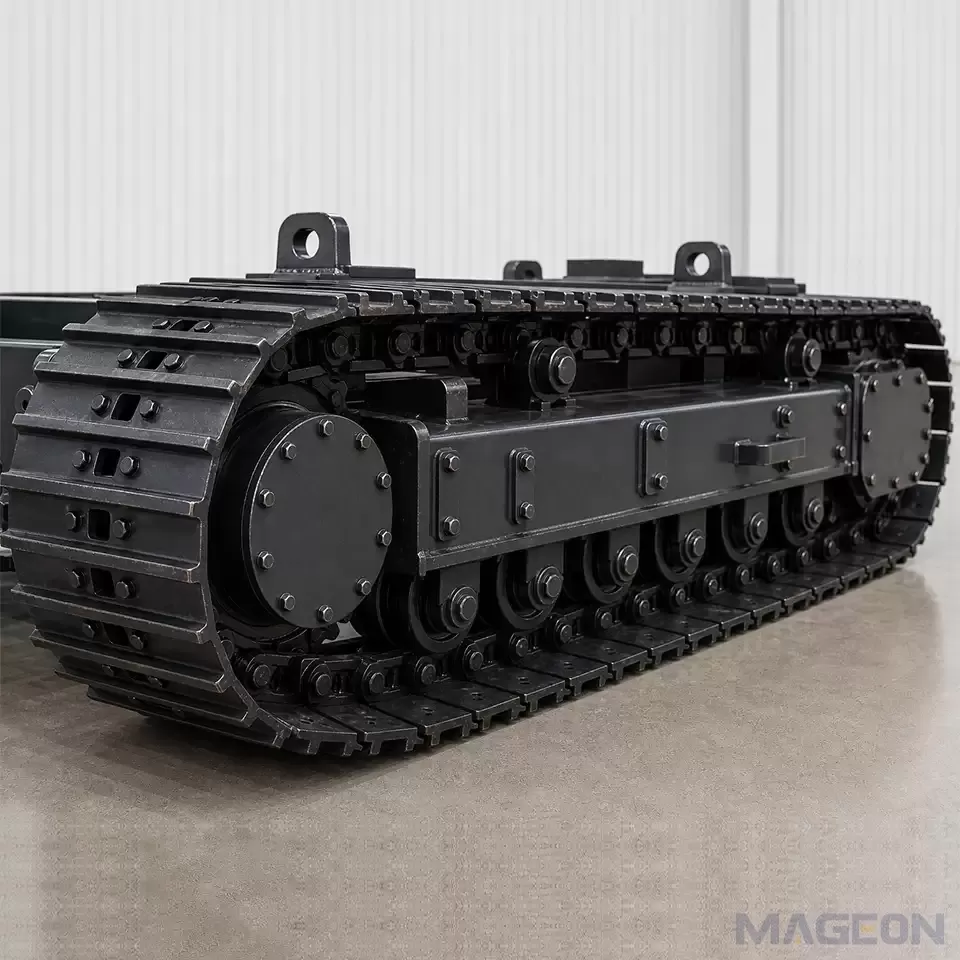
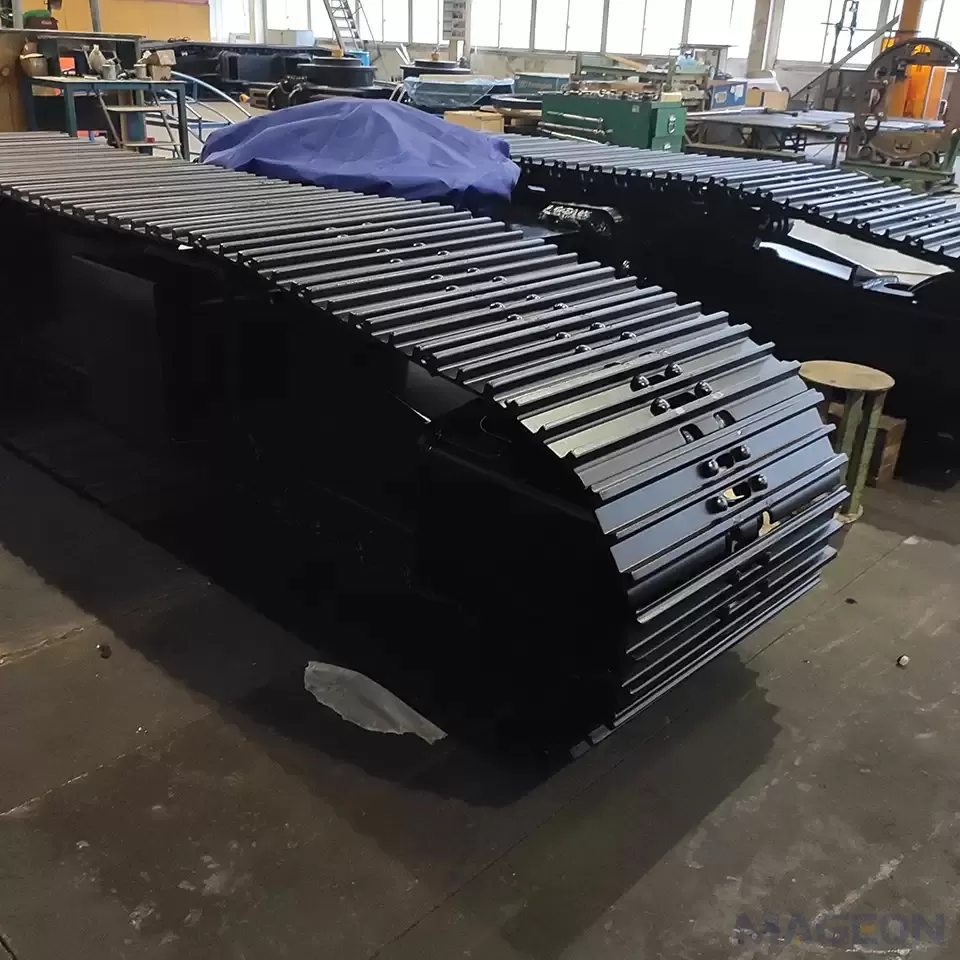
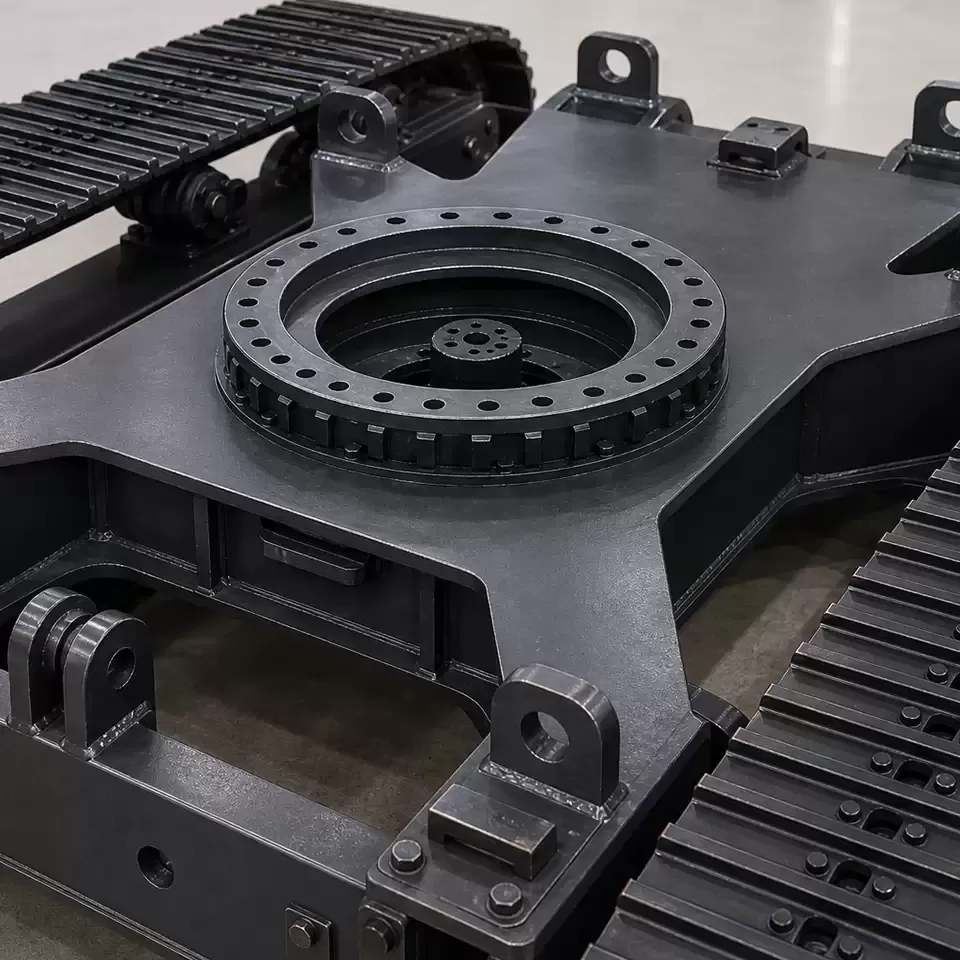
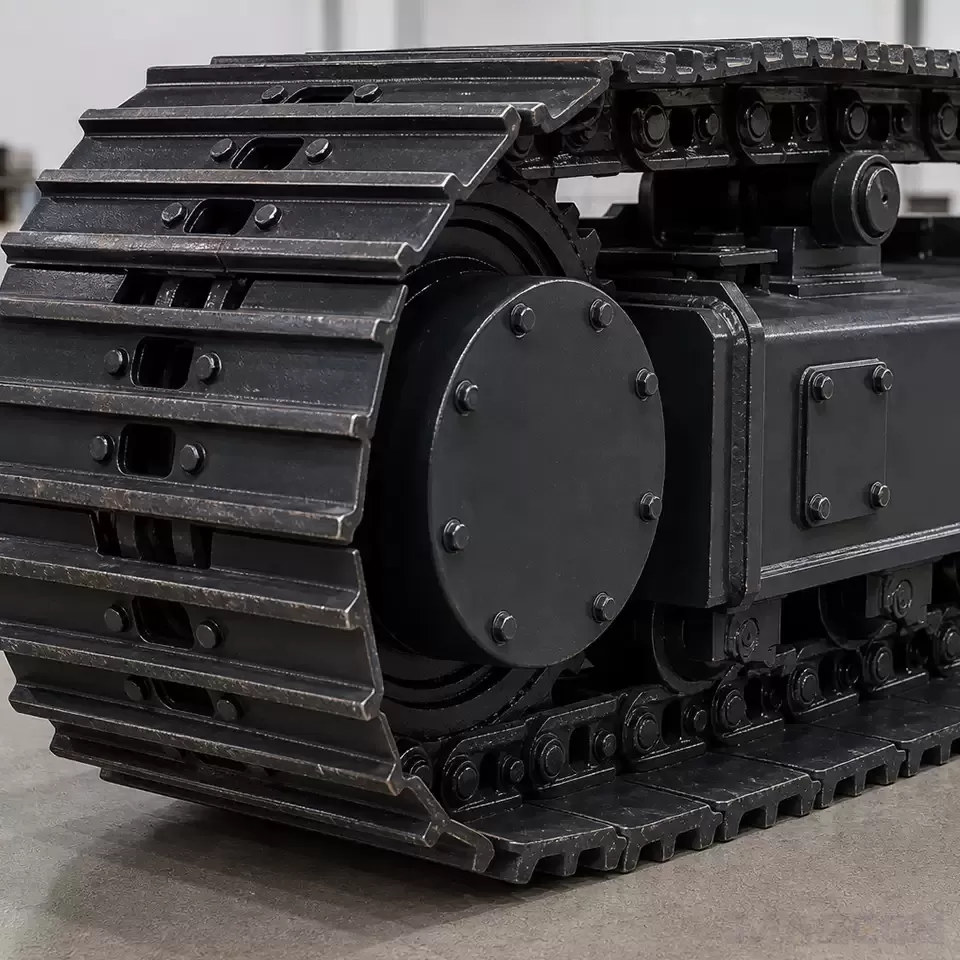
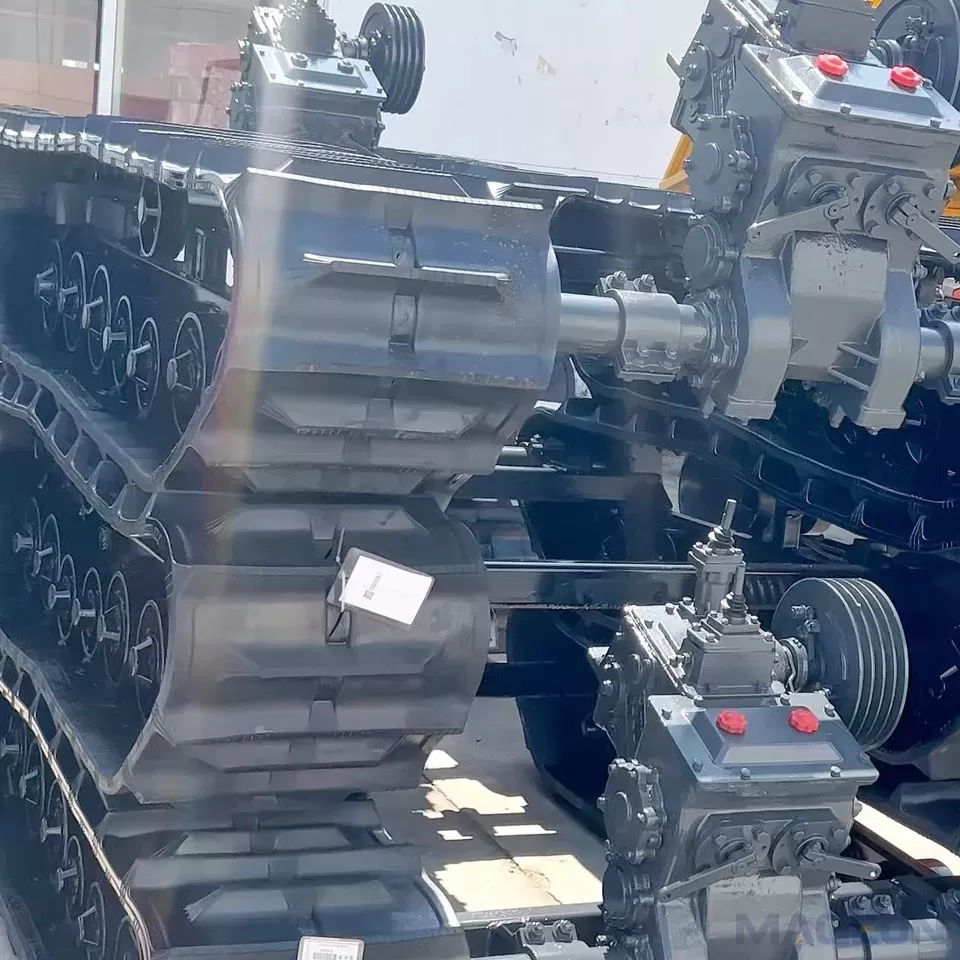
Steel crawler undercarriages use high-strength alloy steel chains and track shoes, making them the absolute主力 for heavy-load and harsh operating conditions.
Core Characteristics:
· High strength, excellent wear resistance — can withstand enormous weight and impact forces
· Good stability, high reliability — maintains structural integrity during heavy-load operations
· Higher noise, greater surface damage — requires rubber pads when operating on paved surfaces
· Load Range:2 – 120 tons
Applicable Scenarios: Mining, large-scale earthworks, tunnel construction, rotary drilling rigs, bulldozers, mucking loaders
1.3 Hybrid Track Undercarriage
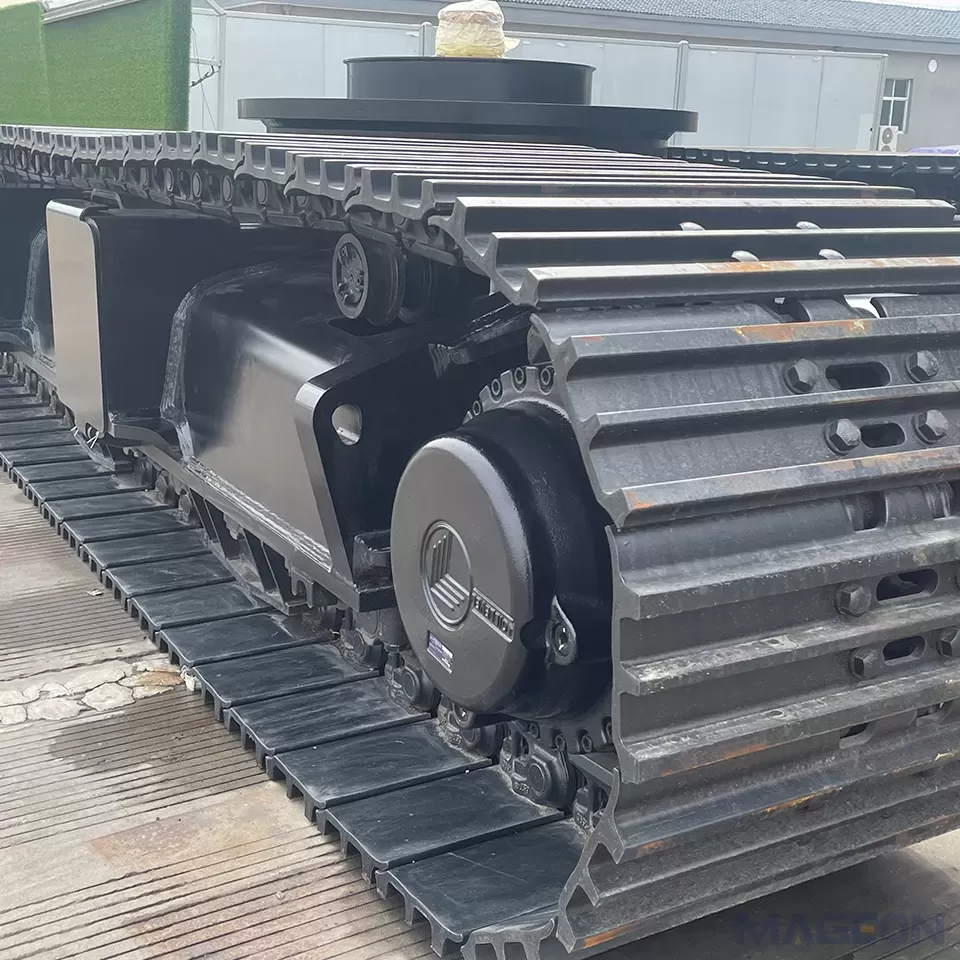
Hybrid track undercarriages are a relatively new development that combines the advantages of both rubber and steel tracks, providing good strength and wear resistance while reducing noise and surface damage.
Core Characteristics:
· Balances strength and surface-friendliness — integrates rubber contact surfaces or pads onto steel track structures
· Better noise control than pure steel undercarriages
· Better surface protection than pure steel undercarriages
· Load capacity the other two types
Applicable Scenarios: Emergency rescue vehicles, forest firefighting vehicles, special operations vehicles, urban emergency response
2. Comprehensive Technical Comparison of the Three Track Undercarriage Types
| Comparison Dimension | Rubber Track Undercarriage | Steel Crawler Undercarriage | Hybrid Track Undercarriage |
|---|---|---|---|
| Load Range | 0.5 – 12 tons | 2 – 120 tons | 5 – 50 tons (design-dependent) |
| Surface Protection | ★★★★★ (Excellent) | ★★☆☆☆ (Poor, requires rubber pads) | ★★★★☆ (Good) |
| Noise Level | ★★★★★ (Very low) | ★★☆☆☆ (Higher) | ★★★★☆ (Lower) |
| Wear Resistance | ★★★☆☆ (Fair) | ★★★★★ (Excellent) | ★★★★☆ (Good) |
| Flexibility/Terrain Adaptability | ★★★★★ (Excellent) | ★★★☆☆ (Fair) | ★★★★☆ (Good) |
| Service Life (Heavy Load) | 800 – 2,000 hours | 3,000 – 8,000 hours | 2,000 – 4,000 hours |
| Maintenance Cost | Moderate | Lower (lifecycle) | Moderate |
| Typical Equipment | Mini excavators, agricultural machinery, small drills | Large excavators, rotary drilling rigs, bulldozers, mucking loaders | Emergency rescue vehicles, forest firefighting vehicles, special-purpose vehicles |
| Recommended Scenarios | Urban construction, indoor operations, farmland, ecologically sensitive areas | Mines, quarries, tunnels, large-scale earthworks | Emergency rescue, forest firefighting, urban emergency response |
3. In-Depth Analysis of Key Selection Factors:Pitch, Width, and Drive Type
When selecting a track undercarriage, beyond deciding between rubber, steel, or hybrid types, there are three key technical parameters that require careful consideration:
3.1 Track Pitch
Track pitch is the distance between the centres of adjacent pin joints and is a key parameter affecting vehicle travel performance and load capacity.
| Pitch Type | Characteristics | Applicable Scenarios |
|---|---|---|
| Small Pitch | Better traction, higher travel stability, more agile turning | Low-speed operations, complex terrain, precision control scenarios |
| Large Pitch | Better suited for high-speed travel, higher load capacity | Long-distance relocation, heavy transport |
MAGEON Selection Recommendation: Pitch selection requires balancing “traction” and “travel speed.” For equipment operating on steep slopes, mud, and other complex terrains, prioritise small pitch;for equipment requiring frequent long-distance relocation, consider large pitch designs.
3.2 Track Width
Track width directly affects ground contact area and ground pressure.
| Width Type | Characteristics | Applicable Scenarios |
|---|---|---|
| Wide Track | Large ground contact area, distributes equipment weight, reduces ground pressure | Soft soil, farmland, swamps, snow, and other soft ground |
| Narrow Track | Agile turning, good mobility in confined spaces | Narrow tunnels, orchard rows, confined urban job sites |
MAGEON Selection Recommendation: Wide tracks can significantly reduce ground pressure — for the same tonnage, wide tracks can achieve 30%-50% lower ground pressure than narrow tracks, providing a decisive advantage in soft soil conditions.
3.3 Drive Type:Hydraulic vs. Mechanical
Track undercarriages primarily use two drive methods — hydraulic and mechanical — each with its own advantages:
| Comparison Dimension | Hydraulic Drive | Mechanical Drive |
|---|---|---|
| Power Output Smoothness | Excellent — smooth output, no shock | Fair — shift shock exists |
| Speed Control Range | Wide — infinitely variable speed | Narrow — limited gears |
| Structural Complexity | Higher — requires pumps, motors, valves | Simple — gear transmission |
| Reliability | Higher — but hydraulic system requires good oil quality | Very high — simple structure, low failure rate |
| Cost | Higher | Lower |
| Applicable Scenarios | Applications requiring high precision (drilling rigs, aerial work platforms) | Applications with stable conditions and cost sensitivity |
MAGEON Selection Recommendation: Hydraulic drive is suitable for equipment requiring fine control and frequent speed changes (e.g., drilling rigs, aerial work platforms);mechanical drive is suitable for applications with relatively stable conditions and cost sensitivity (e.g., some agricultural machinery, small transport vehicles). MAGEON can match the most suitable drive solution based on customer requirements when customising undercarriages.
4. Typical Application Scenarios for the Three Track Undercarriage Types
4.1 Rubber Track Undercarriage — The “Green Messenger” for Urban and Agricultural Applications
Rubber track undercarriages, with their low noise, low vibration, and surface-friendly characteristics, are the preferred choice for urban construction and agricultural applications.
Typical Equipment:
· Mini excavators for urban road construction
· Material handling equipment for indoor venue construction
· Tracked tractors and harvesters for paddy fields and orchards
· Urban landscaping equipment
Core Value: Completing operations without damaging paved surfaces while reducing noise disturbance to surrounding residents.
4.2 Steel Crawler Undercarriage — The “Steel Boot” for Mining and Heavy Loads
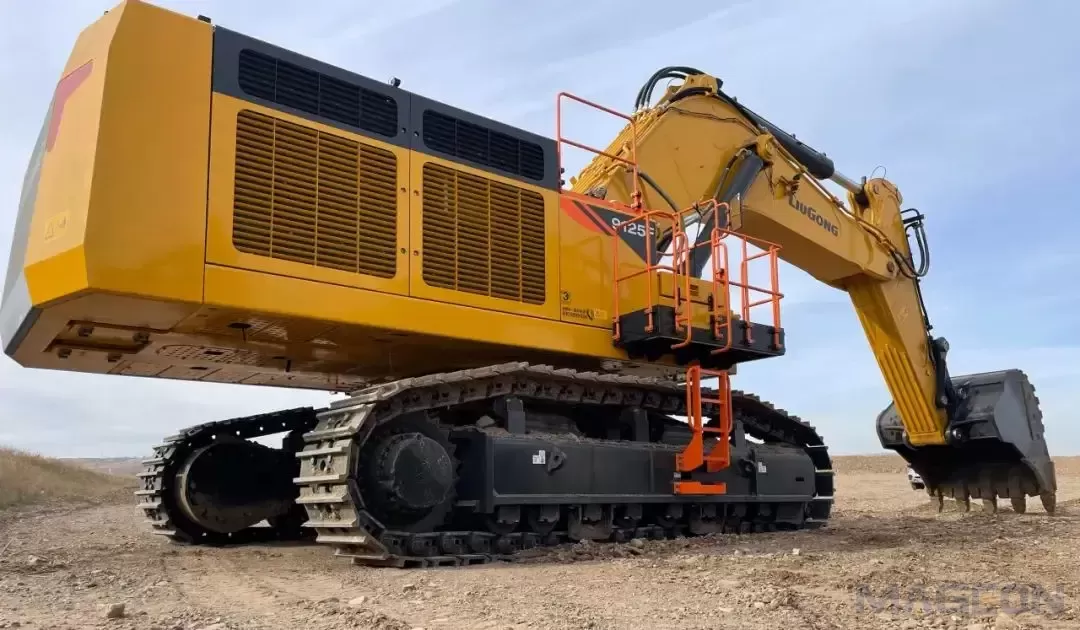
Steel crawler undercarriages, with their ultra-high strength and extreme wear resistance, dominate mining, tunnelling, and large-scale earthworks.
Typical Equipment:
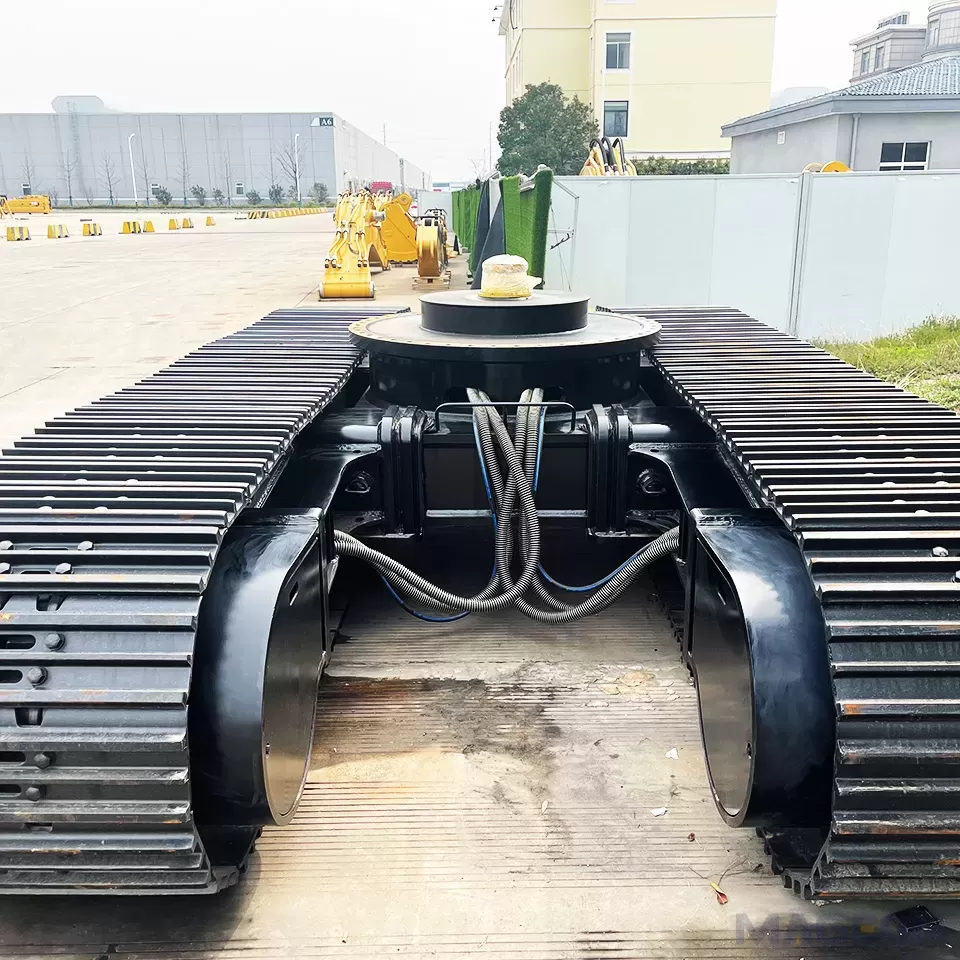
· Rotary Drilling Rig Chassis — the enormous reactive torque and vertical loads during deep-hole drilling can only be handled by heavy-duty steel undercarriages
· Mining excavators, bulldozers
· Tunnel roadheaders, mucking loaders
· Large crushing and screening equipment
Core Value: Maintaining structural integrity and operational reliability under extreme abrasion and heavy-load impact.
4.3 Hybrid Track Undercarriage — The “All-Rounder” for Emergency Rescue
Hybrid track undercarriages balance the strength of steel with the surface-friendliness of rubber, demonstrating unique value in emergency rescue and special operations.
Typical Equipment:
· Emergency rescue vehicles — need to switch quickly between urban roads and disaster ruins
· Forest firefighting vehicles — need to travel on forest trails and firebreaks
· Special operations vehicles — need to balance off-road mobility and on-road travel capability
Core Value: “One vehicle, multiple uses” — seamless switching between multiple terrains and operating conditions without changing the undercarriage.
5. Core Components and Maintenance Points of Track Undercarriages
Regardless of which type of track undercarriage is chosen, the core components — Undercarriage Parts — share a high degree of commonality. Understanding the function and maintenance requirements of these components is key to extending undercarriage service life.
| Component | Function | Maintenance Points |
|---|---|---|
| Track | Direct ground contact, provides traction | Rubber:check ageing, cracks, external damage;Steel:check link wear, pin stretch |
| Drive Sprocket | Engages with track chain, transmits travel power | Check tooth wear — replace when “hooking” wear appears |
| Track Roller | Bears equipment weight, withstands high impact | Check floating seals for leaks, clean accumulated mud |
| Idler | Guides track direction, works with tensioning system | Check seals and lubrication condition |
| Carrier Roller | Supports upper track run, prevents sagging | Check rotation smoothness |
| Tensioning System | Adjusts track tightness, prevents derailment | Regularly check tension — too tight accelerates wear, too loose causes derailment |
MAGEON Golden Rules of Maintenance:
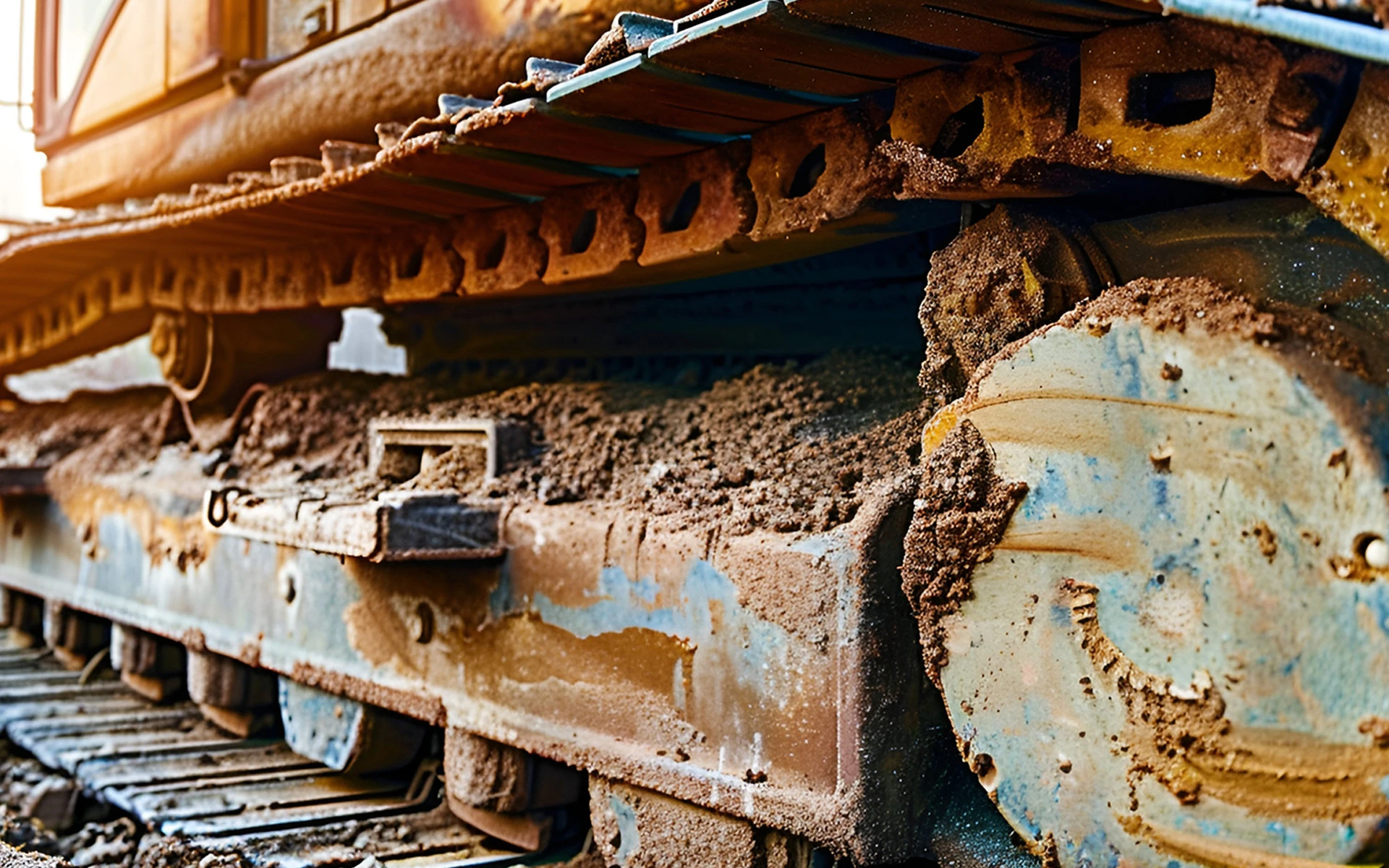
1、Daily cleaning — remove mud and debris from tracks and rollers after each shift
2、Regular tension checks — measure track sag weekly, adjust to recommended values
3、Listen for unusual noises — unusual sounds during travel often indicate impending component failure
4、Timely replacement of worn parts — small issues left unaddressed lead to major failures
6. Frequently Asked Questions (FAQ)
Q1:What are the main differences between rubber track, steel crawler, and hybrid track undercarriages?
A:The core difference lies in track material and application scenarios. The Rubber Track Undercarriage is low-noise and surface-friendly, suitable for urban construction, agriculture, and indoor operations, with a load range of 0.5-12 tons. The Steel Crawler Undercarriage offers high strength and excellent wear resistance, suitable for heavy-load harsh conditions such as mining and tunnelling, with a load range of 2-120 tons. The Hybrid Track Undercarriage combines the advantages of both, providing good strength while reducing noise and surface damage — ideal for special-purpose vehicles such as emergency rescue and forest firefighting that need to switch between multiple terrain types.
Q2:What are the advantages of a hybrid track undercarriage? What scenarios is it suitable for?
A:The core advantage of the hybrid track undercarriage is that it balances the strength of steel undercarriages with the surface-friendliness of rubber undercarriages. It can travel on urban roads without causing severe surface damage, while maintaining sufficient strength and reliability on complex terrain such as ruins and forest trails. Typical applications include:emergency rescue vehicles (switching between urban roads and disaster ruins), forest firefighting vehicles (travelling on forest trails and firebreaks), and special operations vehicles.
Q3:How does track pitch affect equipment performance?
A:Track pitch is the distance between centres of adjacent pin joints. Small pitch tracks provide better traction, higher travel stability, and more agile turning — suitable for low-speed operations, complex terrain, and precision control scenarios. Large pitch tracks are better suited for high-speed travel and offer higher load capacity — suitable for long-distance relocation and heavy transport. Selection requires balancing “traction” and “travel speed.”
Q4:How do I choose track width?
A:Wide tracks have larger ground contact area, distributing equipment weight and reducing ground pressure — suitable for soft soil, farmland, swamps, snow, and other soft ground. For the same tonnage, wide tracks can achieve 30%-50% lower ground pressure than narrow tracks. Narrow tracks offer agile turning and good mobility in confined spaces — suitable for narrow tunnels, orchard rows, and confined urban job sites.
Q5:What are the advantages and disadvantages of hydraulic drive vs. mechanical drive?
A:Hydraulic drive offers smooth power output and wide speed control range (infinitely variable speed) — suitable for applications requiring high precision (drilling rigs, aerial work platforms), but has higher complexity and cost. Mechanical drive features simple structure, high reliability, and lower cost — suitable for applications with relatively stable conditions and cost sensitivity (some agricultural machinery, small transport vehicles).
Q6:How can steel crawler undercarriages operate on paved surfaces without causing damage?
A:Steel crawler undercarriages themselves cause significant damage to asphalt and concrete surfaces. To protect paved surfaces, MAGEON offers rubber track shoes (rubber pads) as an option. Adding rubber pads to steel track shoes retains the load capacity of steel undercarriages while significantly reducing surface damage — ideal for equipment that frequently moves between urban roads and job sites.
Q7:Can MAGEON customise undercarriages for rotary drilling rigs?
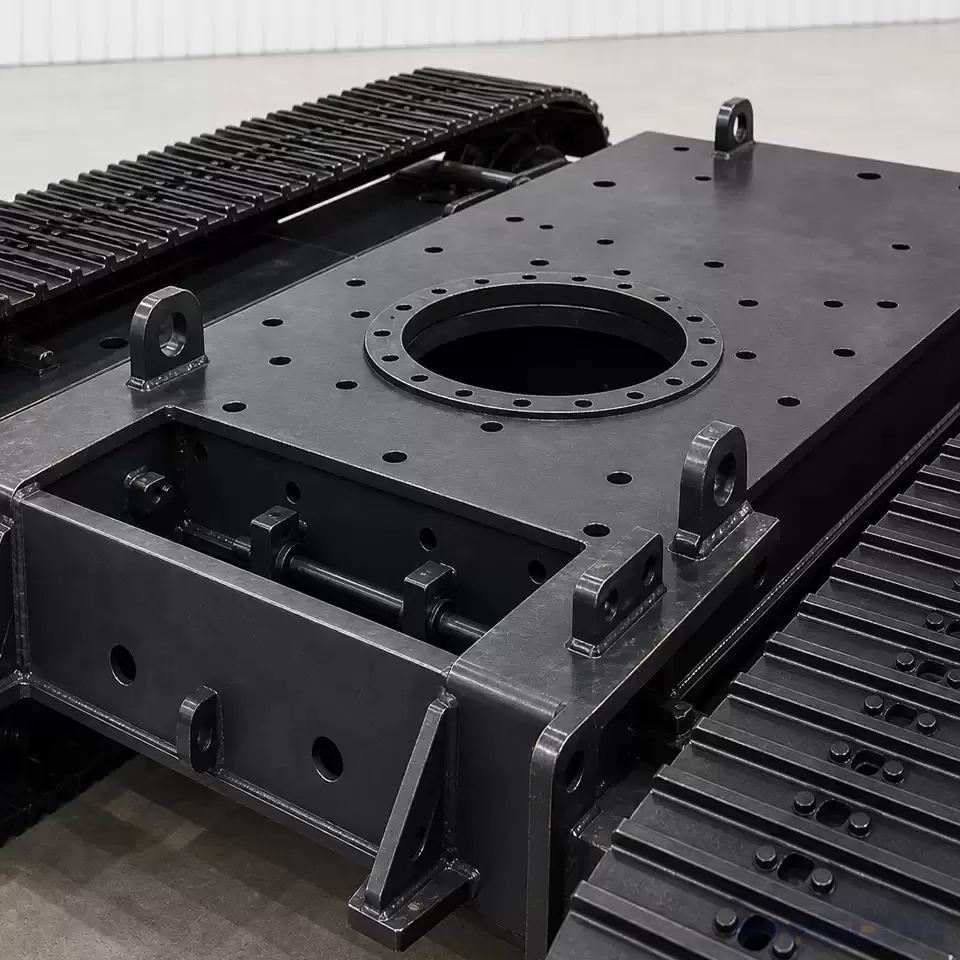
A:Yes. The Rotary Drilling Rig Chassis is one of MAGEON‘s core products. Rotary drilling rigs must simultaneously enormous vertical loads and horizontal torque reaction forces during deep-hole drilling. MAGEON provides 10-100 ton heavy-duty steel undercarriages specifically designed for rotary drilling rigs, equipped with large-diameter slewing bearings and high-strength track frames to ensure absolute stability during large-diameter, deep-hole drilling.
Q8:What undercarriage parts does MAGEON supply?
A:MAGEON supplies a complete range of Undercarriage Parts, including:tracks (rubber/steel), drive sprockets, track rollers, idlers, carrier rollers, tensioning systems, track frames, and more. All components are manufactured to MAGEON‘s own technical standards and are compatible with mainstream host brands.
Q9:What is the load capacity range for MAGEON custom undercarriages?
A:MAGEON‘s Custom Tracked Chassis covers the full load range of 0.5 to 120 tons. The minimum can adapt to mini agricultural equipment and firefighting robots (0.5-ton class), and the maximum can adapt to ultra-large rotary drilling rigs and crawler cranes (120-ton class). Whether rubber, steel, or hybrid, MAGEON can precisely customise based on customer requirements.
Q10:What is the MAGEON custom undercarriage service process?
A:MAGEON provides a full-process customisation service:
① Requirements consultation and operating condition assessment
② Solution design and technical validation
③ Detailed engineering design and component matching
④ Manufacturing and quality control
⑤ Delivery and after-sales support. From requirements to delivery, MAGEON ensures every undercarriage precisely matches your equipment specifications and operating scenarios.
7. About MAGEON
MAGEON is dedicated to delivering high-quality Steel Crawler Undercarriage, Rubber Track Undercarriage, and hybrid track undercarriage custom solutions to the global heavy machinery industry. With deep understanding of all three technology paths and customisation capabilities covering the full load range of 0.5 to 120 tons, we tailor travel-drive solutions that excel in the most extreme working conditions.
Our Core Capabilities:
· Load Range:Full-load custom solutions from 0.5 to 120 tons
· Undercarriage Types:Steel crawler undercarriage, rubber track undercarriage, hybrid track undercarriage, telescopic crawler undercarriage
· Core Applications:Urban construction, mining, tunnelling, emergency rescue, forest firefighting, agricultural machinery, drilling equipment, and more
· Parts Supply:Complete range of Undercarriage Parts including drive sprockets, idlers, track rollers, carrier rollers, tracks, tensioning systems, and more
From requirements analysis to delivery and use, MAGEON stands for exceptional quality and dependable service, helping your equipment perform efficiently on the most challenging terrains.
Please leave your customization requirements, and we will contact you as soon as possible!
Leave your requirements, we'll get back to you within 24 hours.