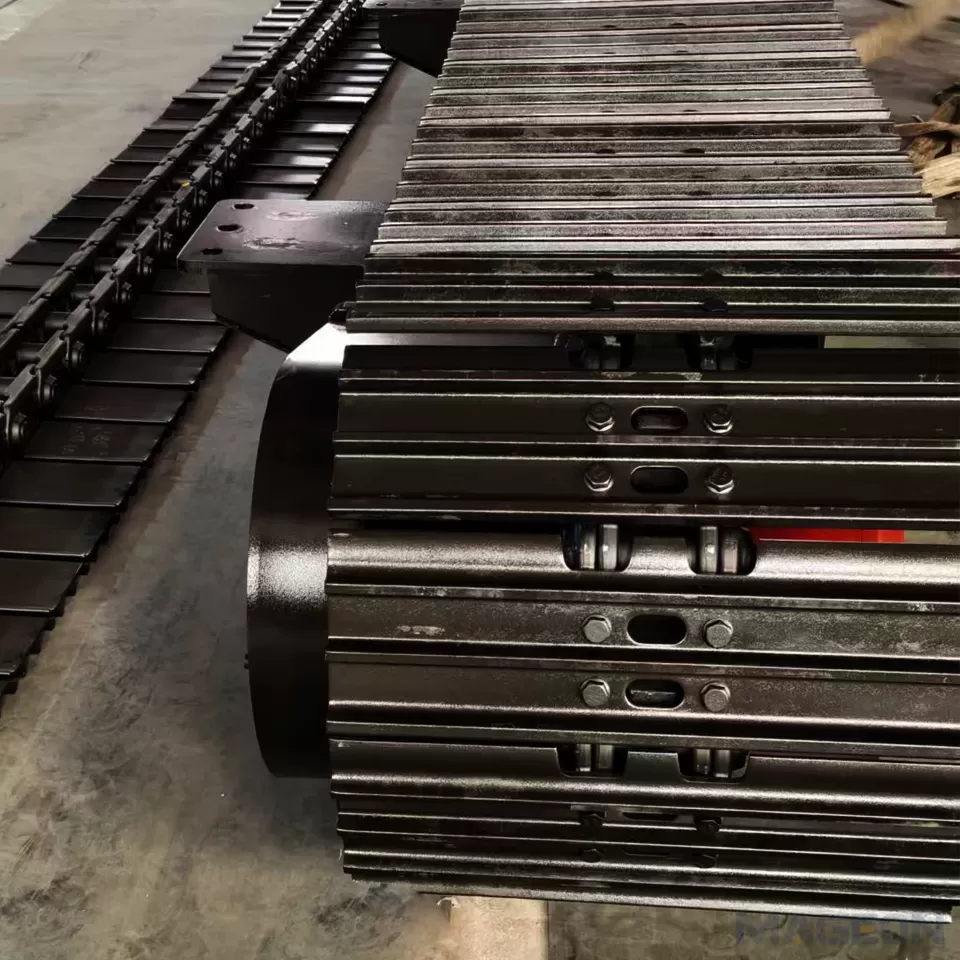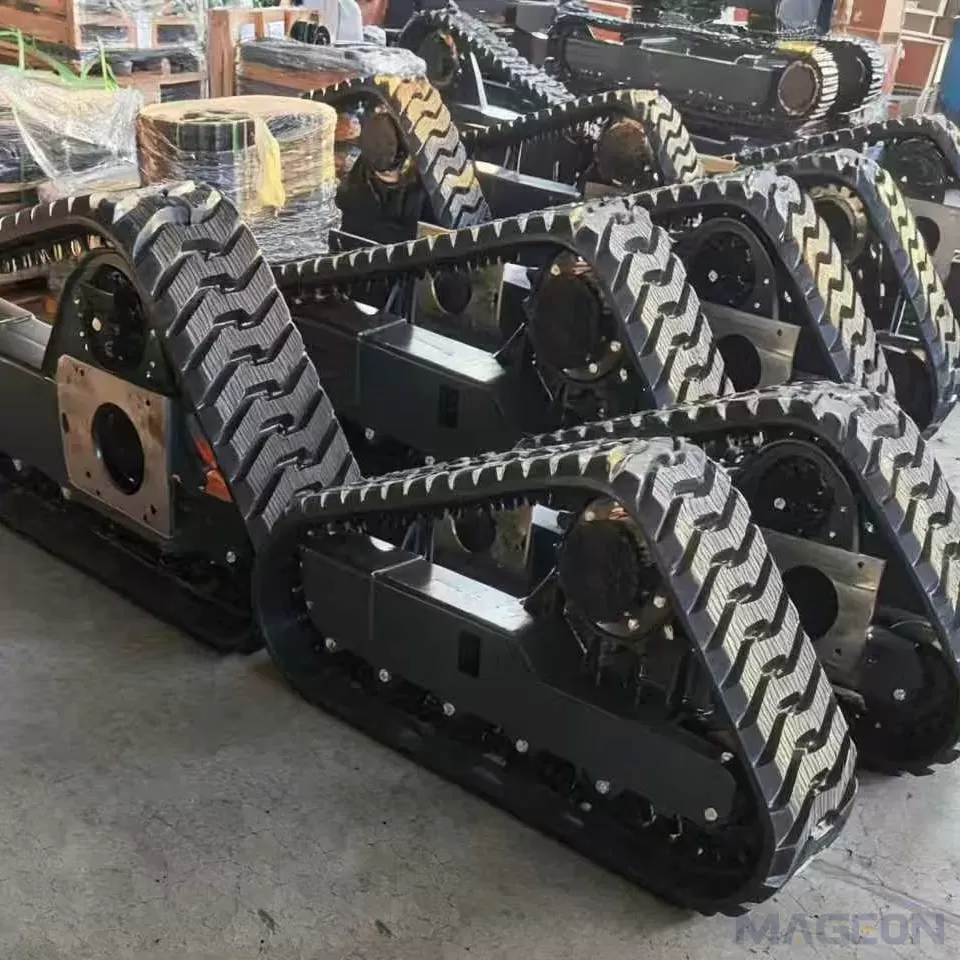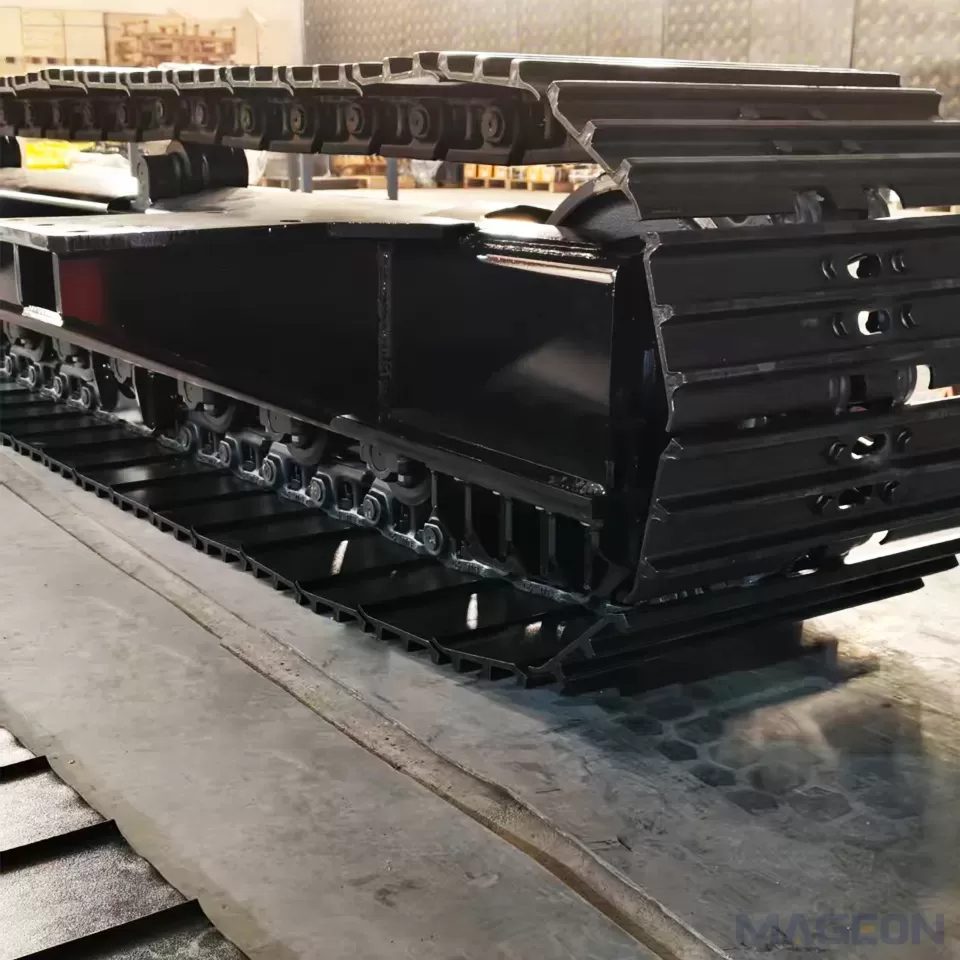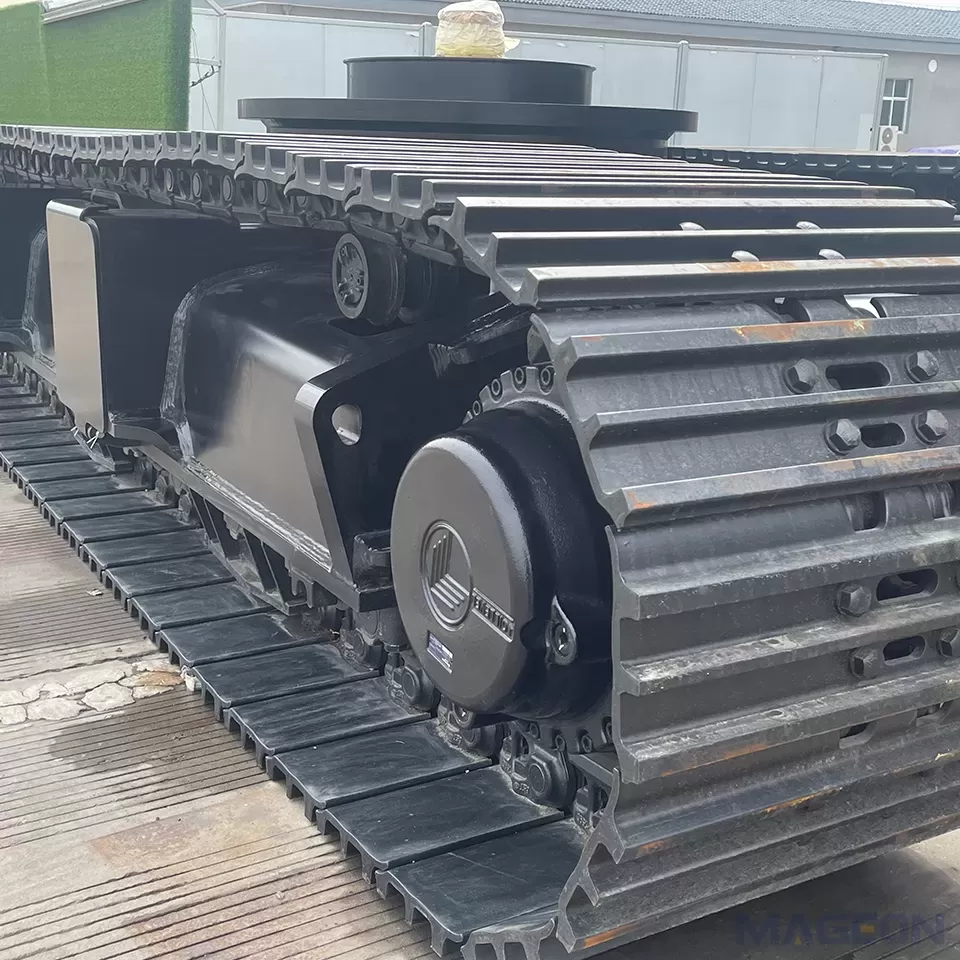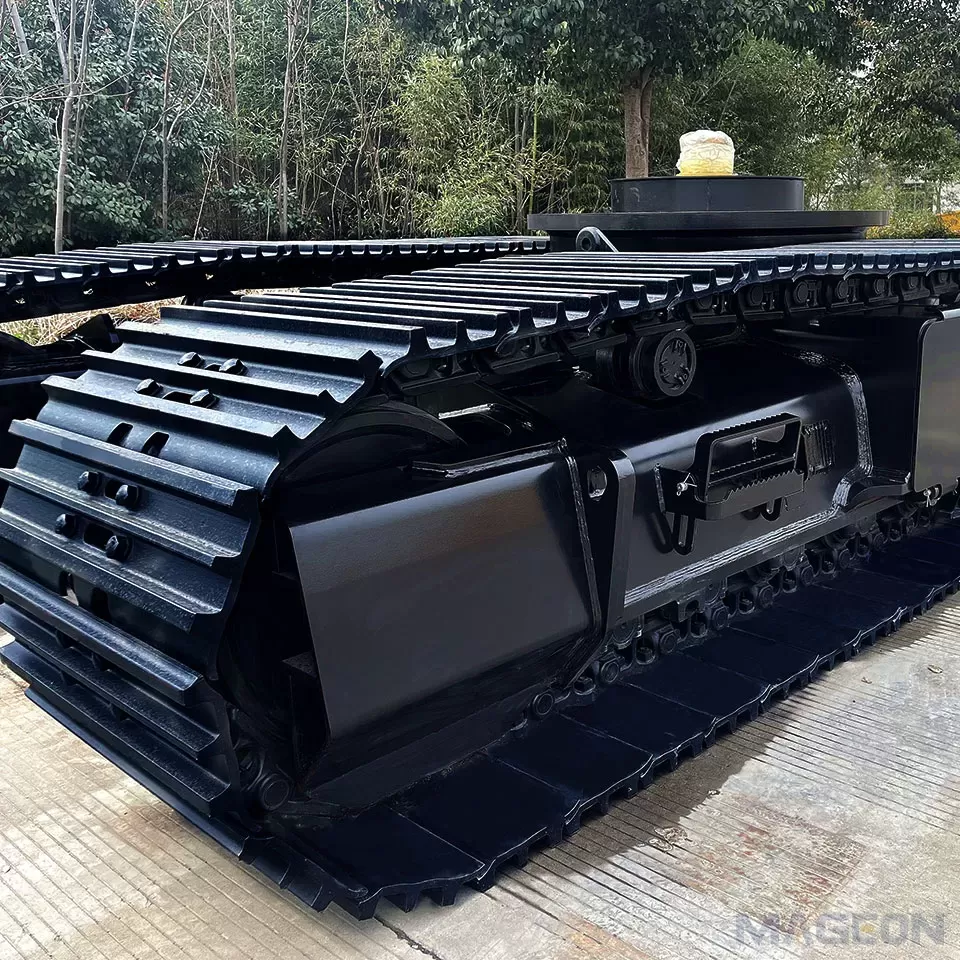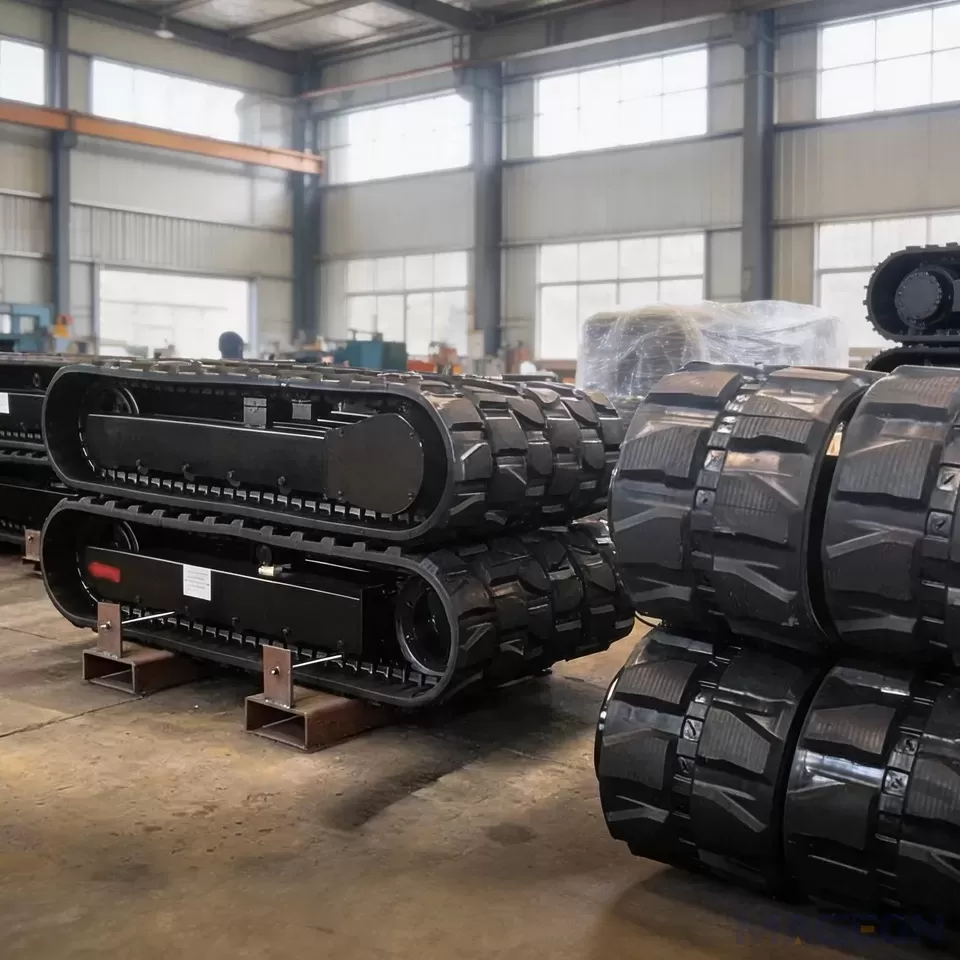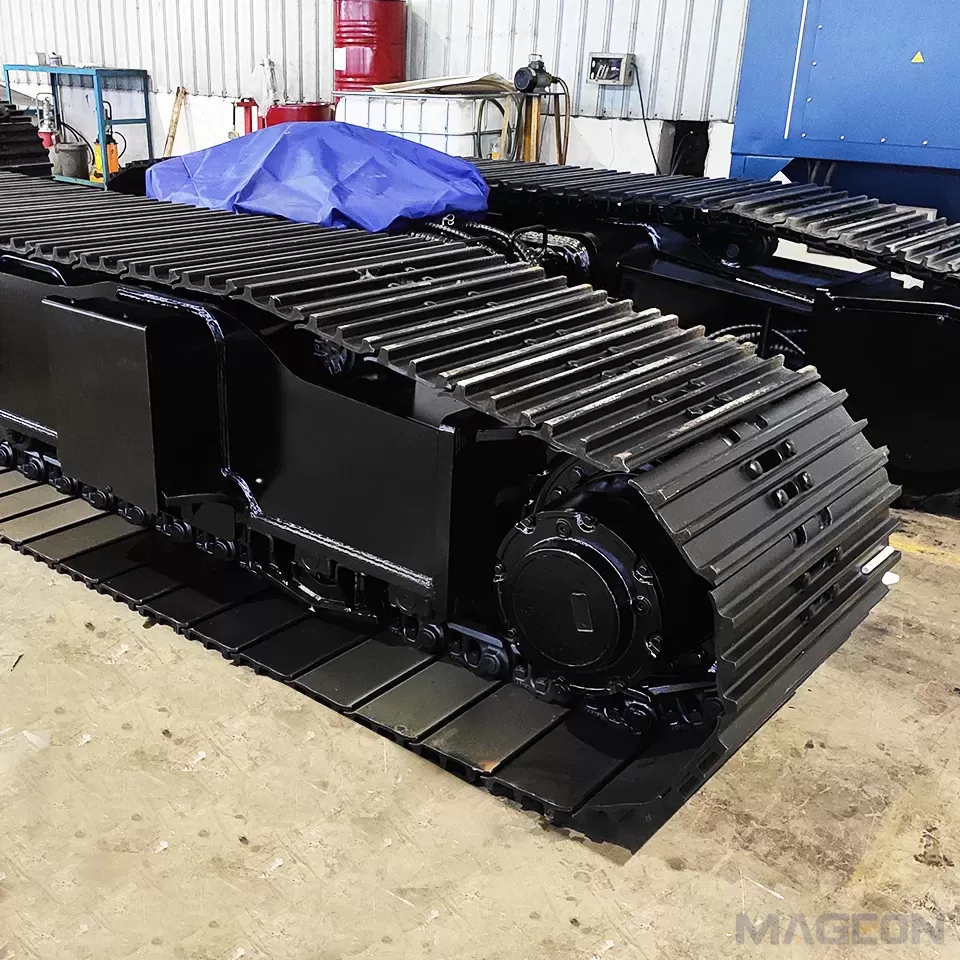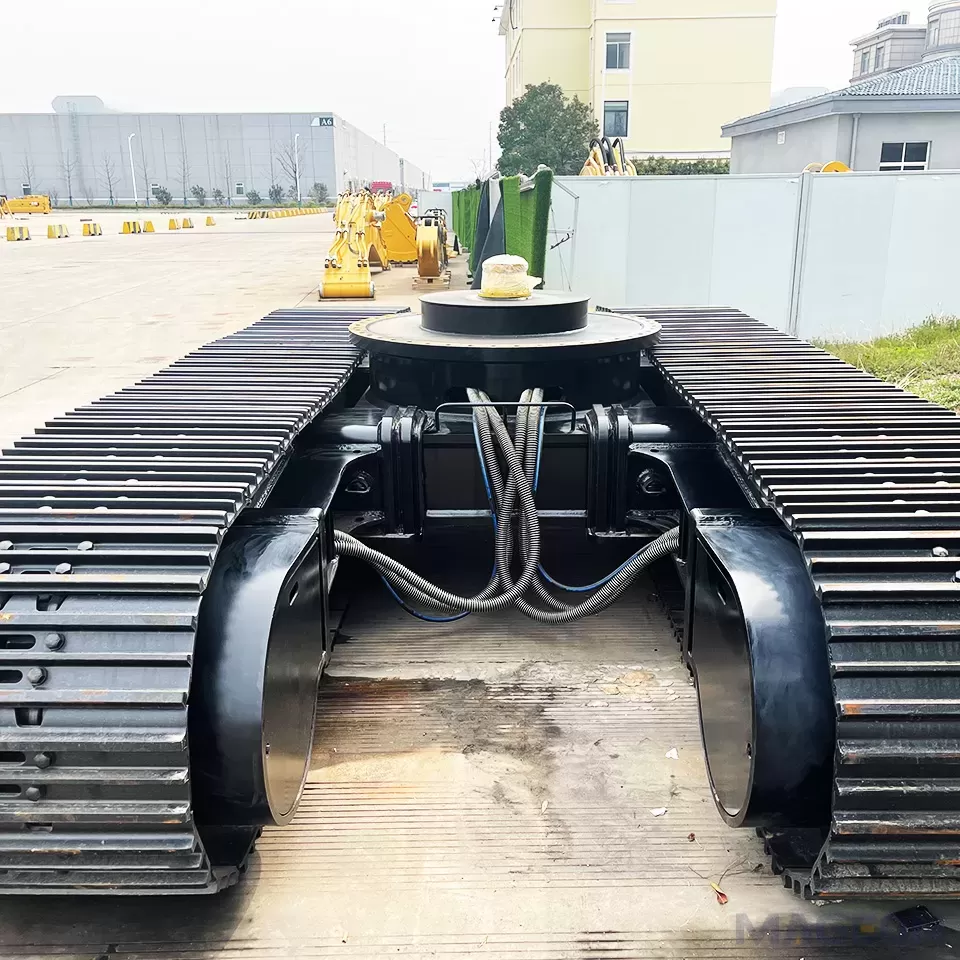
Complete Guide to Undercarriage Impact-Resistant Design: MAGEON Explains Structural Protection and Material Reinforcement for Harsh Operating Conditions
Executive Summary
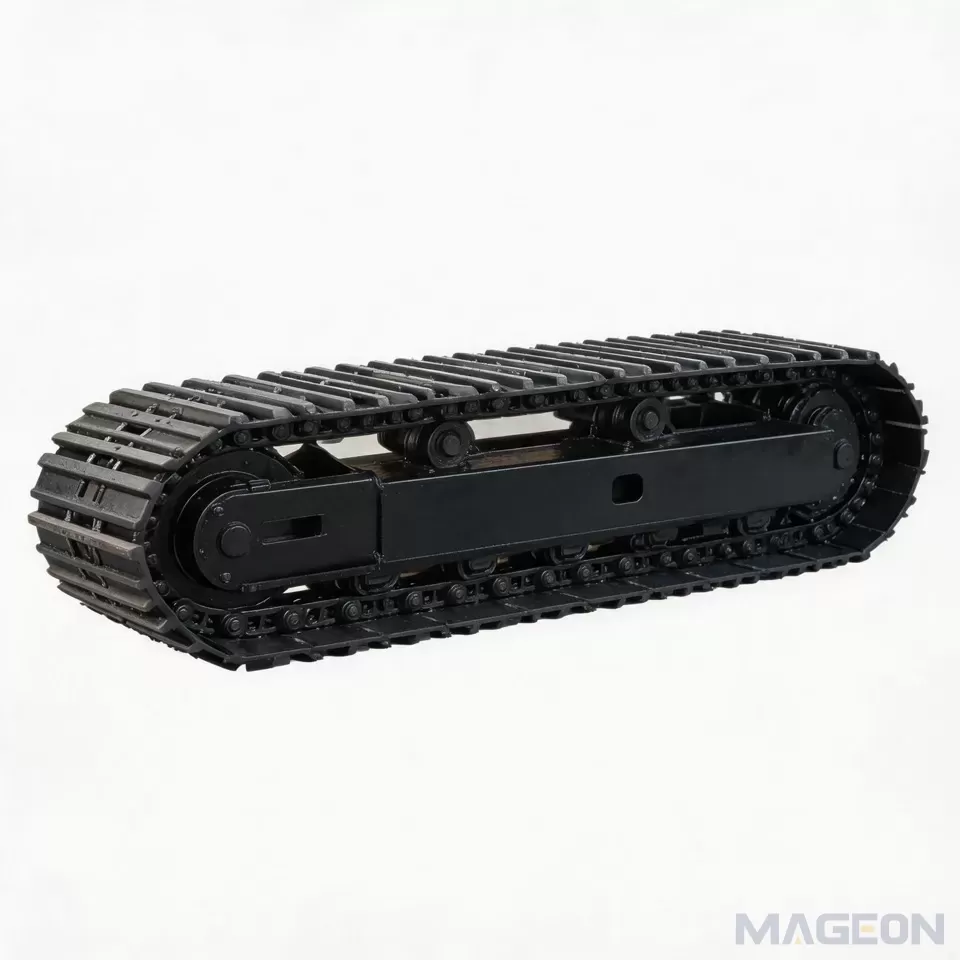
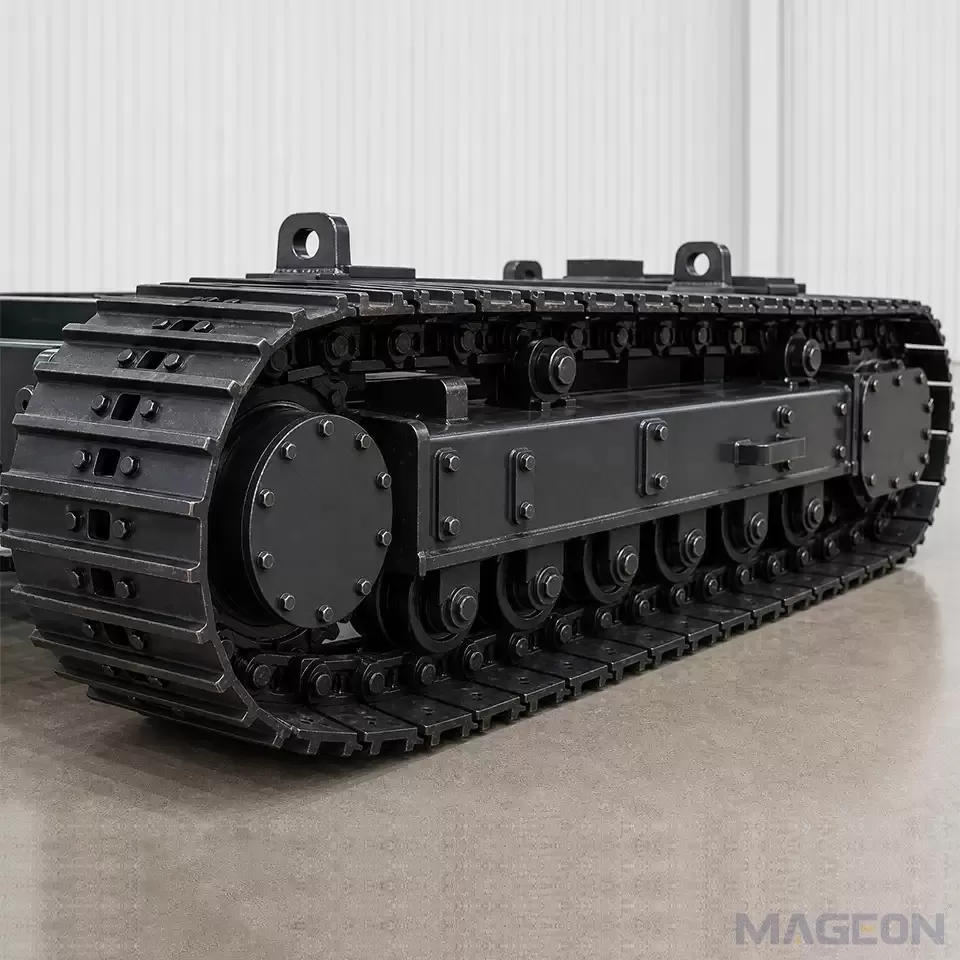
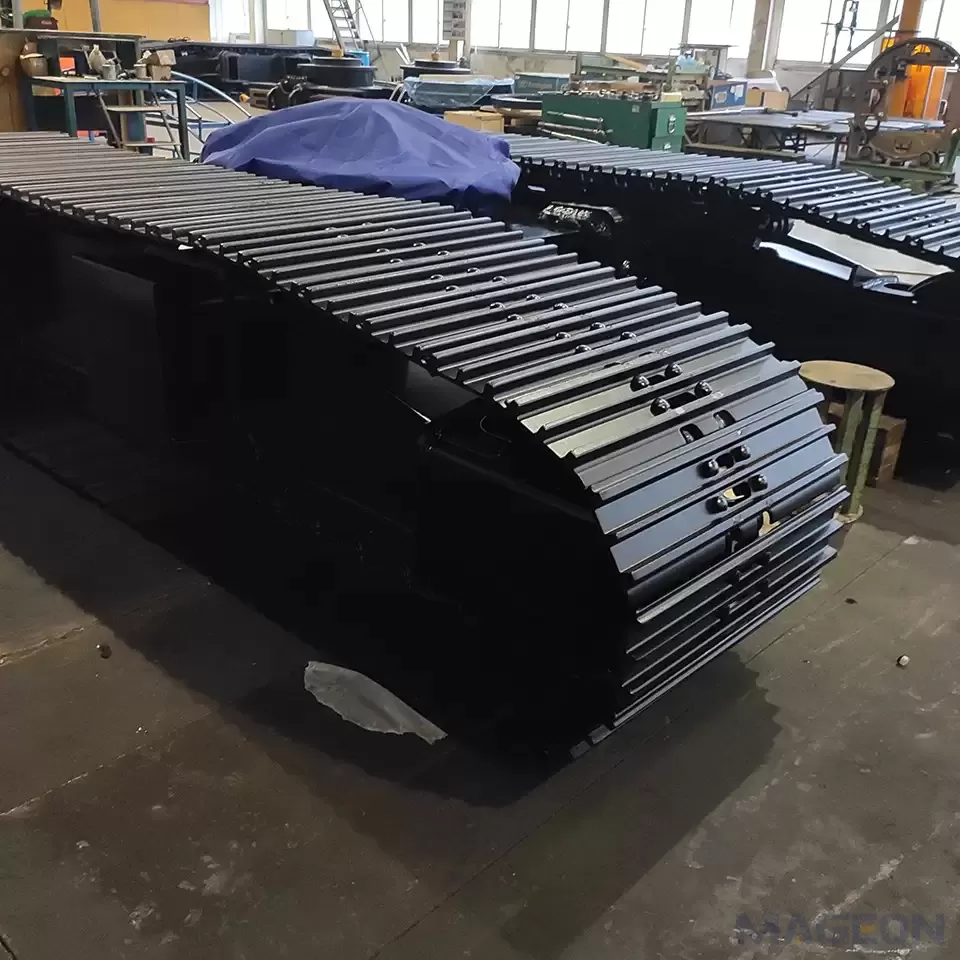
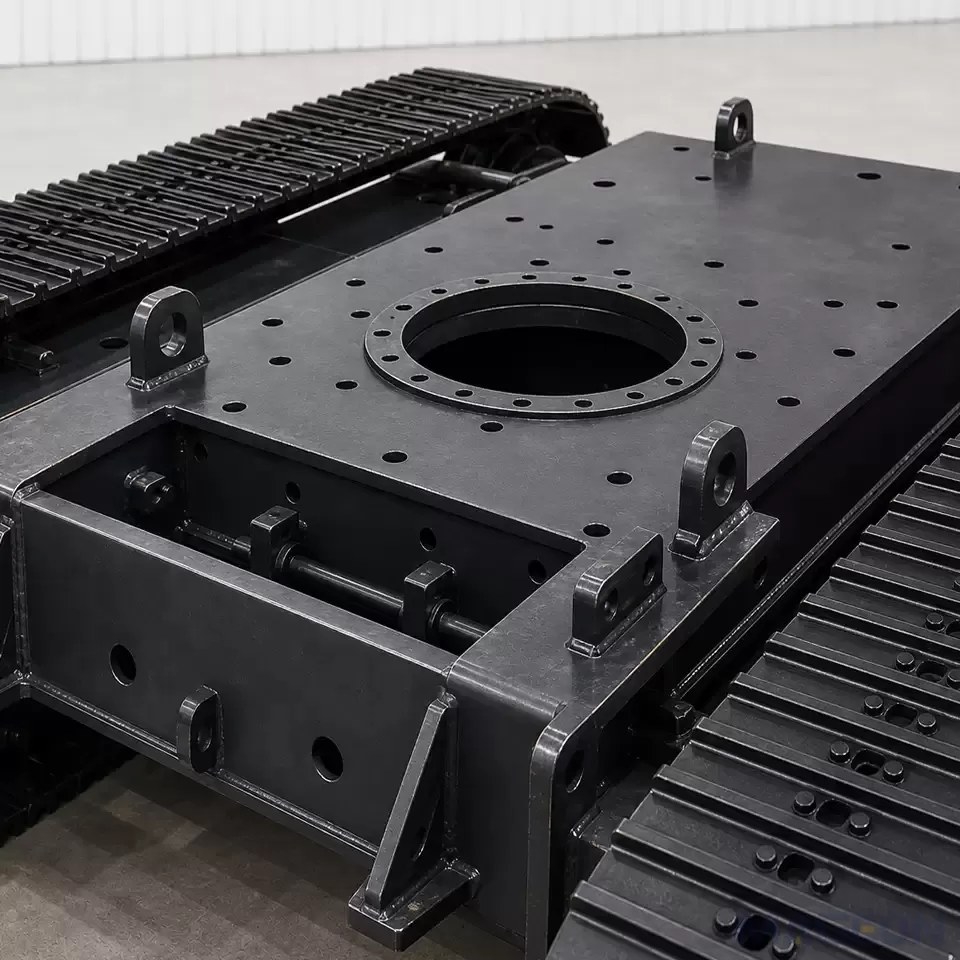
In harsh operating conditions such as mining, tunnel boring, and infrastructure construction, the undercarriage assembly serves as the core transmission component of heavy machinery, enduring severe impact loads and gravel abrasion over extended periods. Track shoe fractures, drive sprocket tooth breakage, pin wear — behind these failures often lies insufficient impact-resistant design. As a globally leading manufacturer of Custom Tracked Chassis, MAGEON draws on hundreds of actual matching project experiences in extreme conditions including mining and tunnelling to provide a systematic analysis of the four key technical aspects of undercarriage impact-resistant design — from material selection and heat treatment processes, to structural cushioning and energy absorption mechanisms, to protective reinforcement and dynamic simulation verification — helping industry users advance from “post-failure repair” to “design prevention.”
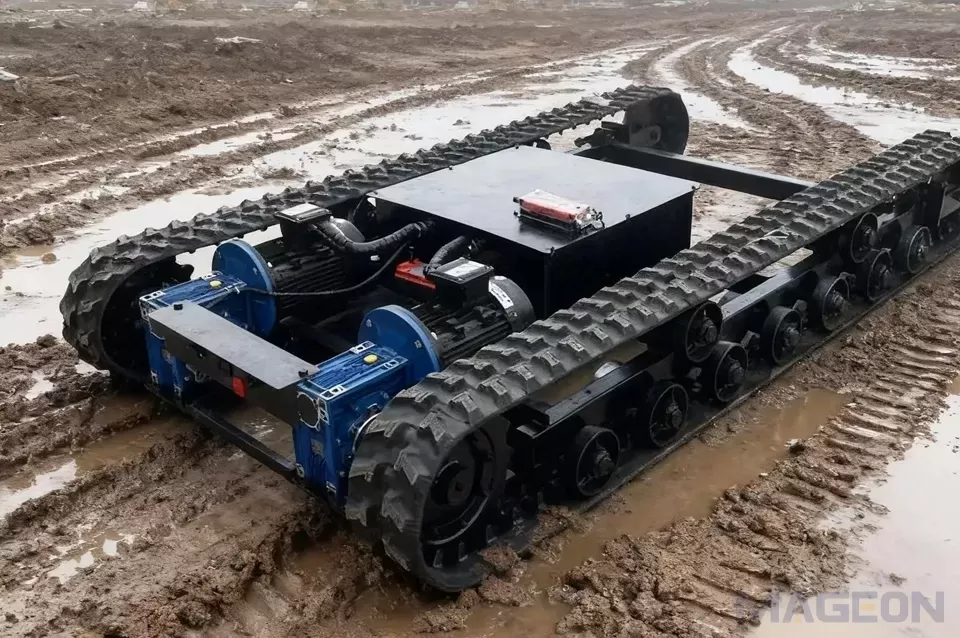
1. Impact Challenges Facing Undercarriage Assemblies in Harsh Conditions
The impact loads faced by undercarriage assemblies in mining, tunnelling, and infrastructure scenarios primarily originate from four sources:
| Impact Type | Source | Typical Conditions | Impact on Assembly |
|---|---|---|---|
| Rockfall Impact | Debris falling from height after blasting | Open-pit mines, tunnel boring | Track shoe deformation, link fracture |
| Gravel Crushing | Track running over large ore blocks | Quarries, crushing stations | Track shoe cracks, pin bending |
| Slope Slip | Sudden traction regain after track slip on steep slopes | Steep slope mining transport | Sprocket tooth breakage, chain stretch |
| Frozen Soil Brittle Fracture | Material toughness decrease at low temperatures | Northeast/Northwest mining areas in winter | Track shoe brittle fracture, weld cracking |
In MAGEON‘s long-term service to mining clients, it has been found that approximately 60% of early undercarriage failures are directly related to impact loads rather than normal abrasive wear. This means impact-resistant design is not “nice to have” — it is the core engineering capability that determines whether an undercarriage can survive in harsh conditions.
2. Four Key Technical Aspects of Impact-Resistant Design
2.1 Material Selection and Heat Treatment Process Optimisation
The impact resistance of an undercarriage assembly first depends on the material selection for core structural components. Based on extensive test data and actual project verification, MAGEON‘s engineering team has summarised the following material selection principles:
Core Structural Component Material Requirements:
Track shoes, drive sprockets:High-strength wear-resistant steel required, tensile strength ≥800MPa recommended
Typical Materials:65Mn spring steel, 35MnB alloy steel, 40Mn2 alloy steel
Heat Treatment:Quenching and tempering (quench + high-temperature tempering), hardness controlled at 32-38HRC
The logic behind this hardness range:Below 32HRC, wear resistance is insufficient;above 38HRC, toughness decreases. The 32-38HRC “golden zone” provides sufficient surface hardness to resist abrasion while retaining core toughness to absorb impact energy.
MAGEON Measured Data: In a matching project for a mining client, after adopting 65Mn material with surface hardening, track shoe impact resistance increased by 40% and service life was extended by 2 times. This data has been repeatedly verified across multiple MAGEON mining projects.
Material Selection Reference Table:
| Material | Tensile Strength | Heat Treatment | Hardness Range | Applicable Conditions | Expected Impact Life |
|---|---|---|---|---|---|
| Q345B | 490-675MPa | Normalising | 150-200HB | General earthworks, municipal | 2,000-3,000 hours |
| 35MnB | ≥800MPa | Quench + temper + surface hardening | 32-38HRC | Mining, tunnelling | 3,000-5,000 hours |
| 40Mn2 | ≥850MPa | Quench + temper + surface hardening | 32-38HRC | Hard rock mining | 4,000-6,000 hours |
| 65Mn | ≥980MPa | Quench + temper + surface hardening | 35-42HRC | High-impact mining | 5,000-8,000 hours |
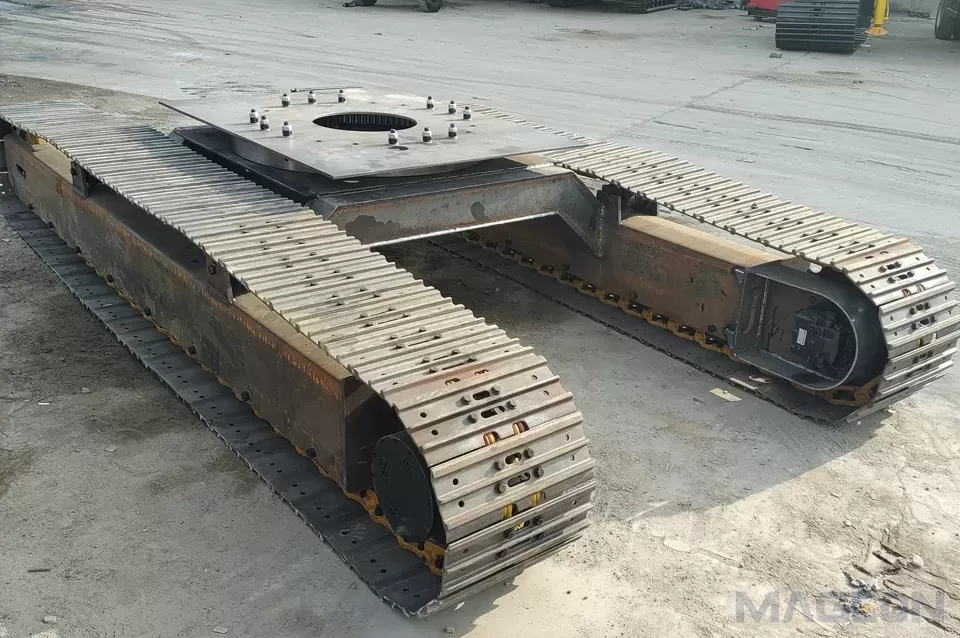
2.2 Structural Cushioning and Energy Absorption Mechanisms
Good material alone is not enough — structural design determines how impact energy is guided and dissipated. MAGEON employs multi-stage cushioning and energy absorption mechanisms in undercarriage structural design:
(1)Track Pin and Bushing Clearance Design
A 0.5-1mm clearance is reserved between the track pin and bushing to absorb impact energy through elastic deformation. This seemingly minor design detail plays a critical role in actual operating conditions. Research from Jilin University‘s College of Mechanical Engineering indicates that reasonable structural clearance can reduce impact stress peaks by 35%.
(2)Drive Sprocket Tooth Root Arc Transition Design
Drive sprocket tooth roots use an arc transition design instead of conventional right-angle transitions. Arc transitions reduce the stress concentration factor from above 2.0 to below 1.5, significantly lowering the probability of tooth root crack initiation. MAGEON uses finite element analysis to determine optimal arc radius when designing drive sprockets, ensuring uniform tooth root stress distribution.
(3)Track Shoe Edge 15° Chamfer
Track shoe edges are provided with a 15° chamfer to prevent sharp structures from causing stress concentration under impact loads. This design is particularly important in mining gravel conditions — sharp edges are highly susceptible to micro-crack formation under gravel impact, which can then propagate into fractures.
Structural Cushioning Design Parameter Quick Reference:
| Design Element | Parameter Recommendation | Impact Stress Reduction | Applicable Conditions |
|---|---|---|---|
| Pin-bushing clearance | 0.5-1mm | Stress peak reduced 35% | All impact conditions |
| Tooth root transition | Arc radius R8-R15 | Kt reduced from 2.0 to ≤1.5 | Heavy-load drive |
| Track shoe chamfer | 15° | Eliminates edge stress concentration | Gravel impact |
| Link fillet | R5-R10 | Reduces link fracture risk | Rockfall impact |
2.3 Protective Reinforcement Measures for Harsh Conditions
With the right material and sound structural design, specific operating conditions still require targeted protective reinforcement. MAGEON provides differentiated protection solutions based on the impact characteristics of different conditions:
(1)Mining Gravel Splash Protection — Surface Hardfacing Wear-Resistant Alloy Layer
For gravel splash and ore crushing in mining environments, a wear-resistant alloy layer (such as Ni-Cr-B-Si system) is hardfaced onto the track shoe surface, with hardness reaching 55-60HRC. This “armour” layer forms a hard protective surface on the track shoe substrate, effectively resisting cutting and crushing from ore edges.
(2)Dust Ingression Protection — Labyrinth Seal + Dual Lip Seal
Mining dust is the “invisible killer” of undercarriage assemblies — after dust enters the lubrication system, it can wear bearings to failure within 24 hours. MAGEON drive sprockets use a labyrinth seal structure combined with dual lip seals, forming a two-stage protective barrier. The labyrinth structure uses a tortuous path to block large particles, while the lip seal tightly conforms to the shaft surface through elastic lips, preventing fine dust ingression.
(3)Low-Temperature Environment Protection — Lubricating Grease Formula Optimisation
At -30℃, conventional lubricating grease hardens or even solidifies, causing dry friction in bearings. MAGEON optimises grease formulas for cold region applications, ensuring good fluidity at -30℃. This optimisation is particularly important for winter operations in Northeast and Northwest mining areas.
Protection Solution Comparison by Operating Condition:
| Operating Condition | Primary Impact Threat | Protective Measure | Key Parameter |
|---|---|---|---|
| Mining gravel | Gravel splash, ore crushing | Surface hardfacing Ni-Cr-B-Si alloy | Hardness 55-60HRC |
| High dust | Dust ingression into lubrication | Labyrinth + dual lip seal | Two-stage protection |
| Low-temp mining | Grease hardening | Low-temp grease formula optimisation | Good fluidity at -30℃ |
| Tunnel slurry | Mud/water ingression + abrasion | Dual seal + wear-resistant coating | Mud/water proof + wear resistant |
2.4 Dynamic Simulation and Fatigue Life Prediction
Impact-resistant design cannot rely on experience alone — MAGEON uses finite element simulation to verify undercarriage impact performance at the design stage.
(1)Impact Simulation Method
ANSYS/LS-DYNA is used to establish a track-ground interaction model simulating actual impact loads. For mining conditions, MAGEON‘s simulation model simulates 300mm thick ore falling from 2 metres height onto the track shoe, evaluating the dynamic response of the track shoe.
(2)Key Control Indicators
| Simulation Indicator | Target Value | Significance |
|---|---|---|
| Impact acceleration | ≤50g | Ensures critical components do not fail from overload |
| Stress concentration factor Kt | ≤1.5 | Prevents local stress exceeding material yield strength |
| Maximum stress | ≤70% of material yield strength | 30% safety margin reserved |
| Plastic deformation | ≤0.5mm | Ensures track shoe remains usable after impact |
3)Fatigue Life Assessment
Combined with Miner’s Rule, fatigue life assessment is performed based on the stress spectrum obtained from simulation and the material‘s S-N curve. MAGEON’s design target is:ensuring 5,000 hours of continuous operation without structural failure in mining conditions.
Simulation Verification Process:
① Establish 3D track-ground interaction model → ② Apply actual operating condition impact load spectrum → ③ Solve dynamic stress distribution → ④ Extract key location stress data → ⑤ Calculate fatigue life based on Miner‘s Rule → ⑥ Optimise design parameters and iterate verification
3. Undercarriage Core Components and Impact-Resistant Design Points
Understanding the role of Undercarriage Parts in impact-resistant design helps in understanding the protection logic of the undercarriage assembly from a system perspective.
| Component | Impact-Resistant Design Points | Key Material/Process | Typical Failure Mode |
|---|---|---|---|
| Track Shoe | 15° chamfer + surface hardfacing + thickness optimisation | 65Mn/35MnB + Ni-Cr-B-Si hardfacing | Cracks, deformation, fracture |
| Drive Sprocket | Arc tooth root transition + labyrinth seal | 40Mn2 + quench/temper + surface hardening | Tooth breakage, tooth root cracks |
| Track Link | Fillet transition + pin hole reinforcement | 35MnB + quench/temper | Fracture, pin hole elongation |
| Track Pin | Surface hardening + clearance design | 20CrMnTi + carburising | Bending, wear |
| Track Roller | Dual seal structure + wear-resistant rim | 45 steel + quench/temper + surface hardening | Oil leak, bearing failure |
| Idler | Deep groove ball bearing + dual seal | 45 steel + quench/temper | Seal failure, seizure |
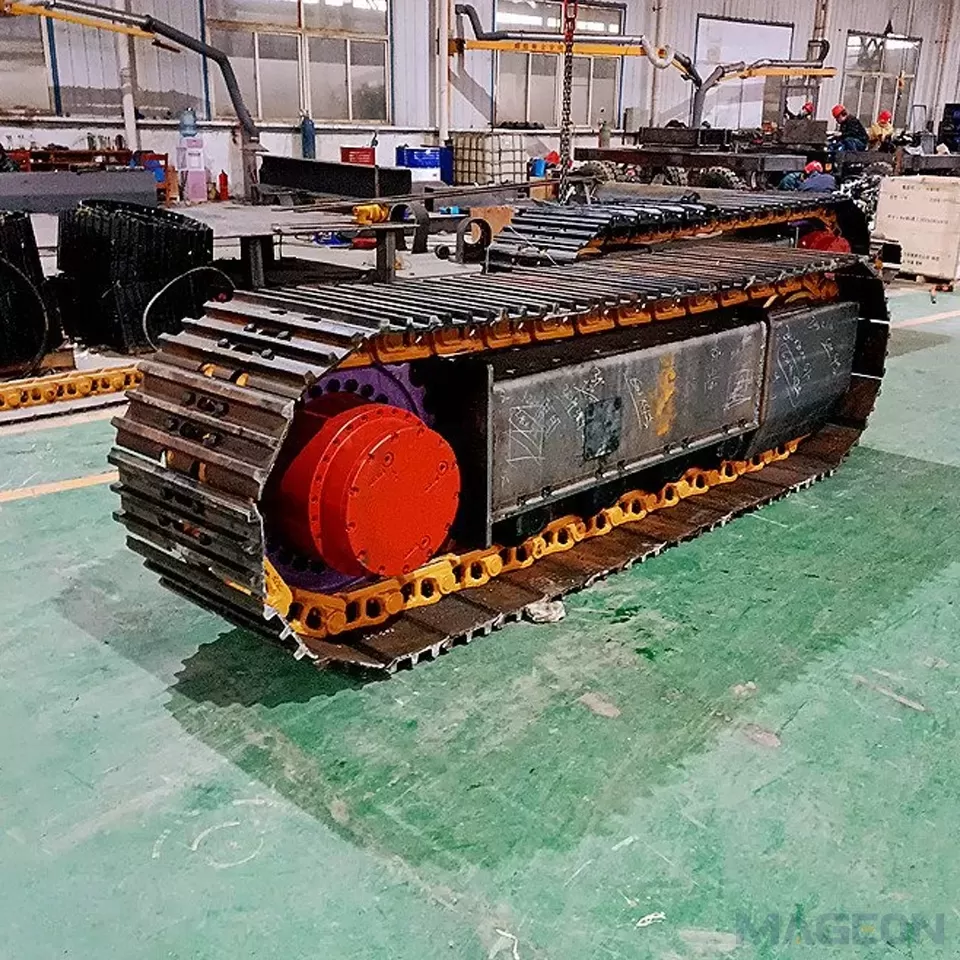
4. MAGEON’s Technical Advantages in Impact-Resistant Undercarriage Assemblies
As a globally leading manufacturer of Custom Tracked Chassis, MAGEON has accumulated deep technical expertise in undercarriage impact-resistant design:
| Core Technology | Technical Advantage & Customer Value |
|---|---|
| Material System | Mastery of heat treatment processes for 65Mn, 35MnB, 40Mn2 alloy steels, with precise hardness control in the 32-38HRC golden zone |
| Structural Design | Experience in optimised designs including pin-bushing clearance, sprocket tooth root arc, and track shoe chamfer |
| Protective Processes | Ni-Cr-B-Si surface hardfacing, labyrinth + dual lip seal protection solutions |
| Simulation Capability | ANSYS/LS-DYNA impact simulation and Miner‘s Rule fatigue assessment |
| Low-Temperature Adaptation | Optimised grease formulas and material toughness for -30℃ environments |
| Project Experience | Hundreds of mining, tunnelling, and infrastructure project experiences, covering 0.5-120 ton load range |
5. Frequently Asked Questions (FAQ)
Q1:Why is impact-resistant design important for undercarriage assemblies?
A:Undercarriage assemblies in harsh conditions such as mining, tunnelling, and infrastructure endure impact loads including rockfall, gravel crushing, slope slip, and frozen soil brittle fracture. MAGEON engineering data shows that approximately 60% of early undercarriage failures are directly related to impact loads rather than normal abrasive wear. Impact-resistant design directly determines undercarriage reliability and service life in harsh conditions.
Q2:What material is most impact-resistant for track shoes?
A:MAGEON recommended high-impact track shoe materials include:65Mn spring steel (tensile strength ≥980MPa, quench/temper + surface hardening, hardness 35-42HRC), 35MnB alloy steel (tensile strength ≥800MPa, 32-38HRC), and 40Mn2 alloy steel (tensile strength ≥850MPa, 32-38HRC). Among these, 65Mn with surface hardening can increase track shoe impact resistance by 40% and extend service life by 2 times in mining conditions.
Q3:Why should hardness be controlled within the 32-38HRC range?
A:This is the “golden zone” of impact-resistant design. Below 32HRC, wear resistance is insufficient and track shoes wear rapidly under gravel abrasion;above 38HRC, toughness decreases and track shoes are prone to brittle fracture under impact loads. The 32-38HRC range provides sufficient surface hardness to resist abrasion while retaining core toughness to absorb impact energy, achieving the optimal balance between wear resistance and impact resistance.
Q4:What is the function of the clearance between track pins and bushings?
A:The 0.5-1mm clearance between track pins and bushings serves the core function of absorbing impact energy through elastic deformation. When the track receives impact, the clearance allows slight elastic displacement, converting impact energy into elastic deformation energy rather than transmitting it entirely to links and track shoes. Jilin University research shows that reasonable structural clearance can reduce impact stress peaks by 35%.
Q5:How can track shoes be protected in mining gravel conditions?
A:MAGEON recommended mining gravel protection solutions include:①Hardfacing Ni-Cr-B-Si wear-resistant alloy layer on track shoe surfaces, hardness 55-60HRC, forming “armour” protection;②15° chamfer on track shoe edges to avoid stress concentration;③Selecting 65Mn or 40Mn2 high-strength materials. Drive sprockets use labyrinth seal structure with dual lip seals to prevent dust ingression into the lubrication system.
Q6:What should be noted for undercarriage assemblies in low-temperature environments?
A:At -30℃, conventional lubricating grease hardens or solidifies, causing dry friction in bearings — this is one of the primary causes of undercarriage failure in low-temperature mining areas. MAGEON optimises grease formulas for cold region applications, ensuring good fluidity at -30℃. Additionally, material toughness decreases at low temperatures, so quenched and tempered alloy steels are recommended, avoiding materials sensitive to low-temperature brittleness.
Q7:How does MAGEON verify the impact resistance of undercarriage assemblies?
A:MAGEON uses ANSYS/LS-DYNA finite element simulation to establish a track-ground interaction model simulating actual impact loads. For mining conditions, the simulation models 300mm thick ore falling from 2 metres height onto the track shoe. Key control indicators include:impact acceleration ≤50g, stress concentration factor Kt ≤1.5, maximum stress ≤70% of material yield strength. Combined with Miner‘s Rule fatigue life assessment, it ensures 5,000 hours of continuous operation without structural failure.
Q8:Can MAGEON customise impact-resistant undercarriages for mining equipment?
A:Yes. MAGEON has hundreds of actual matching project experiences in the mining sector and can customise impact-resistant undercarriages based on specific mining conditions (open-pit/underground, rock hardness, slope, temperature conditions). The Rotary Drilling Rig Chassis and Drilling Rig Undercarriage can both be reinforced for impact conditions, covering 10-100 ton load ranges.
Q9:What undercarriage parts does MAGEON supply?
A:MAGEON supplies a complete range of Undercarriage Parts, including:track shoes (including impact-reinforced types), track links, track pins, bushings, drive sprockets (with arc tooth root design and labyrinth seals), track rollers, idlers, carrier rollers, track frames, tensioning systems, and more. All components are manufactured to MAGEON impact-resistant design standards.
Q10:What qualifications should be considered when selecting an impact-resistant undercarriage manufacturer?
A:Consider:①Material heat treatment process control capability (precise 32-38HRC hardness control);②Actual matching cases in the same conditions (mining, tunnelling);③Impact test reports and simulation analysis reports;④Low-temperature environment adaptation capability (-30℃ grease optimisation);⑤Complete after-sales service and spare parts supply system. MAGEON has mature technical accumulation and project verification in all the above areas.
6. About MAGEON
MAGEON is dedicated to delivering high-quality Steel Crawler Undercarriage and Rubber Track Undercarriage custom solutions to the global heavy machinery industry. With hundreds of actual matching project experiences in harsh conditions including mining, tunnelling, and infrastructure, we tailor travel-drive solutions for every customer’s extreme impact conditions.
Our Core Capabilities:
Load Range:Full-load custom solutions from 0.5 to 120 tons
Impact-Resistant Design:Full-chain capability covering material heat treatment (32-38HRC) + structural cushioning (pin-bushing clearance) + protective reinforcement (hardfacing + seals) + simulation verification (ANSYS/LS-DYNA)
Core Applications:Mining machinery, rotary drilling rigs, tunnel equipment, infrastructure construction, agricultural machinery, and more
Parts Supply:Complete range of Undercarriage Parts including track shoes, track links, drive sprockets, track rollers, idlers, and carrier rollers
From requirements analysis to delivery and use, MAGEON stands for exceptional quality and dependable service, helping your equipment perform efficiently on the most challenging terrains.
Learn more: www.mageontracks.com
Please leave your customization requirements, and we will contact you as soon as possible!
Leave your requirements, we'll get back to you within 24 hours.